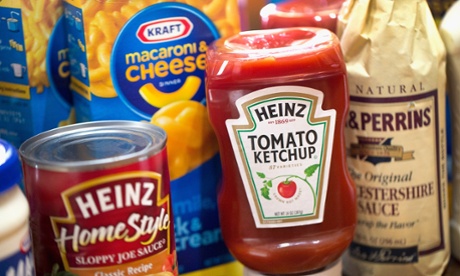
Forget the tomato ketchup and processed cheese. Heinz and Kraft smothered their merger announcement with indigestion-inducing quantities of the word “iconic”. Nine squirts in a six-page summary was designed, presumably, to encourage the thought that the well-known (which is what they meant) brands belong together and that a life of harmony awaits.
What really awaits is deep cost cuts. It has been an open secret that the owners of Heinz – the Brazilian billionaires at 3G plus Warren Buffett – have been hunting for their next candidate for a shake-up. Heinz has been pushed to the point where every $5 of sales yields a dollar of profit. That’s a nice margin. No wonder the hard-running 3G wants to repeat the trick, and Buffett wants to help fund it.
Kraft is a suitable target because the scope for improvement is obvious. The company doesn’t get close to Heinz’s margins and was slow to see the decline of processed food. “It’s clear that our world has changed and our consumers have changed, but our company has not changed enough and certainly has not kept pace,” Kraft’s chief executive, John Cahill, confessed last month.
Cahill will join the board of the combo as vice chairman, which sounds like a walk-on role. Heinz chairman Alex Behring will retain his title, and so will its chief executive, Bernando Hees. The Brazilians calculate there are $1.5bn (£1bn) of annual savings up for grabs and they intend to ensure they arrive.
The terms of surrender for Kraft are undoubtedly good. Shareholders will get 27% of the company’s pre-deal value via a cash dividend plus a 49% holding in the combo. Kraft’s shares rose by a third.
3G and Buffett are prepared to offer those terms not only because they are confident of getting the savings. They also have to find relatively little new cash to make the merger happen – just $10bn to fund Kraft’s dividend. In that sense it’s a clever deal. But spare us the hyperbole. This is a defensive, cost-cutting merger.
Caution for Quinn at Balfour Beatty
It is two months since Leo Quinn, Balfour Beatty’s new Mr Fixit, spoke about the “conspiracy of optimism” that had landed the once-mighty construction firm in a mess. Even now, hard reality arrives with a thump. The UK construction division, source of most of the woes, is taking a further £118m write-down. The final dividend is axed and restatement in a year’s time will be at an “appropriate” level, which could mean anything.
Yet the share price rose 6%. That was a strong vote of confidence in Quinn’s talents as a turnaround specialist. And, to be fair, one can see how, with more discipline in bidding for work, the tale could come good. Balfour has £6.6bn of annual revenues in construction, mostly in the UK and US. At a 2%-3% profit margin, profits would be £130m-£200m, instead of today’s losses.
Meanwhile, the investment division – lots of completed PFI schools, hospitals and court houses – is worth £1.3bn. So, on paper, and with a small sum of net cash in the mix, one can justify Balfour’s market value of £1.7bn.
In practice, everything screams caution. Quinn’s initial self-help programme – £200m of cash-flow improvement, and £100m of cost savings – will take two years. But more may be required to get back to industry standards.
The passage in Quinn’s statement that spoke most loudly was the one about how long Balfour has been in decline. The underlying performance has been going backwards since 2010, significant capital outflows have occurred since 2009, and the root cause is an acquisition spree that started in 2000. Undoing that history will take time.
No medals for Sports Direct governance
Encouraging news. Sports Direct founder Mike Ashley is prepared to explain to MPs the process by which part of the group’s USC subsidiary was placed into administration in January; staff got just 15 minutes’ notice that they were losing their jobs. Keith Hellawell, the retailer’s chairman, made the unexpected offer during a disjointed session of the Scottish affairs committee.
Mind you, let’s hope Hellawell is in full possession of the facts. His other revelation was that he was unaware that Sports Direct executives had been talking to potential administrators about USC as long ago as last November. Hellawell learned about the actual administration only the day before it happened. That will not reassure those who worry about the robustness of boardroom governance at Sports Direct.