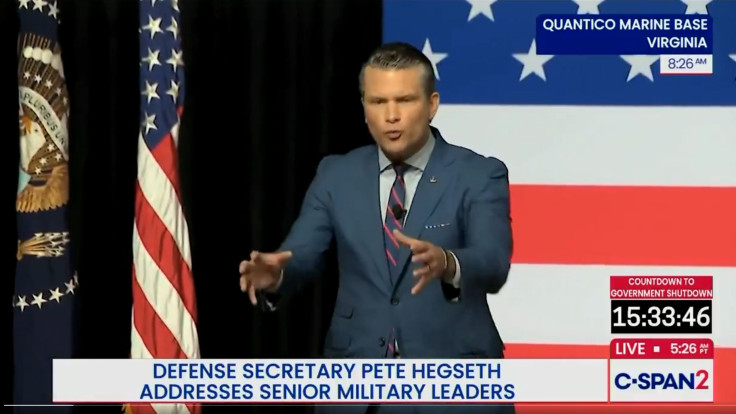
The US military's strike on a suspected drug-smuggling vessel in the Caribbean on 2 September 2025 has ignited a fierce debate over accountability, with US Defence Secretary Pete Hegseth publicly positioning Frank M. Bradley, then head of the elite Joint Special Operations Command (JSOC), as the sole decision-maker responsible for the deadly follow-up attack that killed survivors.
In a blunt statement, Hegseth hailed Bradley as 'an American hero ... a true professional' with 'my 100% support', while the administration insisted the strike was lawful.
But internal legal memos, expert reaction, and early congressional signals suggest the administration may have attempted to shift blame, raising urgent questions about command responsibility and potentially exposing Bradley to the role of a scapegoat.
Second Strike: Who Ordered It — Hegseth or Bradley?
On 2 September 2025, JSOC's elite SEAL Team 6 executed an initial missile strike against a boat believed to be trafficking narcotics near Venezuelan waters. When drone feeds reportedly showed two survivors clinging to wreckage, a second strike was carried out, killing the survivors.
According to a memo produced by the Former JAGs Working Group, which reviews legal and humanitarian compliance of US operations, both the order to 'kill everybody' and the execution of that order, 'if true ... constitute war crimes, murder, or both'.
White House press secretary Karoline Leavitt told reporters that 'Secretary Hegseth authorised Admiral Bradley to conduct these kinetic strikes'. She added that Bradley 'worked well within his authority and the law ... to ensure the boat was destroyed and the threat to the United States of America was eliminated'.
However, Hegseth's public pronouncement of complete confidence in Bradley, while simultaneously emphasising that operational decisions were Bradley's, has drawn sharp criticism from former military-law professionals who argue that it effectively detaches Hegseth from accountability.
Legal Experts and Former JAGs Decry Attempted Shift of Blame
Under international humanitarian law, the deliberate killing of shipwreck survivors who no longer pose a threat constitutes a grave breach. Ryan Goodman, former general counsel for the defence department, warned that if Hegseth ordered the strike, then he bears ultimate responsibility, regardless of whether Bradley formally gave the order.
The attempt to cast Bradley as the sole responsible party has been criticised as a textbook 'scapegoating' manoeuvre. One former senior official told the Washington Post the White House strategy was effectively 'protect Pete', shifting the burden onto military commanders.
Moreover, critics argue that such a decoupling of political responsibility from military action undermines the fundamentals of civilian-led military accountability. The consequence is an elevated risk that unlawful orders may be given and carried out with plausible deniability.

Congressional Probes and Institutional Credibility
Bipartisan pressure is mounting on Congress to open formal investigations. Senators and members of the House Armed Services Committees have asked for access to recordings, orders, and drone-feed videos from the September operation.
Meanwhile, within the Pentagon, senior officials have expressed unease. One anonymously described the White House's posture as 'throwing service members under the bus', warning that the confusion over who authorised the second strike could deeply erode morale and trust in civilian leadership.
The scandal also casts a long shadow over the broader Caribbean/Pacific counter-narcotics campaign launched this year, which has already resulted in dozens of lethal strikes. According to published tallies, at least 82 people were killed in more than 20 maritime operations targeting suspected drug shipments.
Should investigations confirm that the killings were unlawful, it would mark one of the gravest breaches of the laws of war by US forces in decades — a stain on both the military and political leadership.
In pushing operational responsibility onto Bradley, Hegseth may have made the admiral the administration's expendable scapegoat, but the question of accountability remains very much alive.