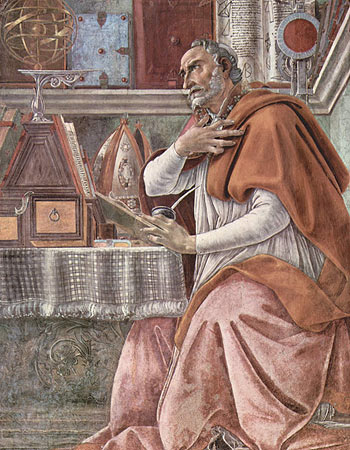
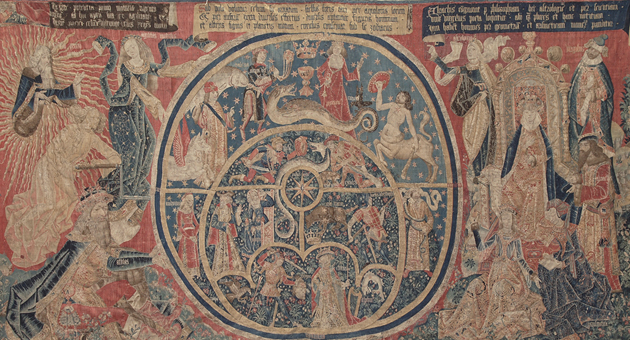
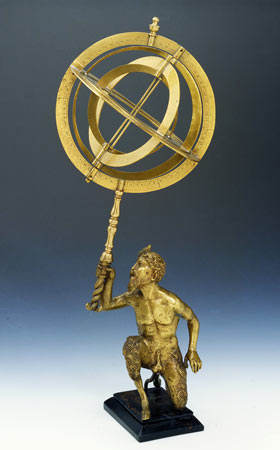
St Augustine in his study, a fresco by Sandro Botticelli, 1480. On the stone beam above the saint's head is an astrolabe, a device used by early astronomers to measure the altitude of celestial bodies and as a navigational aid. The symbolism reflects the 15th century church's uneasy accommodation with scientific thinkingPhotograph: Ognissanti Church, Florence15th century tapestry depicting planetary motionPhotograph: Museo de Santa Cruz, ToledoGold and brass solar orb model, 1575 (anonymous)Photograph: Istituto e Museo di Storia della Scienza
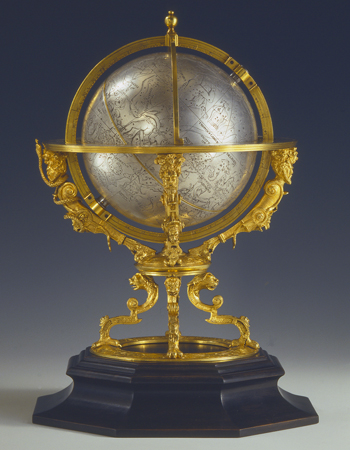
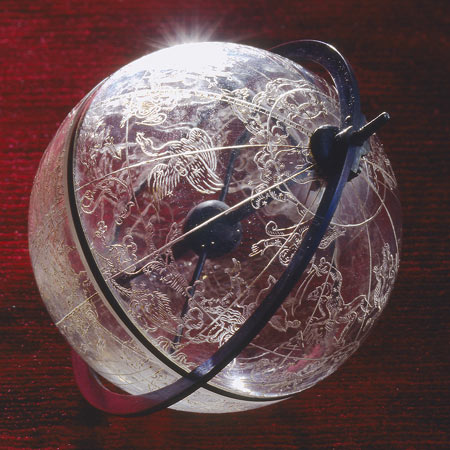
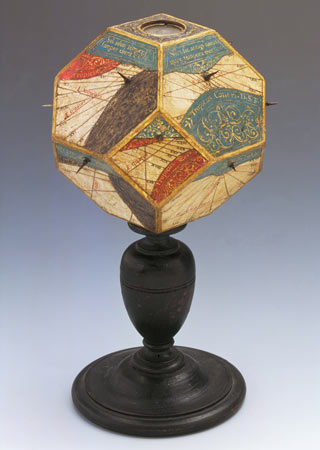
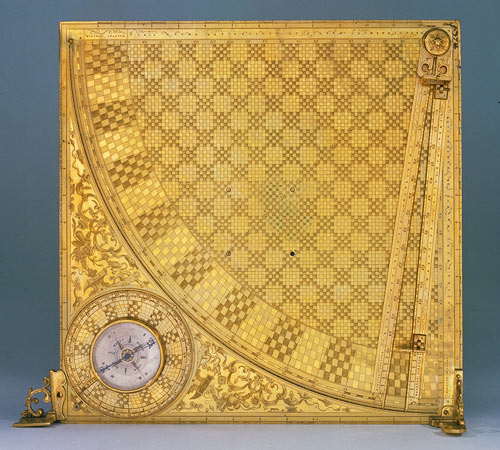
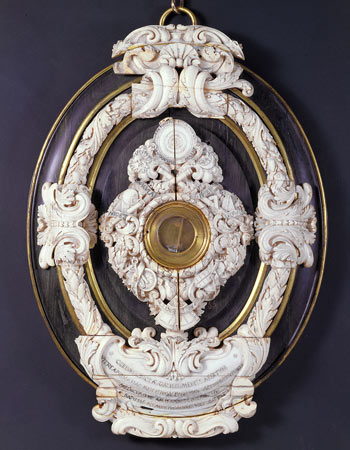
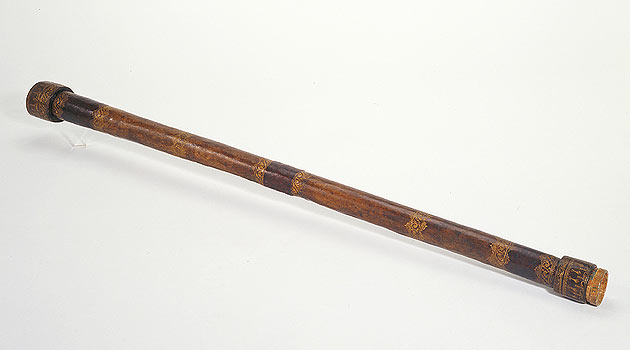
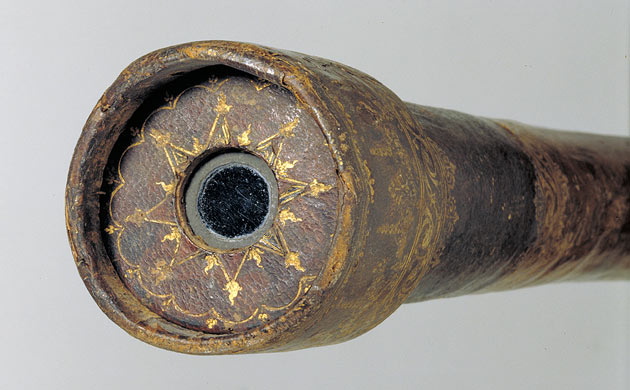
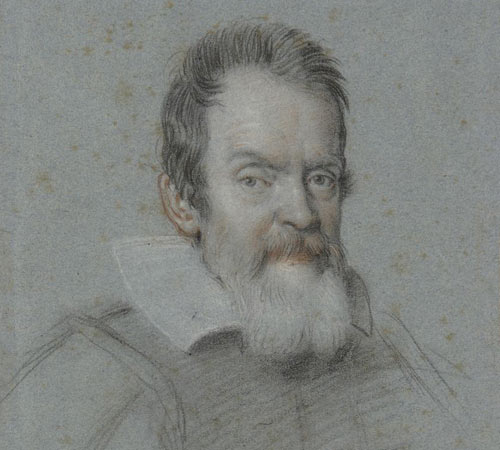
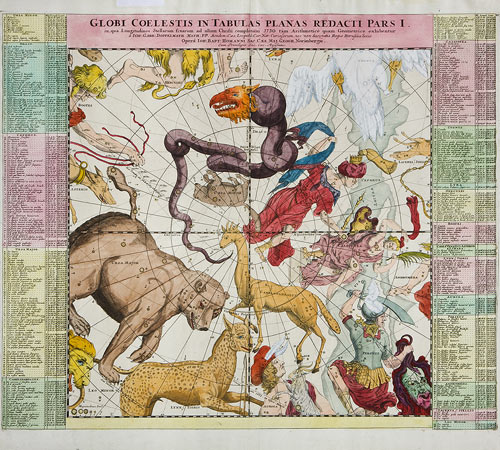
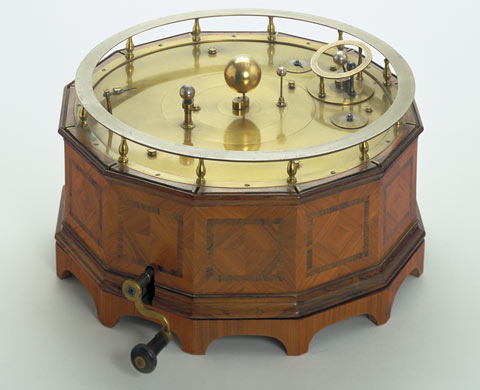
Mechanical celestial globe or armillary sphere made by Eberhard Baldewein in 1574 in Kassel, Germany. The sphere represented the apparent motion of the heavens as they wheeled around the EarthPhotograph: Istituto e Museo di Storia della ScienzaEngraved rock crystal celestial globe made in Milan or Prague at the end of the 16th centuryPhotograph: Kugel Collection, Paris16th century polyhedral solar clock, fashioned out of wood by Stefano Buonsignori of FlorencePhotograph: Istituto e Museo di Storia della ScienzaGold and copper quadrant made by Tobias Volckmer of Braunschweig, Germany, in 1608. Quadrants – comprising a 90-degree graduated arc and a sighting mechanism attached to a moveable arm – were used by mariners and astronomers to measure the altitude of starsPhotograph: Istituto e Museo di Storia della Scienza, FlorenceGalileo's lens: The lens was made by Galileo in 1609 or 1610, the ivory and ebony frame was created much later by Vittorio Crosten in 1677Photograph: Istituto e Museo di Storia della ScienzaTelescope made by Galileo out of wood and leather in 1609 or 1610Photograph: Istituto e Museo di Storia della Scienza, FlorenceGalileo heard sketchy details about the invention of the telescope in Holland and constructed his own, superior version. He used it to make a series of extraordinary discoveries, including mountains and valleys on the surface of the moon, sunspots, moons orbiting Jupiter and the phases of VenusPhotograph: Istituto e Museo di Storia della Scienza, FlorenceGalileo's astronomical discoveries made him famous, but in 1614 he was accused of heresy for his support of the Copernican theory that the sun was the centre of the solar system. He was forced to recant and spent the last years of his life under house arrestPhotograph: Istituto e Museo di Storia della Scienza, FlorenceColoured engraving of a star map by Johann Gabriel Doppelmayr of Nuremberg, 1742Photograph: Private collection, ViennaA planetary or orrery made of wood, glass and brass, 1775-76, by Charles Boyle and James Ferguson. Turning the handle recreated the motion of the planets – with the sun in its proper place at the centre of the solar systemPhotograph: Istituto e Museo di Storia della Scienza, Florence
Sign up to read this article
Read news from 100’s of titles, curated specifically for you.