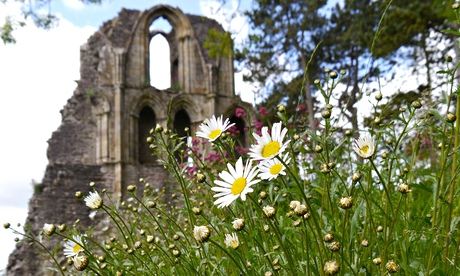
Flowers in the ruins. Oxeye daisies bring summer from the stones. It hasn’t felt much like summer recently, the cold damp weather seems to have suspended it. But once the fuse is lit the wild flowers blow, come hell or high water.
The colour pulse throughout the landscape now is white: wild garlic, cow parsley, hawthorn and daisies flash from woodland banks under trees and roadside verges.
In the ruins of Wenlock abbey the white of oxeye daisies has a special resonance. The flower’s ray florets – the ones pulled off in the divination,“s/he loves me, s/he loves me not” – are the white of the French tricolor. The blue is from the cornflower and the red from the poppy.
From 1080 until its dissolution in 1540 Wenlock was a Cluniac abbey with strong links with Cluny and La Charité-sur-Loire in France. In the Christian tradition oxeyes were associated with John the Baptist whose feast day is 24 June, and in the old calendar with St Barnabas on 11 June. Both dates are really about the summer solstice, and this much older tradition lies at the heart of the daisy. In the centre of the ring of the daisy florets is a golden “heart”, the solar symbol.
Sunlight burns a hole in my dreams. Titty-boo, titty-boo, sings Elvis the thrush through the bedroom window at that get-up -and-get-out-there time of the morning. The robins are already hard at work, hovering like hummingbirds, snatching insects for their ravenous brood in the wall by the kitchen window.
Out on the fence posts between the field and wood, spotted flycatchers are doing the same for their nestlings. Sunlight appears through the trees as brilliant green. This summery moment lights up the ruins of the abbey as the daisies flower. These plants have grown out of their past, they can be symbols of this, emblems of that, but whether they are on an ancient ruin or modern verge, they speak for themselves. Rain or shine they depict summer; whatever the weather or culture the gaze of daisies watches all.
Twitter: @DrPaulEvans1
Field Notes from the Edge: Journeys through Britain’s Secret Wilderness, by Paul Evans, available from Guardian Bookshop 4 June, or from Amazon