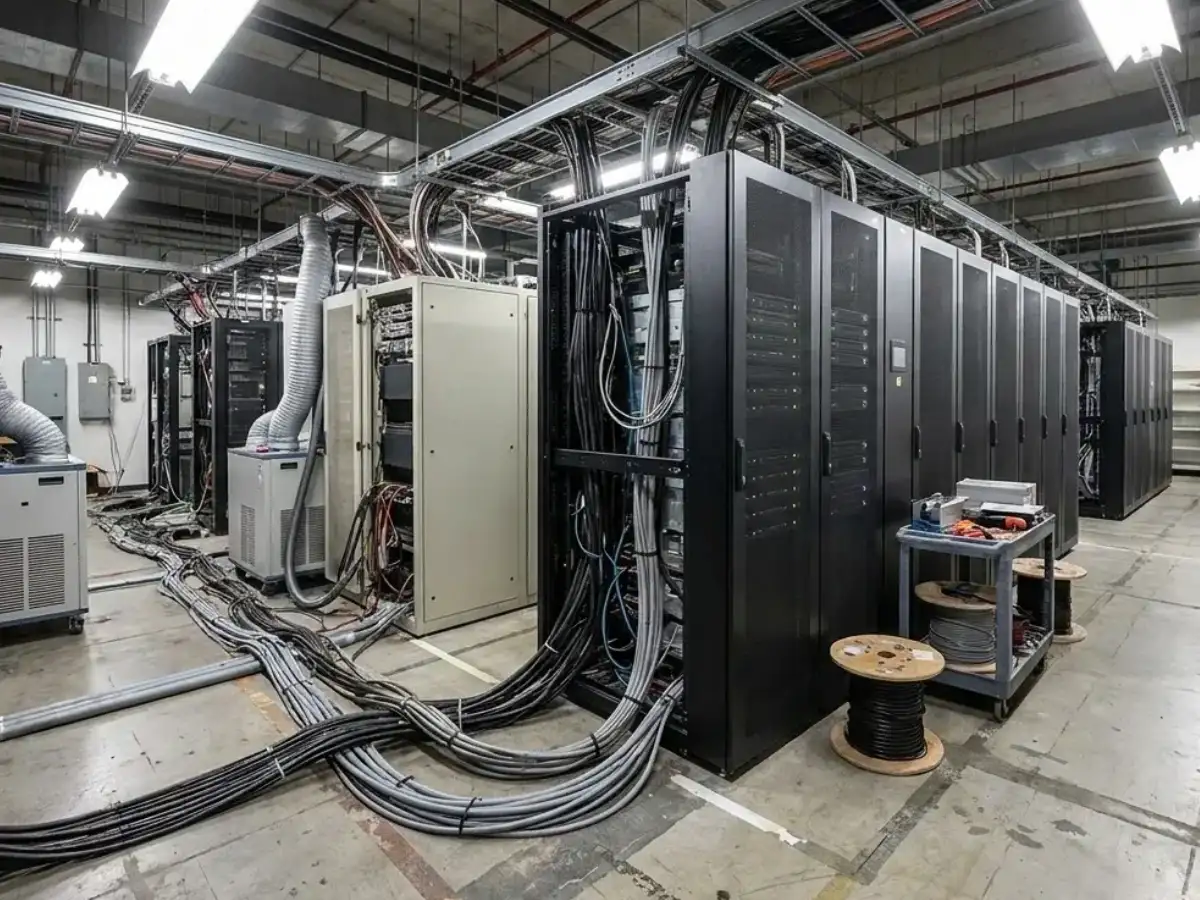
New Delhi: A new study conducted in the US' hottest city Phoenix suggests that waste heat released from data centres can increase air temperatures in downwind neighbourhoods by as much as 4 degrees Fahrenheit, or 2.2 degrees Celsius.
Waste heat produced by a single data centre can surpass the amount emitted by 40,000 households in the US, according to lead author David Sailor, professor and director of Arizona State University's school of geographical sciences and urban planning.
Air-cooled condenser arrays -- which condense turbine exhaust steam -- can discharge air heated to 14-25 degrees Fahrenheit (about 8-14 degrees Celsius) above the surrounding air temperature, creating thermal plumes that move downwind over neighbouring areas, researchers said.
Read More: PM Modi announces ISRO-Norway space pact in Oslo; focus on climate change, fragile ecosystems
"They're such a concentrated load of electricity consumption and hence heat emissions that we became concerned about the impact that they could have locally, and also in the downwind neighbourhoods," Sailor said.
"As we do more measurements under different kinds of atmospheric conditions, I think we're going to see more significant impacts around data centres," Sailor said.
The researchers said that while previous studies have used remote sensing data from satellites to estimate the heat impact of data centres historically, the study, published in the Journal of Engineering for Sustainable Buildings and Cities, is the first to directly measure air temperatures downwind and upwind of data centres to record real-time effects of waste heat on surrounding communities.
The team mounted data-logging high-accuracy and fast-response temperature sensors on cars that drove around Phoenix-area data centres and throughout nearby neighbourhoods during June 18-October 25, 2025.
Using multiple cars allowed the researchers to simultaneously measure temperatures upwind and downwind of four selected facilities ranging from a 36-megawatt single-building data centre in Mesa to a 169-megawatt colocation campus in Chandler (both are cities in Arizona).
The chosen centres reflected the typical design of "hyperscalers" that house thousands of servers and use primarily air-based cooling systems, the team said.
"Five traverses at four facilities in the Phoenix, Arizona metropolitan area, ranging from a 36 MW (megawatt) single-building data center in Mesa to a 169 MW colocation campus in Chandler, reveal downwind air temperature warming as high as 2.2 degrees Celsius, with average downwind air temperatures 0.7-0.9 degrees Celsius warmer than corresponding upwind areas," the authors wrote.
Read More: SC refuses to recall order on shifting stray dogs from public places to shelters
"Thermal signatures were detectable at distances up to 500 m (metres) from facility perimeters," they said.
Sailor said that contributing to an additional heat island magnitude of even one degree or two degrees can significantly impact lives, especially in places where extreme heat already poses public health risks.
A one-degree boost in air temperature, for example, is enough to drive higher use of air conditioning across entire neighbourhoods. Those air conditioners, in turn, put even more heat into the surroundings, the lead author said.