On Monday, Activision announced a deal to acquire the smartphone and online gaming specialist King for $5.9bn, instigating one of the largest takeover bids in recent gaming history. The move was greeted with surprise by analysts who pointed to King’s heavy reliance on a single title, Candy Crush Saga, which appears to be stagnating, as well as the company’s declining revenues – a point underlined on Thursday when King announced its third-quarter earnings, down to $180m, compared with $216m a year ago.
Many compelling reasons for the bid were also put forward. Activision has very little presence in mobile or casual gaming, while King has a user base of 500 million; most of Activision’s titles are aimed at the “core” gaming audience, while King brings a more diverse global audience; and King has Candy Crush Saga (which, at its peak, was generating a million dollars a day), as well as other reasonably successful titles.
But one interesting element has been largely overlooked so far: King’s foothold in the “skill-based gaming” sector, where players pay a fee to compete in online tournaments for cash prizes. Its dedicated site, Royalgames.com, offers multiplayer tournaments using a range of casual brands, including puzzle, “match three” and pool titles. King is in competition with sites such as Skillz and MGTplay, which specialise in cash play tournaments.
The advantage of the sector is that it gives players the chance to win money while completely circumnavigating strict online gambling laws in the US. It’s still a comparatively limited business (Skillz, a leading company in the sector, raised $13m in funding last year and claimed to be running 50,000 prize competition a day), but insiders wonder if the growing popularity of eSports is creating a new generation of gamers who are comfortable with the idea of playing competitively for money.
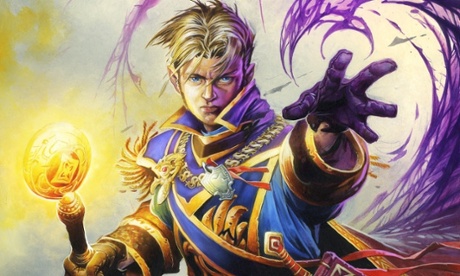
So is there a chance Activision is eyeing up a skill-based gaming future for Hearthstone, its major mobile brand? Speaking to the Guardian this week, Kotick said it was a possibility. “When you think about the future, certainly games of skill for prize play or cash play is an opportunity and one that we’ll seriously consider.” Hearthstone is doing fine right now, earning $20m a month, but adding an extra incentive to committed players may well be on way to ensure revenues remain consistent when more casual users start to drift away.
The free-to-play gaming specialist Nicholas Lovell is unconvinced. “Broadly, senior executives and investors are frequently super excited about cash prizes,” he says. “They reason that if people will enjoy playing the game just for the fun, or the kudos, or the satisfaction, then they would obviously enjoy it much more if there was cash at stake. Of course executives and investors think like this: it is their job to risk money on ventures that they hope will make them money.
“But for many players, this is not why they play games. They play for escapism, to relax, or to have something to talk about with their friends. Adding a financial incentive to this increases the enjoyment for some players, but it massively decreases it for others by increasing the intensity, and the risk, and the potential for loss.”
The developer and analyst Oscar Clark acknowledges these issues while recognising the potential. “Hearthstone is an idea game to have a skill component as long as that aspect is kept separate,” he says. “It would need to be a proposition for the elite player – an extra option, not an essential. Not everygame can pull that off.
“I would start with virtual item stakes as an entry point to skill gaming; with ticketed tournament entry and real money prize competitions as the end goal. The original Magic: The Gathering has a mechanism where both players put up one card as a bounty for competitive play. Having a tier of play where the player can risk a random card – of a certain level of rarity – could be a way to introduce players to the concept; using the ‘doubler’ method from Backgammon would allow players to push their opponent to up the stakes or concede the game.”
It’s all theoretical at the moment, but the fact that Kotick would not rule out cash prizes in relation to Hearthstone is interesting. Activision is already investing heavily in the idea of competitive gaming: in October, the company announced the formation of its own dedicated eSports division to explore the pro-gaming potential of big brands such as Call of Duty and Destiny. The sector makes about $200m a year, but it’s possible that Activision has an eye on the 226 million people (according to research firm Newzoo) who watch eSports, but perhaps don’t participate.
If this is the plan, Hearthstone – which has more similarities with poker than it does with the big moba and FPS titles that dominate pro-gaming – may well be the place to experiment. According to Koitck, however, it won’t be for some time. “Right now the focus is on keeping the network thriving as it is and growing as it is. But I think that in time you’ll see the opportunity to change the commercial opportunities that come from those audiences.”