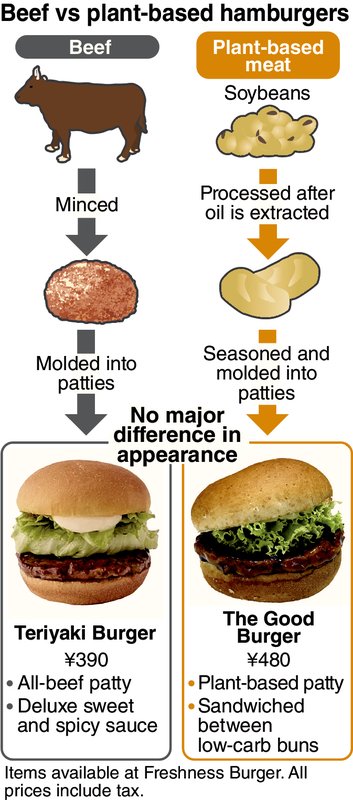
Alternative meat products that are made from plant-based ingredients but have taste and texture close to real meat are gradually taking root in Japan's food-service industry, as a growing number of eateries are using them.
Low in calories and cholesterol, meat substitutes cater to health-conscious consumers, while also being environment-friendly. They are also attracting attention as a great source of protein.
According to the Agriculture, Forestry and Fisheries Ministry, it normally requires 11 kilograms of feed and 20 tons of water to produce 1 kilogram of beef. In addition to this, burps that cows produce as they digest feed contain methane -- a greenhouse gas.
Alternative meat products, on the other hand, are made from ingredients other than animal parts -- mainly from soybeans and peas -- and are rich in protein. Producing them therefore has much less of an impact on the environment than meat.
As demand for livestock products is expected to increase in proportion to the world's population growth, there is a high expectation of the wider use of alternative meat products.
In the United States and Europe, where environmental awareness is high, many eateries, from fast-food shops to high-end restaurants, have already introduced food items prepared with alternative meat products
The operators of McDonald's in Canada and Kentucky Fried Chicken in the United States have test-marketed dishes using meat substitutes in their outlets.
The global market for meat substitutes in 2020 is about 250 billion yen and is expected to grow to about 1.8 trillion yen in 2030, according to an estimate by Yano Research Institute Ltd.
In Japan, a burger with a soybean-based meat substitute was introduced at the Freshness Burger chain on Aug. 12. It is currently available at five outlets in Tokyo and Yokohama but will be on sale nationwide from October.
"Healthy and environmentally friendly, the new burger is selling well," said a company official.
Freshness in the past tried introducing a tofu patty burger, but due to a lack of consumer awareness and interest, it stopped selling the item.
Mos Burger, meanwhile, launched its Greenberger nationwide in May. The patty is made from vegetables and grains, while the buns and other parts are made from ingredients other than animal parts. Shiitake mushroom extracts are used to re-create a flavor close to the savoriness of meat, while konnyaku, a jellylike food made from konnaku yam, is added to create a texture similar to that of meat.
The operator of McDonald's in Japan, on the other hand, has no plans to introduce meat substitute items.
One problem with alternative meat products is that it takes time to process them, meaning that their menu prices are generally higher.
The production amount of textured soy protein -- the main ingredient of meat substitutes -- totaled about 33,000 tons in 2019, a 40% increase from nine years ago, according to the Japan vegetable protein food association.
About 60% of the beef sold in Japan is imported, mainly from the United States and Australia. Under such circumstances, the agriculture ministry is promoting and supporting the wider use of alternative meat products, as they can be a stable source of protein if beef imports are ever halted due to an outbreak of bovine spongiform encephalopathy (BSE) or other infectious diseases.
Read more from The Japan News at https://japannews.yomiuri.co.jp/