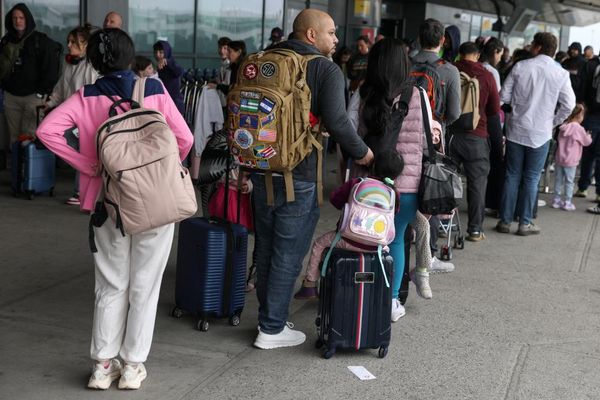
The Health Ministry in Tel Aviv said that about 40 percent of coronavirus cases in Israel from abroad belonged to travelers who were infected in the United States.
Since the emergence of COVID-19, the Israeli government hasn’t taken any measures to stop flights from the US, and banned the publication of any information that could link the spread of the virus to arrivals from there.
The high number of infected cases among arrivals from the US is due to Prime Minister Benjamin Netanyahu’s refusal to impose restrictions on flights from the US. He feared such move would affect the relations with Washington.
Observers interpreted this as a "political silence" to avoid upsetting the President Donald Trump administration.
Early in March, the PM ordered people arriving from Italy, France, Germany, Austria, and Switzerland, to go self-isolate. Then, on March 9, he announced that all arrivals will be put in quarantine, and nine days later, he barred all passengers from entering. However, the decision did not include arrivals from the United States until last Monday.
The Healthy Ministry issued a report, prepared by the head of public health department at the ministry Sigal Sadetsky, indicating that until Wednesday noon, there were 12,200 infected persons, including 176 serious cases with 132 requiring ventilators.
The official death toll from the coronavirus was 126, and the ministry pointed out that 783 infected persons are receiving treatment in hospitals, 7,318 patients are undergoing home treatment, and a total of 2,309 recovered.
It explained that 49 percent of all infections came from contact with confirmed carriers inside Israel, 19 percent were infected while abroad, 15 percent caught the virus in shared public spaces, and 17 percent of the cases remain of unknown origins.
The report also noted that the unknown country of origin of 578 international cases could mean that the number of persons infected in the US might be even higher.
Tel Aviv has 569 patients who were infected in the US, which is fourfold those who contracted the disease in any other country before returning to Israel.
France came in second with about 150 infections, followed by the UK with 110 cases, Brazil, Spain, Bulgaria, Turkey, Russia, Germany, Austria, and Egypt.
The number of infected cases returning from Italy was relatively low, and the report suggested that this could be due to the quarantine imposed at an early stage.
The ministry warned of a large outbreak of the virus in Arab towns, which has so far recorded 418 cases. It indicated that a number of towns must be put under complete isolation, adding that it is considering announcing a comprehensive quarantine in Arab towns throughout Ramadan month.
Earlier, Israeli National Security Council (NSC) issued a circular to ministries, government departments, and the army, urging them to prepare a plan to help ease the economic impact of the coronavirus given that it could not be contained in the near future.
Led by its president Meir Ben Shabbat, NSC and all parties working to combat the spread of the pandemic are devising an “exit plan” to gradually lift the coronavirus closure and resume economic activities.
The plan suggests lifting restrictions in four main phases with a two-week gap between each phase.