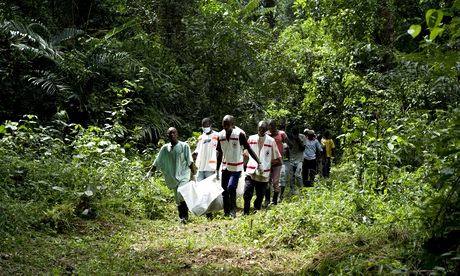
The head of the World Health Organisation has warned that the international community must guard against complacency in the fight against Ebola.
Director general Margaret Chan said the disease still poses a significant risk and that efforts to contain the virus in Sierra Leone, Liberia and Guinea must not be relaxed.
“We need to work hard to make sure the Ebola outbreaks in these three countries are stopped.
“If the outbreak is not finished in these countries, the risk to the rest of the world will continue to exist,” she told the BBC.
She said the infection rate in Sierra Leone, Liberia and Guinea was “still running ahead of us”, but that the situation is much better than in September.
“Going forward, we are now hunting the virus, chasing after the virus, and [will] hopefully bring it down to zero.
“We need to guard against complacency,” she added.
Her comments come as Brice de la Vigne, head of operations for Médecins sans Frontières, warned there was no end in sight to the epidemic that has claimed more than 6,300 lives.
“This epidemic is far from over – it’s very far from over,” he told the Today programme. He said the world’s response was still not adequate and needed to be more flexible to catch fresh outbreaks outside the cities.
“We are not there yet. The situation is still very difficult and, especially in Sierra Leone, still there are not enough treatment beds, contact tracing is insufficient,” he said.
He also warned that there is no room for complacency, pointing out that Guinea has had two lulls that gave false hope the outbreak was under control.
“In Guinea, this is the third wave of the epidemic and MSF Ebola treatment centres are almost full, which was not the case a few weeks back,” de la Vigne said.
Chan admitted that the response of the WHO and other aid agencies and governments was slow and there could have been a “much more robust” reaction when Ebola first took hold in Guinea in March.
Separately, she told a conference in Geneva that health workers in the three countries had paid a heavy price for the Ebola outbreak.
“Prior to the outbreaks, these countries had only one to two doctors to treat a population of nearly 100,000 people. That number has been diminished as more than 600 healthcare staff have been infected.”
She said the countries were already among the poorest in the world and years of conflict had left health infrastructures badly damaged or destroyed. Many hospitals had no electricity or running water and the world should focus on building up their health systems post Ebola, she said.