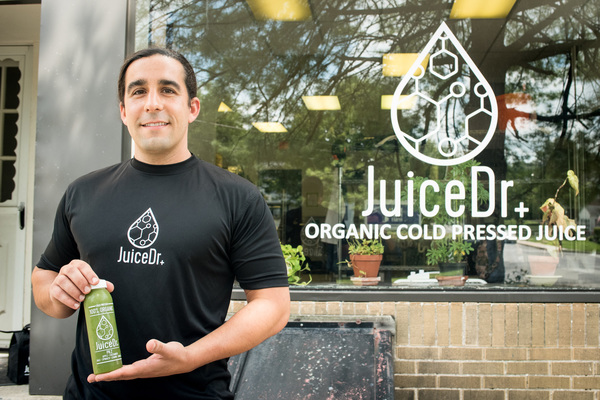
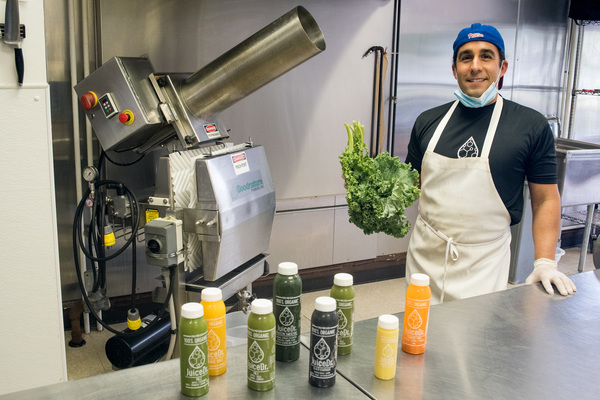
PHILADELPHIA _ FJ Leto has changed course from his carnivorous teen years, now finding culinary excitement in a glass. He blends and then presses kale, cucumber, spinach, lemon, apple and ginger into drinkable form in a tiny commercial kitchen in suburban Philadelphia.
The area native came to this dietary conversion while living at a Tibetan Buddhist meditation center in Berkeley, Calif., where the menu was vegetarian.
More surprising, perhaps, is that Leto has staked a new business on it as the consumer market is saturated with juices and approaching a high-water mark for the cold-pressed type his Juice Dr. is producing.
In 2012, Barron's called it a national movement fueled by wellness-oriented millennials. By some estimates, the cold-pressed juice industry had grown to $100 million by last year _ just as Juice Dr. was launching the first of three green drinks. More juices are to follow in September.
But comparing Juice Dr. with other juice companies would miss the point, Leto said.
"I call us a health company, not a juice company," said the 30-year-old, sporting business casual _ flip-flops and shorts, his hair gathered in a ponytail. "The juice is our tool."
Juice Dr. makes 100 percent organic drinks, each 11-ounce bottle one day's serving of primarily locally sourced fruits and vegetables. They are sold on a subscription basis and delivered to homes and businesses, or are available for pickup from the company's headquarters and kitchen. Free access to a health coach is available to all customers through www.juicedr.org.
The drinks were first available in January 2015 at the region's three HubBub Coffee shops, a startup led by Drew Crockett, with direct-to-consumer service added two months later throughout Philadelphia and its burbs.
"The pairing is brilliant," Crockett said of HubBub's work with Juice Dr., an effort intended to "round out" his customers' dining experiences. They are working on a line of snacks, as well.
"The issue historically is that there is a disconnect between what customers are looking for and the options available in the coffee-bar segment, traditionally carbohydrate-heavy options," Crockett said.
With six employees, all of whom are health coaches or nutritionists, Juice Dr.'s revenue has exceeded $20,000 a month, Leto said. He envisions annual sales reaching $100 million within five years, aided by kitchens throughout the country enabling localized delivery of fresh, nonpasteurized juices with shelf lives of just days.
Profitable, Juice Dr. has 100 to 150 subscription customers. A two-week trial costs $40 to $80, depending on the number of juice days, after which each client personalizes a program.
Started with $75,000 _ $55,000 of which came from friends and family, the rest from Leto himself _ Juice Dr. is closing on its first round of outside fundraising, he said, declining to disclose details.
Paul Baudier of Pressed Juice in New York, a consultant to juice and health food businesses throughout the world, is a minority partner. Leto's vision attracted him, he said.
"As a health company with a systematic, scientific approach to a trendy consumer health product, there aren't many like it around," Baudier said. "If this idea takes hold and people start looking to their food providers as their health coaches, it could change the face of modern medicine and the biggest health problems Americans deal with, like heart disease and type II diabetes, for the better."
For help in developing the juices _ where taste is critical, as is keeping the ingredients from separating _ Leto turned to Drexel University and Stella Lucia Volpe, professor and chair of the Department of Nutrition Sciences, and Juan Muniz, lab director and an assistant clinical professor.
Volpe said "hard data" exist on the health and nutritional benefits of cold-pressed juices, which are made without the nutrition-destructive processes of traditional heat-generating centrifugal blending.
"The data are strong, however, on fruit and vegetable consumption and overall health benefits and prevention of some chronic diseases," she said, adding that at least five servings per day are recommended.
At Cornell University, Chang Y. "Cy" Lee, a professor of food chemistry, said cold-press juices satisfy a consumer trend of "less processing is better."
Mike McGrath's health-management company, the Charge Group, customizes health and nutrition programs for employees and business professionals. It has started recommending Juice Dr. drinks to its clients.
The drinks are also served at McGrath's home, which he shares with his wife, Jessica Nagle, and their two children, Liam, 6, and Isla, 4.
"We do fight over them _ in a loving way," McGrath said.