There could be no better dress rehearsal for this screen adaptation of author John Birmingham’s best-seller about sharehouse accommodation, He Died With a Felafel in his Hand, than director Richard Lowenstein’s scungy 1986 classic Dogs in Space, which cast pub rock legend Michael Hutchence as a drug-addled inhabitant of a trashed terrace home in 1970s Melbourne.
Birmingham’s book, a series of vignettes that became a bible of sorts about brave souls surviving 20- and 30-something communal living in Australia, no doubt took inspiration from the film’s affectionate but ultimately cautious vision of run-down buildings and their spaced-out tenants.
The story offered a beer-splattered kaleidoscope of outrageous sharehouse situations (walls falling off homes; militant investigators chasing people for rent). The exaggerated truth in the tales connected with readers living through it or remembering their experiences.
A heroin overdose in the final act of Dogs in Space provided a sting in its tail. He Died with a Felafel in His Hand features an OD in the very first scene, but this one is used more for comedic than dramatic effect. Lowenstein’s opening shot focuses on an upright hand in front of a television, motionless and holding a souvlaki, with trails of garlic sauce dripping down the arm. Danny (Noah Taylor) arrives to demand the volume be turned down and discovers the grisly scene.
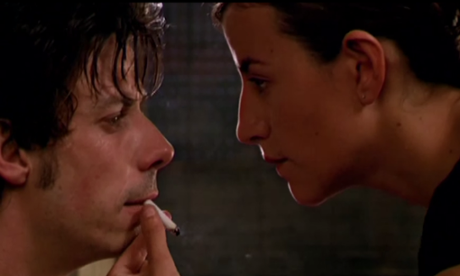
The camera transitions to a close-up of a toad getting whacked by a golf club then into a ramshackle house where Danny, cigarette dangling from his mouth, is strumming a guitar and performing a lethargic rendition of California Dreaming (we’ll see variations of this at different sharehouses as the film progresses). Frivolous conversation between tenants, largely concerning sex and weird anecdotes, plays like a bonged-out version of Seinfeld.
European vegetarian Anya (Romane Bohringer) arrives to inspect an available room and discovers a number of strange sights. There’s a fat schlep named Jabba who maintains dictatorship over the bean-bag and remote control, a tenant who sleeps in a tent in the lounge so he can pay half-rent, and a beef patty that’s been stuck to the ceiling for years.
There’s a basketball ring (inside, of course), continual and seemingly compulsory drinking and smoking, a recreation known as “albino moon tanning” and a dress-up house party comprised of strange activities that seem like rituals from far-flung locales. The film’s first and most outrageous act culminates with a shot of the entire back of the house falling off while an unperturbed crowd sings around a flaming clothesline.
Danny absconds to the next location, carrying with him his trusty Underwood typewriter. He’s a writer who rarely produces any work but quotes Kerouac, references Hunter S Thompson and Stephen King, and maintains the general demeanour of an arts grad holding on to dreams of a prosperous creative life.
The film’s episodic structure is bound together by Noah Taylor’s sad-eyed performance; that thin whippet-like face of indeterminate age is a good fit for a character who seems to regard himself as ahead of his time but is constantly playing catch-up with the basics (like assets and income).
The film’s representations of “the man” via hyper-comical aggressive police and authority figures is out-of-sync with its darker moments – domestic confrontations that range from intense to inconsequential and, most dramatically, a scene in which a character self-harms.
But the mixed tone of He Died With a Felafel in His Hand is part of its bits-and-pieces charm. The vision of irresponsibility and excess is enveloped in critical context: the hangover will outlast the party, Lowenstein appears to be saying, and without the supportive tissue of close friends and family, the good days are inevitably numbered. Dogs in Space contemplated a similar message – like this film, it’s less about shared experiences than individual journeys – but took a very different tack.