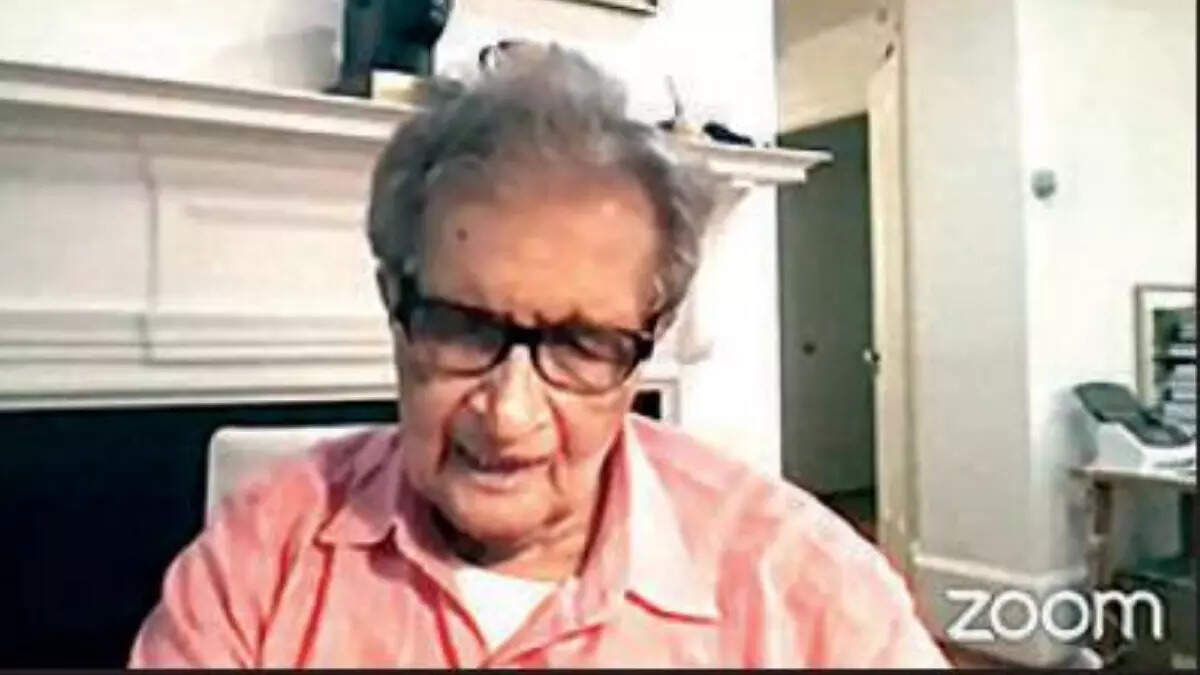
KOLKATA: A debate on reopening of school campuses amid the pandemic was also on in countries, like the US, and we would have to take judicious steps as there could not be any straight approach to that, said Nobel laureate economist Amartya Sen, pointing out that there was more need to create opportunities for learning before focusing on the evaluation system now.
Sen, who attended a webinar organized by Pratichi India Trust-Sahajog on Sunday night, said there could not be any uniform way to open schools during the pandemic, as the situation was fluid. “We have to carefully observe the condition before opening schools… It is true students get hugely impacted if schools are closed. On the other hand, we have to look into the possibility of students getting infected after schools are open. There is a debate over this in Boston, the city where I live. There are different opinions on this in India, too.”
His opinion came at a time when at least eight states in the country have started in-person classes. The Union health ministry called the reopening of schools “a tightrope walk” and left the decision entirely to states concerned. Bengal chief minister Mamata Banerjee had earlier said that schools here would reopen after the Pujas in phases, depending on the situation.
Sen pointed out that the situation had to be addressed at the micro level, analysing the local conditions. “Whatever will work in west Birbhum may not be applicable for east Bankura. We have to be careful while opening up schools. We have to judiciously assess the harms and benefits. You cannot quickly decide whether schools need to be closed or remain open,” he said.
Asked about average grades being awarded to students during the pandemic, he said, “There are times when we put a lot of stress on evaluation. The primary stage is to provide opportunities for learning. Then we can assess how far the students were able to assimilate the knowledge and make progress.”
Accepting that there could be loopholes in the evaluation system during the pandemic, Sen said they had to be addressed. “We should never think that evaluation is a very big issue. Evaluation is useful, but we have to decide on how far we are going to use that. There has to be discussions on evaluation and education we are providing to kids,” he said.