Michael Hogan, entertainment writer
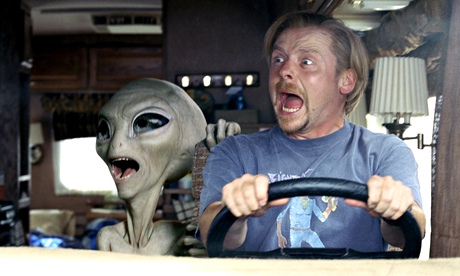
The nerdy worm turned this week when strawberry blond actor Simon Pegg slammed superhero flicks as childish and suggested the film industry had dumbed down. It might be glasshouse-based stone-chucking coming from Pegg, whose entire career has been based on being clown prince of the geeks and self-styled Nerd Do Well (the title of his memoir), but I agree.
Pop culture has disengaged our brains and arrested our development. Our cinemas are dominated by CGI spectacle, Pixar cartoon cutesyness and boring blockbuster sequels. Our restaurants are all artisan burgers, pop-up hotdogs and faux-ironic fried chicken. Our wardrobes overflow with hoodies, onesies, logo Ts and other outsized toddler-wear. Our Facebook feeds are all “yay!” this, “nom!” that and “fwee more sleeps to ickle-wickle holibobs!” the other. We’re preserved in pubescent aspic and Pegg’s pronouncements were right, if a bit rich.
After the inevitable Twitstorm in a social media teacup, he backtracked via a self-flagellating blog (well, at least it wasn’t an open letter). Square Pegg had dug himself into a round hole but his original point was a good one. The revenge of the nerds is complete and the geeks inherited the earth. Yet their subsequent output has turned us into overgrown kids, obsessed with comic books, computer games, fast food and lazy nostalgia. The daydreams of our 1980s and 1990s childhoods have become a 21st-century reality – and it’s doing us a dumb-assed disservice.
Ed Cumming, Observer magazine commissioning editor
As he quickly realised, Pegg’s words were wrongheaded. But they were understandable; the lament of every ageing man that things aren’t what they were. For the nerds, the real problem is not that there are too many spacemen and superheroes, but that they are being enjoyed by the wrong kind of people. You can see why it would be irritating – you build a persona around seeing value in a neglected art form, then all of a sudden the world loves it, too. The first strategy is to redraw your lines and insist on calling comics “graphic novels” – a good example of dumbing-up. The next is to outgrow them, as Pegg tried to claim. But he’s fooling no one.
He harks back to films like Taxi Driver, forgetting that in 1976 Scorsese’s epic was outgrossed by King Kong and Barbara Streisand vehicle A Star Is Born, which is hardly Kosintev’s Lear. Thor and Captain America might have made more money, but the most talked-about films of last year were a three-hour plotless film about ageing (Boyhood), a meta-theatrical meditation on fame (Birdman) and an arthouse thriller about jazz drumming (Whiplash). The best actor Oscar went to a portrayal of a disabled astrophysicist. Where’s the dumbing? Online everyone can be a critic and everyone a creator – bad news for the old guard, but good news for pop culture.
MH The films you mention might have been the most talked-about among broadsheet critics, awards panels and the dreaded “metropolitan elite™” but not in the real world. At both the UK and global box office, none figured in the year’s top 50 – which was headed, depressingly, by Transformers. Joined in the top 10 by four superhero movies, four sequels and one set in space.
When I were a lad (cue Hovis ad music), there was one Superman or Star Wars film per year if you were lucky. These were genuine communal events and the local cinema was crammed with actual children, rather than infantilised middle-aged men droning on about “reboots”, “story arcs” and “dark origin stories” in a bid to convince themselves they’re not stuck in an eternal adolescent loop.
Nowadays, with one eye on lucrative foreign markets, the other on merchandise moolah and a third (this is sci-fi, we’re allowed three eyes) on the chortling man-child audience, there are half-a-dozen cape-clad comic adaptations per year. The Avengers: Age of Ultron (I think it’s about washing powder) still tops the box office chart and this summer alone, we’ve got Ant-Man and The Fantastic Four to “look forward to” – not to mention the latest instalments in the Jurassic, Terminator and Mission: Impossible franchises, plus countless other brainless blockbuster sequels. It’s like being beaten over the head with a big lowbrow mallet and it shouldn’t be seen as fogeyish or snobby to say so.
EC There are lots of them because they reflect the appetites of the day. If by “real world” you mean blockbuster audiences, then we are talking mostly about young men, who have always liked bangs and wallops, but have grown up anxious about the effects of technology and are drawn to films that reflect those fears.
There is also so much choice in entertainment that cinema audiences are lured by extremes: the most exhilarating fights, the specialist effects. Blockbusters are not just competing with other films, but with Grand Theft Auto and Call of Duty and whatever the latest thing on your phone is. It is reductive to say that this has to be infantile. Competition breeds innovation.
Big Hollywood might depend on a brand name to hang the movie on and draw people’s initial attention, but beyond that there is plenty of interesting work going on. Not even Simon Pegg would argue that Christopher Nolan’s Batman films were worse than the earlier shambles. X-Men, Transformers and Iron Man proved you could do more with the genre than mediocre Superman films. JJ Abrams gave fresh life to Star Trek, and looks like he’ll do the same with Star Wars. 22 Jump Street was even funnier than the first. We shouldn’t be fooled by familiar names.
MH So Nolan’s Dark Knight trilogy (nearly eight hours of self-indulgent mumbling with the odd cool bit) was a slight improvement on Joel Schumacher’s 1990s camp-fest, 22 Jump Street was mildly amusing and a few spandex-and-spaceships flicks were marginally better than they might have been? Well, consider me wowed and convinced. More Marvel mediocrity please!
But sarcasm aside, surely we’ve reached peak geek and Hollywood’s fixation on explosion-based franchises could be dialled down to make room for more mainstream grown-up drama? With robo-rubbish at one end of the celluloid spectrum and jazz drumming at the other, I fear the gap between multiplex and arthouse is growing too wide. I’d also like cinema ticket prices to be slashed so audiences didn’t feel compelled to see predictable bankers and could experiment more. Nerds of the world, take off your 3D glasses and faux-ironic Boba Fett T-shirt (at least until December’s Star Wars frenzy). You have nothing to lose but your virginity.
EC I’m not sure you can win a debate about the infantilisation of pop culture with a virgins gag. That aside, yes: the fashion for clanging computer-generated metal will fade. History will sift the dross. But it’s a myth to think there has ever been a mass demand for the kind of weighty drama you’re talking about. It’s like thinking that Victorian novels were mostly of Dickensian brilliance, rather than pulpy shag-fests. Every era has its fads, its unlikely cultural artefacts. To claim that ours is somehow more puerile than any other, or that our interests are less worthy, is the height of narcissism – childish, even.