The spring sun in Tunis had gained sufficient strength to warm the backs of the young men crowding the pavement cafes lining Avenue Habib Bourguiba. With the local economy flat-lining and jobs in short supply, many were filling empty hours amid the faded elegance of the city’s broad, leafy main boulevard.
Hatem Ben Arfa simply sought temporary respite from the intensity of the world he had known ever since his graduation from Clairefontaine, France’s national football academy. Barred from playing professionally by Fifa after representing two clubs, Newcastle United and Hull City, early last season, a No10 described as “a genius” by Gérard Houllier was on an enforced sabbatical.
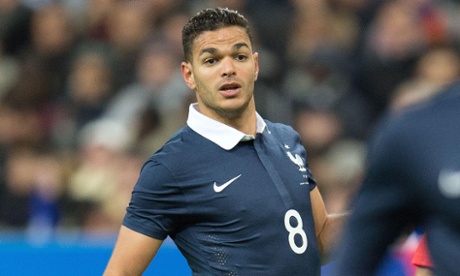
Fast-forward seven months and Ben Arfa has returned to centre stage. After excelling for Nice he is back in the France squad for the first time in three years and should feature against England at Wembley on Tuesday night.
His international re-emergence, as a substitute, in Friday’s win against Germany at the Stade de France on what would become a horrific night in Paris, reflected a series of outstanding Ligue One performances. One goal, against St Étienne, involved the dodging of six markers before scoring with his supposedly weaker right foot.
If he and Didier Deschamps – Les Bleus’ coach who experienced a spectacular fallout with Ben Arfa when he coached him at Marseille – have reached a rapprochement, the mood of forgiveness is far from universal. Should their former bete noire impress at Wembley, Alan Pardew and Steve Bruce will most definitely not be sending congratulatory text messages.
Those Newcastle fans who once applauded his every touch may be more inclined to view the 28-year-old’s extraordinary renaissance as another take on the scapegoat’s return from the wilderness. Similar sentiments are echoed in north Africa.
Although born in Clamart, a Paris banlieue, Ben Arfa’s parents had emigrated from Tunisia where his father, Kamel, starred in midfield for the national football team. As a boy, Hatem spent two months of every summer in Tunis and a part of his heart has always remained in the city.
When Fifa’s strictures delayed a mooted January move to Nice until the summer, it became a place of sanctuary for a man who had done much of his growing up in public.
Confronted by six unexpected months off he toured Thailand before indulging in some nostalgia. “I went back to the Tunis neighbourhood where I grew up,” Ben Arfa recently revealed. “It was important to go back. I found old childhood friends. In Tunis, I forgot I was a footballer. I lived a different life. I went to cafes. I found the images and sensations of my childhood.”
If much of his football appeared as seamless and effortless as his ability to morph between fluent French, English and Arabic in the course of a single conversation, life off the field was somewhat messier. While the brilliance of his ball manipulation and ability to outmanoeuvre opponents often bewitched, he lacked the emotional maturity needed to complement such rare talent.
A difficult relationship – and subsequent estrangement – from a demanding father only exacerbated the inner turmoil. “At Nice, I’ve found some kind of inner peace,” he has said. “It’s been a long struggle, much like the 12 labours of Hercules. This is the first time in my life I’ve felt as serene in my head.
“I stayed in the fog a long time, a little lost, a little disorientated. Last winter I was going through an inner conflict. In my head a little devil was telling me to ‘let it [football] go’ and an angel [was] saying ‘don’t let it go’. It was a real fight.”
If he is almost as clever with words as with the ball, conflict is nothing new to Ben Arfa. At Lyon, Marseille and Newcastle he polarised opinion, enchanting fans and exasperating coaches before invariably acrimonious departures.
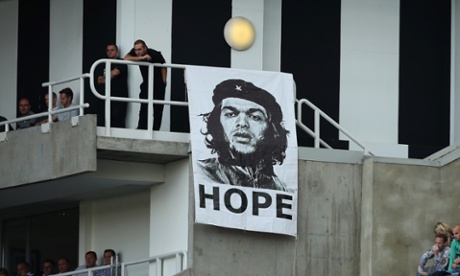
On Tyneside, a playmaker eventually exiled to the youth squad by Pardew became the symbol of the crowd’s growing discontent with the current Crystal Palace manager’s Tyneside regimen. A giant, highly professional Che Guevara banner – (with Ben Arfa’s face replacing that of the Argentinian revolutionary) – lovingly hand-stitched by supporters, regularly symbolised such unrest as it billowed in the Gallowgate breeze.
Newcastle’s long balls were a source of consternation, with Ben Arfa claiming his enthusiasm for tactical argument with Pardew proved detrimental. Meanwhile certain team-mates, infuriated by his reluctance to track back and persistent attempts to beat one man too many, lobbied the manager to exclude him. Once Yohan Cabaye, his staunchest dressing room ally, departed for Paris Saint-Germain, things really unravelled.
“I did not see any light,” he said, describing life at Newcastle and then Hull. “I was a prisoner. I had the feeling of being locked in a dark place without a door. I saw hell.”
Things had certainly deteriorated from happier days when Pardew likened Ben Arfa to Lionel Messi, and described a stunning goal he scored against Blackburn Rovers as “the best I’ve ever seen”.
With the devil in his head temporarily cowing the angel, Ben Arfa soon had Bruce at the end of his tether too. With the Hull loan and the remainder of his Newcastle contract torn up, Thailand beckoned.
A walk down memory lane swiftly followed. Suddenly Houllier’s “genius” was just another 20-something playing five-a-side with childhood friends in a dusty Tunis suburb. The healing process had begun.