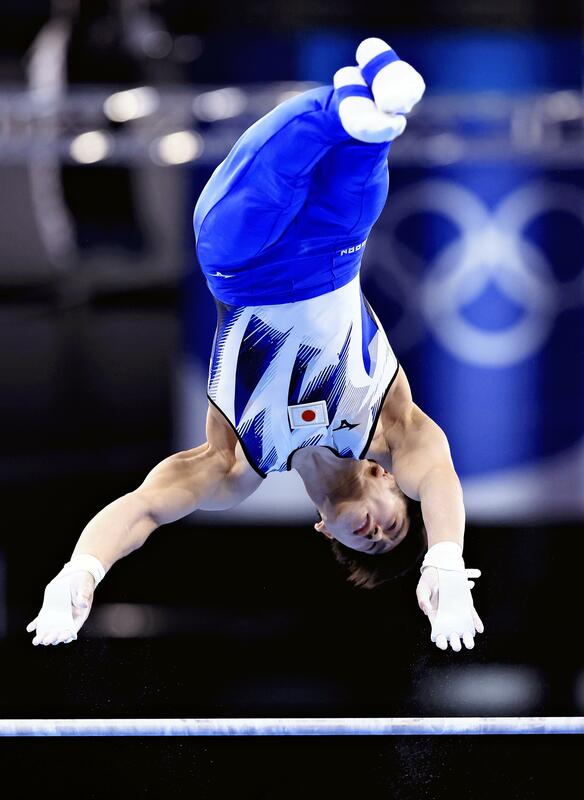
Daiki Hashimoto took the gold medal in the men's individual horizontal bar at the Tokyo Olympics on Tuesday with a score of 15.066 in the final, winning his second gold at the Games after triumphing in the individual all-around event.
"I think what led to this result was that I was able to do 18 performances [from the qualifying round to the individual final] without making a mistake," the 19-year-old said to reporters Wednesday. "It was fun to perform on the Olympic stage," he added.
The last time a Japanese gymnast won an Olympic gold medal on the horizontal bar was the 1984 Los Angeles Games, when Shinji Morisue topped the field.
Hashimoto, who said he was able to thoroughly prepare for the Olympics because of the one-year postponement, said he wants to win the team event gold medal at the 2024 Paris Olympics.
Having won what is considered the crown jewel of gymnastics, Hashimoto expressed joy Tuesday by raising a fist in the air.
Hashimoto successfully executed a Cassina, a highly difficult G-level maneuver, and he also pulled off an E-level maneuver called a Kolman. He then executed his landing perfectly.
Hashimoto stayed focused and was unfazed by a series of falls by other competitors.
Hashimoto's coaches said he never gives up until he can successfully perform a technique and that extensive practice has given him an outstanding sense of stability.
In Japan, many elementary school students learn how to do a backwards roll over a bar in physical education class. Iron bars frequently can be found at parks. Japanese people are familiar with the horizontal bar, and it is a special event for all gymnasts, and one in which the country has enjoyed a long tradition of success.
The event has been the source of many Olympic dramas.
There is a Japanese idiom to the effect of "ogres use clubs," meaning "adding power to something that's already powerful." Takashi Ono, the team captain at the 1964 Tokyo Olympics, illustrated the point well with his unrivaled performance on the horizontal bar and was hailed as "Ono uses the bar." Morisue scored a perfect 10 three consecutive times at the 1984 Olympics.
Mitsuo Tsukahara won the horizontal bar at the 1972 Munich Games. During the event, he was the first athlete to perform a full-twisting double backwards somersault when dismounting from the bar, a move dubbed the "moon somersault."
"What is required on the bar is not only the ability to do difficult maneuvers, but also the strength to compete despite the pressure of performing in the final individual artistic gymnastics event," Tsukahara said.
At the 2004 Athens Olympics, Hiroyuki Tomita's solid finish on the high bar led his team to victory.
"The parabola drawn by his new moon somersault with his body stretched out symbolizes a bridge to glory," said a TV commentator at the time.
Kohei Uchimura pulled off an upset victory in the individual all-around at the 2016 Rio de Janeiro Games.
"I think [the bar] is the event that moves people the most," Hashimoto said. "I wasn't good at it before, but it became my strong point. I feel that I've grown a lot."
With his performance at the 2020 Tokyo Games, Hashimoto's name has been added to the page of Japan's excellence in the sport.
Read more from The Japan News at https://japannews.yomiuri.co.jp/