There was a good moment this week during Sky Sports’ excellent TV coverage of an absorbing Champions League semi-final between Barcelona and Bayern Munich. During a pause in the action an advert for Sky’s forthcoming live Premier League schedule scrolled across the screen, a selection of matches that had one obvious thing in common, mainly that very few of them actually matter. Chelsea versus Liverpool! Arsenal versus Swansea! Some men against some other men! With men in suits talking at half-time! A part of me thinks Sky should just shrug its shoulders, hang it all and start calling these big-budget dead rubbers things like JUDGMENT DAY! or HOLY CRAP WOW! or SPIRIT-SAPPING EVENT-TEDIUM.
Beyond this there is definitely something a little sad about a zombified league that has effectively finished three weeks early save for one last relegation spot (and folks, don’t be fooled: this is just a relegation spot; we get three every year). Which has had no interest in the Champions League for almost two months. But which is still trotting through the motions in its dusty Sunday best, like a dowager countess still faithfully dressing for dinner in the long room. Mainly it seemed oddly poignant that in the middle of one of the most absorbing club football matches of the season, the Premier League’s current state of boredom should be paraded like a guilty little secret. And in this sense, the evidence seems clear. It has, from a competitive point of view, been an unusually boring season almost everywhere. Perhaps even – and I’m just putting this out there – the single most boring moment in modern football history. Not that anyone’s knocking boredom as a concept.
One of the best things about watching football has always been the easy access to regular draughts of unadulterated, socially acceptable boredom. Boredom has always been an essential part of the experience. To follow a team, in the true sense, is to submit willingly to great yawning stretches of boredom, that shared, bilious, tetchy nothingness that makes the moments of relief so more-ishly vivid. Except, of course, there are different kinds of boredom. There is a deeper boredom, a boredom that comes dressed in gaudier clothes and wearing a fixed smile. It is towards this kind of managed, macro-boredom that football has turned its face, given over to a system that entrenches established financial power, extinguishes real competitiveness, but still keeps on shouting about how exciting all this is, the same relentlessly fevered voices offering the same relentlessly fevered answers to the same relentlessly fevered questions.
At the end of which there is a rare sameiness across Europe’s top leagues. Spain has the usual two-horse race, illustrating more than ever the miracle of Atlético Madrid’s achievement last year. In France Paris Saint-Germain have kicked on, languidly, towards a third title in a row. Juventus are 15 points clear in Italy, Red Bull Salzburg 10 points clear in Austria, Benfica and Porto out on their own again. Meanwhile, for Bayern Munich, the real challenge now is to win the Bundesliga before the winter break, thereby allowing key players to be rested for up to six months, or ideally never to actually play at all.
There is still life out there. Turkey has a title battle while Algeria has a brilliant race for honours. Otherwise it is hard to avoid the sense that the top leagues have become ruinously stratified, that the commercial rewards of success, combined with some wonky if (presumably) well-meaning regulations have created a syndicated oligarchy. Money has always dictated success in football. Huge, insurmountable amounts of money dictates huge, insurmountable degrees of success. Welcome to the new boredom!
There is a sadness here too, a sense of talent hoarded at the top, promising players stockpiled, the joy of team-building, of patience repaid, of painstaking struggle and reward machine gunned out of existence. Last season the Premier League had a proper title race basically because Luis Suárez was playing for Liverpool. Suárez, though, was simply too good. He had to go. Money will not allow this, just as money has finally killed off the Klopp supremacy at Borussia Dortmund, a champion team built and rebuilt, but always on a burning deck.
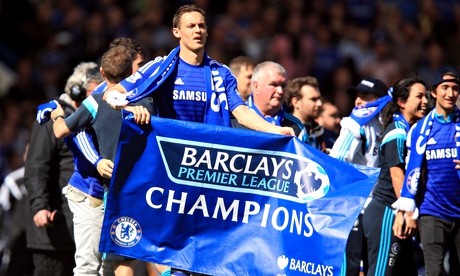
If the best teams are still impossibly watchable this is because brilliant football players playing against brilliant football players will always be a indissolubly pure sporting spectacle. Beyond this though, in the tier below the very top, there is a sense of capped possibilities, a diminished cast, less space within which football can actually happen. Hence the cartoonish obsession with elements of personality and soap opera, and oddities like the peculiarly tedious debate about the style of Chelsea’s title win, as though this was some kind of Cold War-style ideological opposition – defending well versus defending poorly – rather than just a narrow consumer choice, interchangeably wealthy club versus interchangeably wealthy club.
What can we do about all this? Clearly the financial fair play rules haven’t worked as they might, creating instead a slightly different kind of unassailable hierarchy.
Similarly the move towards collective TV rights in Spain is clearly progressive, not just for La Liga but for every other club in Europe. Beyond this, the obvious thing is simply to seek out football that isn’t boring. In the leagues below the top tier there is still genuine competition, rewards to be had for something other than financial might.
The lesson of Bournemouth’s promotion, for example, is that stability and talent can still generate success. While the response to it suggests there is genuine hunger for anti-heroes, for mobility between the barricades. With this in mind probably the best thing to do is to talk about the boredom, to express a sense of consumer dissatisfaction, to suggest that perhaps this not the way you want your sport to be. And for now, as the European season deflates towards an unusually flaccid climax, simply to luxuriate in the oddity of it all, modern football’s own Peak Boredom.