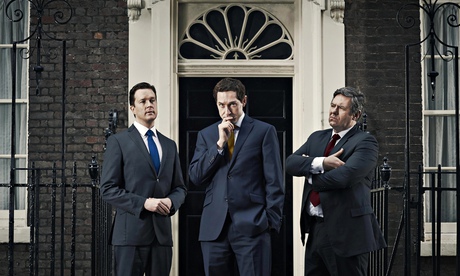
Grounded at the weekend by a virus, I didn’t, as I might ordinarily have done, go to the theatre: instead I declined on to the sofa and let it come to me, by way of Coalition on Channel 4 by James Graham, one of Britain’s most energetic and talented writers for stage and screen. The drama, based on interviews and testimony, begins on election night 2010 and ends, after a week of uncertainty and haggling, on the lawn at No 10 with David Cameron and Nick Clegg throwing their first joint press conference. Thoroughly enjoyable it was too: not the least of the pleasures was watching Mark Gatiss’s Mycroft-esque, sepulchral Peter Mandelson. Despite the evidence of a certain amount of shambolic and/or scheming behaviour, everyone came off rather well: on the whole principled, good-hearted, and very much the opposite of the sweary, cynical folk from The Thick of It. In fact, some of my colleagues who gather field notes from the corridors of power thought it was an absurdly flattering portrait of our politicians.
It feels like Channel 4 has been very much on the pulse in this election: there has been the watchable, if tendentious “fictional documentary” Ukip: The First 100 Days, set after a putative election win by Nigel Farage. And another James Graham drama, The Vote, set in a polling station, goes out on election night. Just a feeling, but is it being a teensy bit braver about timely political drama than its colleagues at the BBC?
Ad feminam fighter
So Penelope Curtis, director of Tate Britain, is to depart to the Calouste Gulbenkian museum. I disagree with my esteemed colleague at the Telegraph who calls the Lisbon institution “small”: it’s pretty vast, with a collection containing everything from gorgeous Persian textiles to Old Masters (a ravishing Ghirlandaio portrait of a lady, for example) and an important collection of slightly terrifyingly anthropomorphic art nouveau jewellery. Curtis, whose seriousness I have always liked, has withstood barrages of often ad feminam criticism over the past five years and maybe, yes, the museum hasn’t quite been on song recently. Everyone can have their two penn’orth on this, but I felt I wanted it to be more fully the museum we could visit to consider the state of Britain, refracted through the eyes of its artists present and past. More like the National Theatre: a place of assembly and debate.
The German press, meanwhile, has been going into overdrive predicting that Chris Dercon, director of Tate Modern, is about to take a job as artistic director of the Volksbühne in Berlin – an intriguing if odd rumour, given that he has no theatre experience. Dercon emailed to declare himself “flattered ... but my mind is at and with Tate”. Make of that what you will.
Antediluvian advice
Back on the sofa (yes, it’s been a glamorous week) I have been reading the perfect invalid’s book: The Grand Babylon Hotel by Arnold Bennett, the great author of the Potteries. Perfect because it is funny, undemanding, and involves kidnapping, dilapidated central European royalty and redoubtable American millionairesses. Bennett, besides his many excellent novels and short stories, wrote a number of self-help books including Journalism for Women (1898). He begins, encouragingly: “Despite a current impression to the contrary, implicit in nearly every printed utterance on the subject, there should not be any essential functional disparity between the journalist male and the journalist female.” However, early training for women is at fault, and this leads to myriad problems, he writes. Women journalists are, he contends, “unreliable as a class” and enjoy a well-earned “reputation for slipshod style”.
Finally: “Their writing is commonly marred by a ... shrillness, a certain quality of multiloquence ... a garrulous, gesticulating inefficacy.” I’ll take my gesticulating inefficacy home for an Easter egg, shall I?