“Has a Football League referee ever gone on to become a manager in the same league?” wondered Alex Reed last week.
Yes, would be the short answer. But for the long (and really rather good) answer we’ll turn this one over to Knowledge reader Clayton Freeman:
“At the head of the list is Fred Kirkham in 1907. Kirkham’s fame as a referee was widespread enough that, in addition to multiple internationals, he had been selected to officiate one of the most daunting assignments imaginable: a one-match playoff between Celtic and Rangers to decide the 1905 Scottish League title.
“In April 1907 Kirkham refereed a Southern League match between Tottenham Hotspur and Watford. The following week, he was at the Spurs match again, but in an entirely new capacity as club manager. The appointment lasted only a year, and Kirkham returned to refereeing. Interestingly, it is possible that he may have continued refereeing even while managing Spurs. Fred Kirkham is listed in two Liverpool Courier accounts (here and here) as referee of two Merseyside derbies in October 1907 and April 1908, although it is conceivable that his name was confused with Tom Kirkham, an official active at the same time. While the extent of his activities in the league during this time remains elusive, his name appears as referee of a Belgium v Holland international on 9 March 1913 in Antwerp.
“In 1914 Herbert Bamlett officiated the FA Cup final between Liverpool and Burnley; by that summer, he had become manager of Oldham Athletic, although the first world war disrupted his tenure there. Among his later managerial appointments was Manchester United, where he took charge for four years from 1927 and took the Red Devils to relegation in 1931.
“At international level, probably the most illustrious of the many referee/managers was the Austrian Hugo Meisl, noted for his management of Austria’s national squad in the 1920s and 1930s. Meisl also officiated international matches during the same period, including the 1912 Olympics. Meisl served as a match referee at least as early as 10 June 1908, when England won 7-0 in Hungary, and as late as 21 May 1923, a 4-2 English victory in Sweden.
“Some went still further, continuing as players during their officiating career. As noted in the RSSSF archive, the inaugural Copa América includes one dramatic example. The English-born Brazilian Sidney Pullen officiated Argentina’s 6-1 victory over Chile on 6 July, then played at center half for Brazil against the same Chilean team two days later. Pullen subsequently played Brazil’s other tournament matches against Argentina and Uruguay as well. Safe to say this practice is extinct; If Argentina and Chile face off at some point in this month’s Copa America, I wouldn’t expect to see Neymar blowing the whistle.”
THE LOWEST RANKED FA CUP FINAL
“Despite its PR with few exceptions FA Cup normally ends up with one or two top-end teams in the final and/or winning,” wrote Andy Wainwright last week. “This is not just recently either. So what is the lowest aggregate league position of the two finalists?”
And yet another comprehensive missive arrived in the Knowledge inbox this week concerning this puzzler. This time we’ll hand the floor over to Malcolm Warburton.
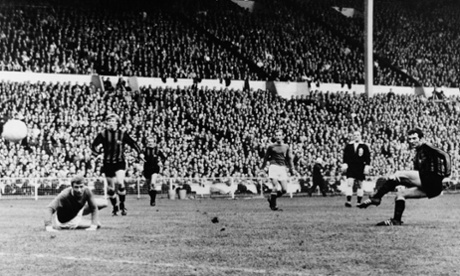
“There have been 14 occasions on which neither FA Cup finalist has finished in the top half of the top tier of English league football. Of the eight occasions when both finalists were in the lower half of the top tier the highest aggregate position is 34. This first occurred in 1929 when Bolton Wanderers (14th) beat Portsmouth (20th) and then again in 1969 when Manchester City (13th) beat Leicester City (21st).
“In addition there have been four finals between a lower half top tier team and a second tier team. Of these (counting the second tier position sequentially below the top tier) the highest aggregate of 44 was the 1975 final between West Ham United (13th) and Fulham (ninth in tier two). Not to be overlooked, however, is the 1949 final between Wolverhampton Wanderers (sixth in top tier) and Leicester City (19th in second), giving an aggregate of 47.
Furthermore there were three successive FA Cup finals (1900 to 1902) between a club in the lower half of the top tier and a Southern League club - effectively the third tier. Of these, using the convention of placing Southern League positions below the two tiers of the Football League, the highest aggregate is for the 1901 finalists, Tottenham Hotspur (fifth in Southern League) and Sheffield United (14th of 18 in the top tier), giving an aggregate position of 55.
“At the other extreme the top two clubs in the league met in the 1913 final, a position not repeated until 1986 and then again in 2007.”
Dan Yambao reports the same results and adds: “Despite the Magic™ of the Cup, 10 finals in 134 where the combined league position was 20th or below certainly proves that that Magic™ just doesn’t quite make it to the finish line.”
CHAMPION LOSERS
“A couple of weeks ago my team Greenock Morton clinched the SPFL League One title despite losing 11 out of 36 games,” wrote happy Alan Hay last week. “I make that a smidge over 30% loss rate – has anyone ever won their league with a higher loss percentage?”
“After a plunge into the RSSSF archive,” begins the proflic Clayton Freeman, “I can confirm that it’s happened a number of times. (For these purposes, I’m including only leagues using a traditional format, not those with end-of-year playoffs like Mexico, the United States, and Australia; in these leagues, teams with higher loss percentages win the final championship more frequently. Also, the list only includes leagues in which teams played at least 20 matches.) There may be other examples, but these are the ones I’ve identified:
1902-03 Sheffield Wednesday English Division 1 (32.35% – 11 losses in 34)
1950-51 OGC Nice French Ligue 1 (32.35% – 11 losses in 34)
1968 Östers IF Swedish Allsvenskan (31.82% – seven losses in 22)
1957-58 Petrolul Ploiesti Romanian League (31.82% – seven losses in 22)
1997 Halmstads BK Swedish Allsvenskan (30.76% – eight losses in 26)
KNOWLEDGE ARCHIVE
“Did the great and the good of football officialdom (OK, Sepp Blatter) actually ever play the game professionally?” asked Andy Burrows back in the halcyon days of 2007.
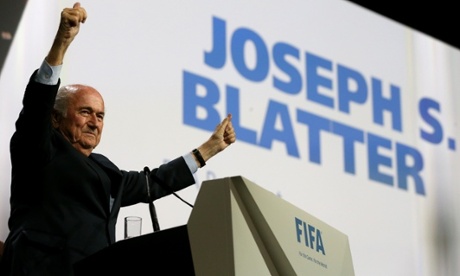
Not professionally Andy, but you will be thrilled to know that football’s biggest cheese did play as a striker at an amateur level for a number of years in Switzerland. Indeed, according to Fifa’s official website Blatter’s career spanned a whopping 23 years from 1948 (this is presumably including youth football as he would have been 12 at that time) to 1971 - most, if not all, of which was spent with his hometown side FC Visp.
“I scored a lot of goals,” boasted Blatter to interviewers from CNN as they filmed a television documentary about him last year. “That’s not a false modesty - it’s really true, especially at the youth level.” We’d be inclined not to believe him about this, or the story about splitting a pair of boots (“I took the left, he took the right”) with a friend for his first ever game, but since he did own up to diving and having a go at referees during his playing days in the same interview, we’re prepared to give him the benefit of the doubt.
For thousands more questions and answers take a trip through the dusty corridors of the Knowledge archive.
CAN YOU HELP?
“Whilst watching a late-season Sunderland game on TV, I noticed during the player introductions the height difference between Sunderland keeper Costel Pantilimon and striker Jermain Defoe,” writes Luke Maloney. “According to Wikipedia, Pantilimon is 2.03m (6ft 8in) and Defoe is 1.71m (5ft 7.5in). During the FA Cup run a few years ago I vaguely remember hearing that Pantilimon was the tallest player in the Premier League (though it didn’t stop him getting benched for the final) so I wanted to know, has there ever been a bigger height difference in a starting Premier League XI?”
“Middlesbrough’s failure in the play-off final gave me an excuse to reiterate my theory about kits with a diagonal stripe- ‘You never win anything with a sash,’” writes Mike Pollitt. “Like all my theories about football, though, it’s almost certainly wrong – I’m sure it’s been done outside the UK (it’s probably common in some countries) but can anyone outdo my friends and colleagues and come up with an instance of a British club lifting a trophy wearing a sash-emblazoned shirt?”
“As the 2015 season is coming to the end across the world, and having nothing better to do on a Sunday night, I decided to watch the supposedly dead rubber of the Liga MX final second leg,” writes Andrés Mora. “Ronaldinho’s Querétaro had lost 0-5 in the away match at Santos Laguna, but somehow they managed to score three goals before half-time and the impossible miracle suddenly looked plausible. In the end, Santos parked the bus and held on to clinch the title, but it got me wondering: has any team ever wasted a five-goal advantage in a two-legged tie?”
Send your questions and answers to knowledge@theguardian.com or get in touch via Twitter @TheKnowledge_GU.