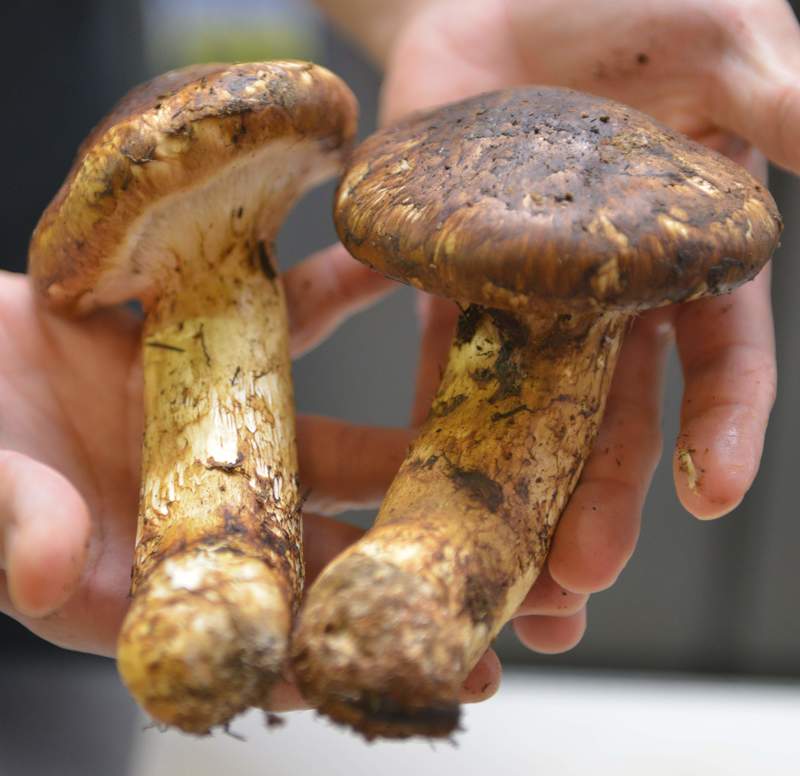
Matsutake mushrooms, while well-established as an autumn delicacy, is also commonly known as "flowers of the peaks." The International Union for Conservation of Nature and Natural Resources (IUCN) classified the matsutake mushroom as endangered species in July, and getting a hold of them has become far more difficult. Although a number of reasons have been cited for the decrease in harvested mushrooms, surprisingly, it seems that mountains that have experienced an increase in greenery have dealt the largest blow.
--Cherished since Nara period, now listed as endangered species
"Takamatsu no / Kono mine mo seni / Kasatate te / Michi sakaritaru / Aki no ano yosa" (This Takamatsu peak appears narrow with so many matsutake mushrooms growing in clusters with their umbrellas opening. What a nice autumn scent!)
This poem of unknown origin is one of the more than 4,500 waka pieces contained in Manyoshu, the oldest anthology of Japanese poems composed from around the 7th century to the 8th century. The piece evokes a mental image of matsutake mushrooms at that time growing in clusters so large that the peak upon which they grew appeared to be narrow and the area being filled with their aroma.
The scent of matsutake mushroom has captured the hearts of the Japanese people since times of old. According to records remaining from the time, even while in the midst of the Onin War (1467-77), court nobles enjoyed harvesting them.
These mushrooms were once a fairly common food item. Toshio Yoshimura, 72, who served as an editor of Mie Prefecture's history compilation, inspected records from the Taisho era (1912-1926) and discovered that the mushrooms sold for about about 15 sen (an old Japanese currency; 100 sen equaled 1 yen) per kilogram while the price of shiitake mushrooms was eight times higher. "I enjoyed hunting for matsutake when I was young, but the environment of the mountains has changed dramatically," Yoshimura said, recalling his childhood.
--Bare trees and dried grass to blame
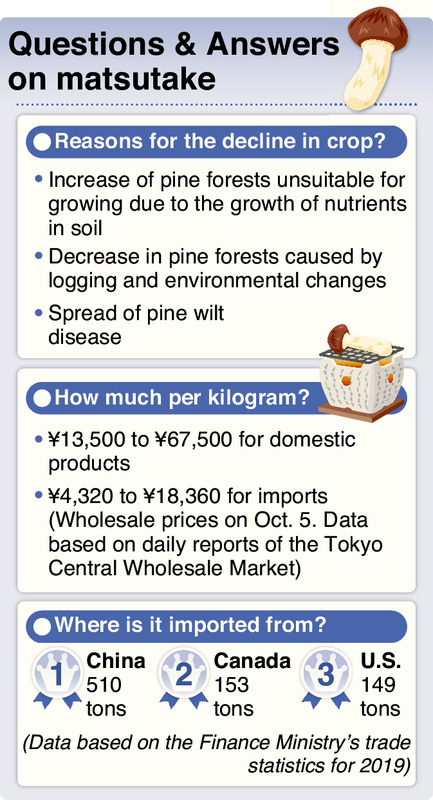
Matsutake mushrooms are distributed extensively throughout Europe, the United States and Asia. According to an IUCN estimate, the number of places suitable for growth has decreased by more than 30% in the past 50 years. The situation is especially serious in Japan, where crops began declining sharply around the middle of the Showa era (1926-1989), when the country entered a period of high economic growth. Crops plunged to about 14 tons, 0.1% of the peak volume recorded in 1941.
Pine deforestation and pine wilt caused by pine weevils are cited as reasons for the sharp drop in matsutake mushroom harvests. The mushrooms release spores as they intertwine their roots to those of Japanese red pines, forming a symbiotic relationship in which moisture and minerals are received in exchange for nutrients. As a result, pine forests serve as a lifeline for the mushrooms. Unlike shiitake mushrooms, which sprout on decaying trees, matsutake mushrooms can only grow through a symbiotic relationship with living trees. This trait makes artificial cultivation difficult and is a contributing factor in the harvest's decrease.
However, it seems that there is actually another factor at play. Prof. Fumio Eguchi of the Tokyo University of Agriculture, a scholar of mushroom studies, pointed out that a major reason for the drop in matsutake crops is "less human involvement in the development of satoyama woodland areas." As firewood, branches, leaves and grasses have fallen out of use in fuels and fertilizers, trees that have been left bare and grass that has dried out has continued to pile up, making the soil fertile. As matsutake mushrooms prefer sterile soil, this is actually a hindrance to their growth. While there are many cases in which human involvement could possibly lead to the extinction of a species, in the case of the matsutake, the opposite can be said.
Most of the matsutake sold in stores is imported mainly from China and North America and accounted for 98% of last year's domestic distribution. Even though matsutake crops overseas have also been on the decline for the same reason, securing a sufficient import volume is relatively easy because the mushrooms aren't highly prized in foreign countries unlike the high-end mushrooms known as truffles.
Why? The reason is the mushroom's specific aroma, which has been described in a number of not so positive ways, including "smelling like the body odor of someone who hasn't bathed" and "smelling of hot and sweaty feet."
A European scholar dubbed the matsutake a "mushroom with a disgusting smell." While it is surprising that there is such a stark difference in the way the aroma is perceived, it may be a difference that the Japanese can be thankful for.
--Red-listed seafood
Other foods are also on their way to becoming hard to procure in the future. The IUCN has already designated such items as Japanese eels, blue-fin tuna and bigeye tuna as endangered species. Hard-shell clams (hamaguri) and giant clams (mirugai) have also been registered on the Environment Ministry's red list of domestic endangered wildlife. Overfishing and a decrease in the number of habitable areas are said to be primary reasons for their declining population.
Rohan Koda, a literary giant of the Meiji era (1868-1912), was fond of a dobinmushi soup dish recipe that features a large matsutake mushroom torn into two pieces and placed atop a broiled unagi eel and boiled in a teapot in a Japanese broth diluted with sake. He is said to have only eaten mushrooms that had absorbed the unagi's flavor.
Rohan's short story, entitled "Hinpu Ko Fuko" (Poverty Happy or Unhappy), has a passage that can be translated as: "It's not worth discussing poverty and wealth. All we have to do is work hard every single day." Rohan may have felt the happiness of the ordinary people who gathered around his dining table after finishing their jobs for the day through the dish's flavor. I wonder what kind of face he would have made had he been informed of the cost of preparing his favorite dish.
Memo
Even if foods such as matsutake are classified as endangered, it isn't as though the harvesting and trading of such items will be banned immediately. However, there is no doubt that it will lead to an acceleration of the momentum for global resource management.
In fact, the trade of European eels became outlawed in 2009, having been designated as endangered by the IUCN the previous year, without the approval of exporting countries. The restriction was decided following a discussion held under the framework of the Washington Convention aimed at protecting wildlife. Also, in the case of the Pacific bluefin tuna, an international committee consisting of 26 countries and regions has been tackling the issue of resource management through efforts such as setting quotas for fishing hauls.
Nevertheless, being greedy when it comes to food is human nature. That being the case, alternatives foods are currently being sought out. One such example is the bakamatsutake mushroom, a species similar to matsutake. The Nara Forest Research Institute in Nara Prefecture, along with other private companies, successfully artificially cultivated bakamatsutake in 2018. As bakamatsutake grows much faster than matsutake, it was given the prefix "baka," which can mean something ridiculous. Its flavor, however, is similar to that of matsutake and is said to have a stronger aroma.
As for the unagi eels that have also been red-listed, Kindai University developed catfish with a flavor similar to unagi in 2015 by experimenting with the water and feed that was used. The university's PR slogan is, "You'd be wise not to underestimate a pachimon [an imitation]." Perhaps it's also a good idea to try these products without looking down on them as mere substitutes.
Read more from The Japan News at https://japannews.yomiuri.co.jp/