

The US and Israel are now at war with Iran, and for many Iranians in Australia, watching it unfold doesn’t feel like a simple “good versus bad” story. The killing of Iran’s supreme leader, Ayatollah Ali Khamenei, in the opening strikes is landing as a moment of celebration and deep dread at the same time.
People are relieved the man they see as responsible for decades of repression is gone, but they’re also scared for their families under bombardment, and uneasy that the path to this moment runs through Donald Trump and another foreign‑led war in the Middle East.
What Khamenei’s rule looked like
Khamenei spent more than three decades as Iran’s ultimate decision‑maker, and his time in power is tied to a long list of human rights abuses. Amnesty International and other groups have documented how security forces under his watch repeatedly used live ammunition to crush protests, including the 2019 demonstrations when at least hundreds were shot dead in just a few days.
In 2022, hundreds of people, including at least 58 children, were killed after mass anti-government demonstrations erupted after the death of Mahsa Amini in police custody.
This January, bodies like Iran Human Rights and the International Commission of Jurists reported “mass killings” as forces fired on crowds in Tehran and other cities, with officials later admitting that thousands may have died and rights groups warning of a spike in executions after rushed trials.
For many Iranians, that’s who Khamenei was when the bombs hit: the person they hold responsible for one of the bloodiest periods since the 1979 revolution.

‘A deep separation between loving Iran and rejecting the regime’
Iranian‑Australian journalist Mojdeh Kash told PEDESTRIAN.TV that most Iranians she knows live in a constant state of contradiction. “It’s about all mixed emotions with Iranians,” she explained. “For many people, there’s a deep separation between loving Iran and rejecting the regime that governs it. The love for the country, its culture, history, people, has never disappeared. But at the same time, there’s a strong resentment toward the leadership.”
That shows up in small, everyday ways. She talks about watching the Olympics and wanting Iranian athletes to win, but feeling uncomfortable when those wins are framed as victories for the Islamic Republic. A lot of people, she says, “prefer to be called Persian rather than Iranian” because Persian points back to “this ancient, beautiful culture, country that we had”.
The way she puts it is simple: “We love Iran but we’re frustrated with the government and we want the change”.
For her, Khamenei’s death doesn’t fix the structure that allowed those crackdowns to happen. She describes the Islamic Revolutionary Guard Corps (or Sepah) as “a big corporation” that “owns almost everything in Iran”, from the only legal TV network to massive chunks of the economy. “Now, the military Sepah owns almost everything in Iran,” she says, and she worries that if the system survives, “they may turn the country into rebels… just to stay. They don’t care”.

‘Happy for a second and then mostly worried’
*Zahra, an Iranian national living in Australia, says even answering “how are you?” has become weird. “In my daily conversations when people ask me like ‘how are you?’, this is the most difficult question to answer,” she says. When she tries to explain, she goes back to the fatal protests in January which ended in more than 30,000 people killed and says “from that time we were not okay and we are still not okay”.
When she heard Khamenei had been killed in the US–Israel strikes, she felt joy she wasn’t expecting. “So many people were happy or celebrating because of course he was in charge of all these killings and brutality,” she says. “Of course I was happy, but I was happy for a second and then I was worried, because I knew something is going to start and I don’t know what’s going to happen.”
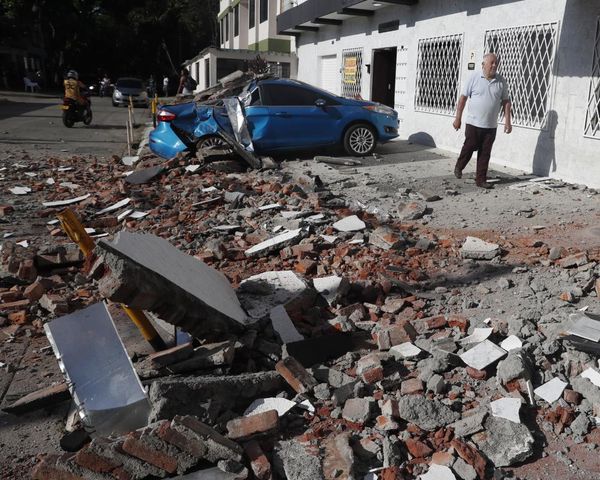
Her parents are still in Isfahan. For them, this is their second war — they survived the Iran–Iraq conflict in the 1980s and are now under bombardment again. “All my family are there,” she says.
“They called me just once,” she says. “They are alive, I can just say that.” The call was brief, with her parents insisting they were “fine” and hanging up. What stays with her is how exposed they are: “The country’s under a war and they [are] actually [under a] blackout [from] the internet and people can’t access the information that they need. There’s no shelters, there’s no alarms and that’s just so shocking.”
Through social media, *Zahra has been hearing from people inside Iran during short windows when connections work. Her niece sent videos via an Iranian app called Rubika showing neighbours in their alley in Isfahan quietly celebrating when they heard Khamenei was dead. Others in Tehran have messaged her saying they’re “terrified and very disappointed and sad” about the bombing, but still think “this is even better” if it finally breaks the regime.

Why Trump is doing this and why people are nervous
On the other side of the world, Trump has laid out a jumble of reasons for the war, from Iran’s nuclear program and missiles to its backing for groups like Hezbollah and the Houthis. In a video posted when the strikes began, he called Iran’s rulers a “sick and sinister regime” that has “waged an unending campaign of bloodshed and mass murder” and said, “We’re not gonna put up with it any longer”.
He has promised “regime change” and told Iranians “the hour of your freedom is at hand”, while saying the campaign should last around four to five weeks.
Political scientist Professor Wesley Widmaier thinks the uneasiness you hear from Iranians in Australia makes sense if you remember how earlier US moves in the Middle East have played out. From the US’ entry into Iraq in 2003 to the coup in 1953 to overthrow a democratically elected government in Iran, Widmaier warns us to “beware the unintended consequences”.

When he listens to the diaspora, Widmaier hears that history in their ambivalence. He says many people are “happy to be rid of an awful leader — no one thought the supreme leader was an admirable person”, but they’re also uncomfortable because “we live in a rules-based order and simply going in and toppling a government unilaterally… doesn’t lead to a legitimate regime change or transfer of power”. The desire for justice and the desire for a legal, stable process are pulling in different directions.
*Zahra feels that split inside herself. She says she “wasn’t really in favour of what Trump was doing or of course what Israel’s government is doing”, but she “doesn’t see any other option because I think people have tried every single option that they had”.
She thinks the US will need to stay involved long enough to stop regime insiders from “tak[ing] the country back to how it was”, but she’s nervous about what that oversight will look like and how long it could last.
Mojdeh is paying close attention to how countries like Australia respond. She says “people want to see the support of the Australian government”, and points to moves like expelling Iranian diplomats, pushing to list the IRGC as a terrorist organisation and Anthony Albanese saying he stands with “the brave people of Iran” and won’t mourn Khamenei as gestures the community “really appreciated”. At the same time, she understands why Penny Wong has stressed that currently Australia will not participate in strikes against Iran, even while calling Iran a “destabilising” force and backing US and Israeli actions diplomatically.
For now, Iranians here are left watching a war that could either finally break the system that’s hurt them for most of their lives, or repeat a cycle they’ve seen before. They’re glad Khamenei is gone, scared for their families, and quietly hoping this isn’t just another moment where the “success” everyone talks about becomes the next generation’s problem to live through.
*Zahra’s name has been changed to protect her identity at her request.
The post ‘Happy, Angry, Terrified’: The Mixed Reactions From Iranians Watching The War appeared first on PEDESTRIAN.TV .