

Thanks for all your questions. And thanks very much to Hans – or HUO, as one of you called him – for taking part and answering as many as he could.
CasparLlewellynSmith asks:
Can you explain the concept for Do It – the series of exhibitions and the book – and its appeal? And have you had a pop at carrying out all of the artists’ instructions yourself – and which was ‘best’?
 Guardian contributor
 Like all my exhibitions Do It grew out of a dialogue with artists. In 1993 we had a discussion with French artists Bertrand Lavier and Christian Boltanski, who both urged me to do an exhibition with instructions which could be carried out by anyone. We were inspired by Gilbert and George's idea of "art for all", and wanted to do an exhibition which like the musical score could be performed differently in many parts of the world. The exhibition has not stopped ever since, and there have been more than 200 interpretations realised in museums and art schools all over the world. The exhibition learns from every city where it takes place, through local research. The instructions have been written in many languages, and translated into many languages. And some years ago artists encouraged me to do a do it at home version, so we invited artists to write instructions for home use which are published on www.e-flux.com. I myself have realised the instruction of Franz West and transformed the broom into a sculpture, as well as the instruction of Yoko Ono to make a 'wish tree'. I've also frequently realised the instruction of Carsten Holler who encourages us to exchange a smartphone with a close friend for 24 hours and answer everything; a very dangerous game.
Updated
Beedoubleyou asks:
Who in your opinion is the most exciting young artist in Britain today?
Guardian contributor The young British art scene is incredibly exciting; and I keep meeting wonderful artists. We are working on an exhibition with Lynette Yiadom-Boakye for this summer at the Serpentine. This summer's exhibition follows last year's exhibition with Ed Atkins. We also feature the young generation in our annual Serpentine Park Nights where an artist takes over the pavilion to create a work of art. This year's Park Nights will feature Jesse Darling, Marianna Simnett and Fleur Melbourn, who follow Hannah Perry, Heather Phillipson and Lena Lapelyte. And it's only the beginning. Also, in the youngest generation of artists London is incredibly strong, with artists like Felix Melia, or Josh Bitelli, and many more.
Tom asks:
Are the traditional mediums of painting or sculpture losing significance?
Guardian contributor No, not at all. It's parallel realities, like in quantum physics. Painting and sculpture coexist with moving images, digital art...
ArborAnn asks:
Welcome HUO! Thanks for answering our questions!
Do you think there might be any contradiction in lecturing others on the perils of climate change when you take hundreds of flights a year and travel even the shortest distances by taxi?
Guardian contributor The answer is to try to use again more and more trains. When I moved to London in 2006 I realised that I could not afford an apartment big enough to accommodate my many thousands of books. I therefore decided to put all the books in a cheap apartment in Berlin, and rent a very small space in London, and then spend time writing in my archive in Berlin. I now move all the books to Brussels, to avoid unnecessary flying. The new amazing train network between London, Paris, Brussels, Germany and now also the south of France creates a new map of Europe. When I started my research in the 1990s, I did everything by night trains, and as we can see from the great example of the artist Tino Seghal, night trains are urgent for the 21st century.
Updated
Ongley says:
Pedant’s corner, I’m afraid, regarding your answer about the Venice Biennale. You said: ‘With such extraordinary artists as Giankian di Lucchi.’ But you meant Yervant Gianikian and Angela Ricci Lucchi.
Guardian contributor Guardian contributor Yervant Ginikian and Angela Ricci Lucchi's work in Venice is an extraordinary piece about memory, and the importance of memory in our digital age. As maybe amnesia is very much at the core of our digital age.
Updated
In purely theoretical terms, do you think it’s possible to answer a straightforward question without glib reference to something once said by an artist or cultural theorist?
Guardian contributor The answer is yes. And as Paul Chan says, we should do less quoting. The reason for me quoting Glissant and Cedric Price in today's answers to this live interview is that both were and are amazing toolboxes for my work and I feel a desire to share it with other people. So it's not about quoting for quoting's sake but about hinting at books and texts being toolboxes. And it's also about memory, as in the age of the internet, we have more and more information but that does not necessarily mean more memory; to maintain the memory of Edouard Glissant is very important to me. And again, the answer to your question is yes!
Alves asks:
Do you agree with the Tate Modern curator Simon Baker when he says that photography should be seen as ‘part of the history of art’?
Guardian contributor
To cut museums, means to cut the future. In difficult times, we need art more than ever before.
EttaMiles asks:
I have just finished reading your book Ways of Curating and was thoroughly inspired. On 6 May, Jonathan Jones wrote in the Guardian:
‘… Five more years of Cameron will reduce the arts to a national joke. Proposals for further enormous cuts that have more to do with ideology than necessity, combined with the Conservatives’ politically desperate promises not to destroy the NHS or education, mean the cultural sector will effectively be demolished by a second Cameron government.’
How can curators and museum professionals mediate between realising progressive and exciting new projects –like the ones you discuss in Ways of Curating – and a diminishing budget for museums and galleries?
Guardian contributor I grew up in the 1970s and 80s near Zurich in the surroundings of the then incredible Kunsthaus Zurich, where I and my entire generation as kids got non-stop inspiration from the collection and such visionary exhibitions as Tendency Towards the Total Work of Art. The museum was a school of seeing, a laboratory, that inspired me and all my friends from many different disciplines in architecture, science, music... and got them started. To cut museums, means to cut the future. In difficult times, we need art more than ever before.
Updated
Zibibbo asks:
You once said you found the art world ‘too constrictive’. Indeed, much of your work seems to be about opening art up to other creative disciplines like science, architecture and design. Is the traditional idea of Art with a capital ‘A’ – creative endeavours that best explore and define the human condition – still plausible or relevant? And is the idea of ‘high culture’ that Kenneth Clark argued for in Civilisation worth saving, or do you think it should climb off its pedestal and take its place as just one of our many creative industries – no better or worse than graphic design, advertising, film, digital media, etc?
Guardian contributor If we want to understand the forces that are effective in the field of art, it's important to understand what's happening in poetry, architecture, music, literature etc. To take this into account when making an exhibition leads to exhibition formats which build bridges between the disciplines. When I used the expression "too constrictive", that referred to formats of exhibitions. Often artists' projects remain unrealised because they don't fit into any of the existing formats, hence the necessity to come up with new formats to make this project happen. I started the Agency of Unrealised Projects which is a big archive of unrealised projects in order to help them to be realised.
Updated
Jamie-leigh Hargreaves asks:
What is your highlight of the Venice Biennale?
Guardian contributor I would like to mention one of the highlights which is not to be missed in the Biennale, as it's not in the centre of Venice, and so special, is the Armenian pavilion, curated by Adelina von Furstenberg. With such extraordinary artists as Giankian di Lucchi, and Anna Boghigian, and many more, in a very unusual location of a monastery.
Alexneedham74 asks:
Do you really read a book per day? And if so, how do you manage it?
Guardian contributor I have a ritual to buy a book every day, and always read several books in parallel. I get up very early in the morning, around 4.35am, to have reading time before the day starts.
Updated
Daffyddw asks:
Why don’t you wear a tie? Is it because they are too expensive or is it because of the soup stains?
Guardian contributor
I'm not an artist. I'm a catalyst, an enabler.
SiLevy asks:
If you were an artist, what do you think would be the focus of your work?
Guardian contributor See my answer to clareyesno above: I'm not an artist. I'm a catalyst, an enabler.
It's fascinating how strongly one can be inspired by writings from a completely different field from one's own. Marcel Duchamp often mentioned that the scientist Poincaré gave him more ideas than anyone else.
Emma Bell asks:
Through your book Ways of Curating, I’ve loved tracing your ‘curating family tree’ –the pioneers who influenced your practice. You mentioned specific books you’ve loved, such as Alexander Dorner’s The Way Beyond Art. What top five titles would you recommend for a young curator such as myself?
Guardian contributor For me, what I've learned most from as a curator has been conversations with artists, a proximity to artists; to visit artists' studios every day. This was all started when as a teenager I can across David Sylvester's book of his conversations with Francis Bacon. I would also like to mention all the other interviews of his I was inspired by - some are gathered in a book called London Recordings, and in Interviews with American Artists. You already mentioned Dorner; in terms of writings on museums, I would like to add Willem Sandberg; his books, exhibition catalogues, and radio interviews were a great inspiration. He was an anarchist, and graphic designer, and a visionary director of the Stedlijk Museum in the 1950s and 60s. Lucy Lippard was another great inspiration - all her writings on art and ecology, but also her exhibition catalogues, in the form of sets of postcard instructions, which inspired all my DIY exhibitions like Do It. As I've written in my answers to Steven Fraser and RedfordScott, I read Edouard Glissant every day. Etel Adnan is one of my favourite writers. One example is her book Mount Tamlpais which is about the mountain Tamlpais which she describes as her best friend. This book taught me to look and look and look again.
Last but not least, I always thought it's fascinating how strongly one can be inspired by writings from a completely different field from one's own field. Marcel Duchamp often mentioned that the scientist Poincare gave him more ideas than anyone else. In my case one of the biggest inspirations came from the British architect and urbanist Cedric Price. When I met Richard Hamilton and Rita Dornagh for the first time, I told them about my idea to make exhibitions which are not a top down masterplan but include self-organisation, they asked me to meet Cedric Price. His writings on cybernetics, architecture, the non planned, became hugely inspiring for many of my exhibitions from Cities on the Move, to Laboratorium, to Utopia Station.
Updated
RedfordScott asks:
Can you conceive of an art world post contemporary art?
Guardian contributor This is a very exciting moment for art, as we live and experience a true polyphony of art centres on all continents. I would like to come back to Glissant - I have a ritual, to read him every morning when I wake up for 15 minutes. I try to learn from him, again and again, how we can engage with as many possibilities of a global dialogue whilst resisting the homogenising forces of globalisation (see my answer to Steven Fraser). Glissant's thought is about the archipelago, the exchange that takes place between the islands, allowing each to preserve their own identity. As he told me, it was in the Antillean islands that the idea of Creolization, that is the blend of cultures, was most brilliantly fulfilled. Continents reject mixings whereas archipelagic thought makes it possible to say that neither the person's identity nor the collective identity are fixed once and for all. I can change through the exchange with the other without losing or diluting my sense of self. And that's what Glissant shows us in such a wonderful way.
Concerning your question about the contemporary - the word contemporary implies a relation. One is contemporary of another. It's similar to the Medieval Latin word contemporarius, whose constituent parts con - which means with - and temporarius - which means time - similarly point towards relational meaning/with time. This means that one needs a plurality of temporalities across space; a plurality of experience and pathways; and to resist the homogenising forces of the market. When I lived in Paris, in the 1990s, I was a neighbour of the great filmmaker and anthropologist Jean Roche. He often told me about the immense courage required in order to be contemporary - to engage in the difficult negotiation between past and future. He spoke of a means of accessing the present moment through a form of archeology. Being contemporary means returning to a present we have never been to - to resist the homogenisation of time through ruptures and discontinuities.
Updated
Steven Fraser asks:
Do you think we will ever see an independent Scotland or Quebec?
Guardian contributor Art is transnational. It transcends boundaries; national boundaries. For this whole discussion of independence, the writings of Edouard Glissant are very important. It's very urgent that his dozens of books which exist in French and of which almost none are being translated into English, are being translated. He talks about the archipelago, and about mondialite – the idea of mondialite resists the homogenising forces of globalisation; as it resists the rejection to enter a global dialogue.
Updated
Hans Ulrich is in the building …
Hans Ulrich is in the building …
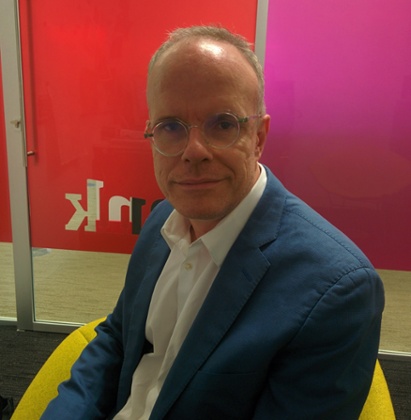
Soon he’ll be taking on Gilbert and George, but first, Hans Ulrich Obrist is at the Guardian, ready to answer your questions. His first response was to clareyesno, who asked:
Is it true that you subsist on very little sleep? Does it hold you back from experiencing more work? How do you stay healthy without sleep and with so much travel abroad? Also: have you ever considered making your own artworks?
Guardian contributor Actually at the moment I'm sleeping a lot - I was inspired by Helene Cixous, she wrote this amazing book on her dreams, and I was inspired to start writing up my dreams. My dreams - one doesn't dream a lot if one doesn't sleep a lot! So this is a moment of more sleep. I'm interested in lots of different experiments with time - there were periods in the 90s where I try not to sleep at all, there were periods where I drank a lot of coffee, to write, inspired by Balzac whose coffee consumption was legendary. I then followed the rhythm of Da Vinci - to sleep 15 minutes every three hours, which was amazingly productive for a year or so. I stopped though because it needed this big alarm clock to wake up after 15 minutes - it was not sustainable in the long run. In the last couple of years I love to get up brutally early in the morning.
No, I didn't consider my own art. When I was 16 I met the artist Fischli Weiss, and decided that I wanted to work with artists for the rest of my life. I see my work to be a catalyst, a facilitator, an enabler, who works very closely with artists.
Updated
Post your questions for Hans Ulrich Obrist
Just reading about the schedule of star curator Hans Ulrich Obrist will make you feel tired. On a skimpy five hours sleep a night, he co-curates the Serpentine gallery, writes books, and interviews everyone from Gerhard Richter to Marina Abramovic – the latter conversations collated in the newly published Lives of the Artists, Lives of the Architects. Then there’s the OM3AM film salon, held in the middle of the night.
He travels abroad almost every weekend, haring across the world to guest-curate exhibitions, meet with artists, appear on panels and collaborate with the likes of Douglas Coupland and Rem Koolhaas. His zest for creativity is as big as his carbon footprint – and he’s seen as one of the most influential people in the global art scene.
His next engagement is an on-stage conversation with Gilbert and George, hosted by the Guardian, where he’ll unpick the work of Britain’s favourite art duo. But before that, he’s joining us to answer your questions in a live webchat, from 5pm BST onwards on Monday 18 May – post yours in the comments below, and he’ll answer as many as possible.
Updated









Thanks for all the great questions. All best wishes, Hans Ulrich.