There has been a widespread move to scrap the use of hanko seals on business and administrative documents, triggered by the novel coronavirus outbreak.
The ongoing pandemic has exposed how Japan is lagging behind in digitization, prompting the government to announce a policy of abolishing all requirements to use seals for administrative procedures. With some hanko makers and sellers lamenting that this is a matter of survival for them, the long and widely practiced culture of using seals is now at a crossroads.
-- Loss of industry
"There is a fear that the whole [hanko] industry may perish as makers and sellers will not have a stable income," said Toru Hideshima, 73, who runs the hanko store Han no Hideshima in Fukuoka.
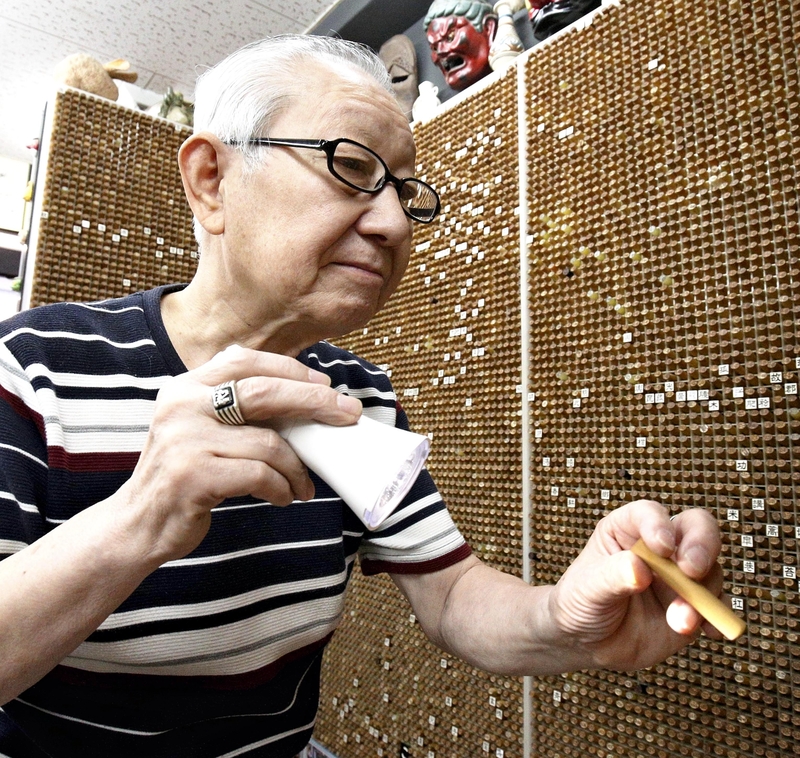
Hideshima is the second-generation owner of the store, which was established in 1931. During the period of high economic growth, the store was so busy that businesspeople had to line up to buy the hanko necessary for such procedures as in-house decisions and transactions.
In order to not keep customers waiting, Hideshima was determined to prepare and have in stock "seals for any surname." He scoured phone directories and relevant records to increase the variety of family names. Now the store has more than 60,000 different hanko, covering the walls up to the ceiling.
Amid the pandemic, however, factors such as confusion over online applications for the government's cash handouts revealed the reality – the digitization of administrative procedures is lagging.
Taking this into consideration, the administration of Prime Minister Yoshihide Suga, which came into power in September, came up with a policy to promote the digitization of society. It announced on Nov. 13 that it would entirely abolish the use of seals required for administrative procedures. Subsequently, one local government after another is reviewing the use of hanko.
"The impact of abolishing hanko on administrative documents is significant," said Hideshima. "We'll have no choice but to find a way to spot demand from overseas customers and those who buy seals as commemorative gifts."
-- Tailspin
The production of hanko has been on a downward trend due to such factors as the declining population. According to the Economy, Trade and Industry Ministry, the value of shipments from hanko makers with four employees or more fell to 24.2 billion yen in 2018, about 60% of the value 20 years earlier.
The number of members in the nationwide association for seal makers also dropped by 80% to 897 business operators as of June this year, from 4,370 businesses in 1989.
The pandemic has served another blow to the already severe situation surrounding the industry. Despite companies being encouraged to let more employees work from home, some people have to go to the office just to stamp hanko on documents. This custom has been brought up as a barrier that prevents teleworking from taking root.
In a questionnaire conducted by Tokyo Shoko Research, Ltd. in August and September, 4,812 companies out of 11,129, or 43%, responded that the custom of stamping seals was an obstacle to teleworking.
A company worker in Nerima Ward, Tokyo, who frequently travels to the office to stamp contracts, said: "I'm worried that I might pass the virus on to a family member. I hope more efforts are made to remove hanko culture so that teleworking becomes more widespread."
-- Yamanashi holds on to culture
On the other hand, there is a movement to protect this longstanding culture.
In October, the Yamanashi prefectural assembly unanimously passed a written opinion calling on the central government and the Diet to maintain the system of using seals for verification.
The industry has been thriving in Yamanashi Prefecture since the Edo period (1603-1867) when the handcarving of high-quality crystal seals developed into a business. In 2018, there were 12 seal-related businesses with four employees or more in the prefecture, making it the third-largest prefecture for the industry after Osaka Prefecture and Tokyo.
"Stamping seals is a form of traditional Japanese culture. I find it odd that people would try to eliminate it from our daily lives," said a 54-year-old owner of a hanko manufacturing and sales business in Kofu.
When Taro Kono, who is both minister in charge of administrative reform and minister of state for regulatory reform, tweeted a photo of a stamp that read, "Abolition of hanko," Yamanashi Gov. Kotaro Nagasaki tweeted back, saying, "I am just utterly and totally disgusted."
Hoping hanko culture can also become part of the digitization trend, the Yamanashi prefectural government aims to utilize a system that reads seals for online verification and expand sales channels overseas, such as in Vietnam where there is also a custom of using seals.
Read more from The Japan News at https://japannews.yomiuri.co.jp/