
That's it for today
Thanks to Hanif, and indeed to all of you for your questions. Until next time!
"Writing today, particularly writing in English, is in a surprisingly healthy state"
HuNaught asks:
What is the state of literature today? The same as when you started out, or more competitive? What would your advice be to somebody looking to publish their first novel in 2015?
 Guardian contributor
 I would say that writing today, particularly writing in English - which is the form I'm most aware of - is in a surprisingly healthy state, and that new writing from India, Pakistan and the whole subcontinent is very lively at the moment. There is also much new writing coming out of Africa. So despite people speaking all the time about the death of the novel, and indeed of writing altogether, people clearly haven't given up on the idea that the novel - and I mean in particular the novel - is a central form for expressing both the social and psychological depths of human life.
Updated
bettyparry asks:
Do you think Kafka has any meaning for us today?
Guardian contributor One of the things I've noticed particularly with regard to my own teenage children is that there has occured a break between the culture of the past and the present. My children were mostly brought up in the 90s and 00s which meant their progenitors were really Sony and Apple. They were brought up more or less entirely on what I refer to as "electronics". What this means is that the transmission of humanism or humanistic tradition as I would think of it, is in danger of being lost. Without sentimentalising the past I'd like to say that the books my grandfather read he handed onto my father, and it was in my father's library that I educated myself. And that it would be a tragedy if this form of cultural transmission, that this history of values, was eroded by children who are receiving their education from the electronic media, rather than from other educated adults. I grew up in the 60s, at a time when authority was under attack, but it would seem to me now to be a tragedy for us to regard all authority as perverse or fascistic. It would be a further tragedy if our children saw themselves only as consumers. It is fascinating that some young people are choosing to go to Syria and join Isis. You'd have to say that this was misplaced idealism. It would be terrible to think, that on the other side, our children were merely consumers and had given up on idealism and politics altogether. Although we are condemned to five more years of Tory rule it doesn't follow that we should be disillusioned or give up on thinking about alternatives to this form of aggressive, elitist, and ultimately empty hyper-capitalism which will devastate the post-war values, particularly of the welfare state, that I, in my sentimental way, still hold dear.
"We have probably reached the end of so-called identity politics"
sarahsmith232 asked:
To what extent do you think that the non-white sections of this society are guilty of defining themselves against “the white” other? To what extent do you believe you may be guilty of this yourself?
Guardian contributor I think what interests me at the moment in terms of race, and in terms of the future of Britain, is that we have probably reached the end of so-called identity politics. What I'm interested in now is a broader, socialistic alliance. So whether you are a lesbian, person of colour, or identify with any minority, I would like to see us forming a new politics that is concerned with what I would call public values. Thatcher destroyed public values; indeed, didn't appear to believe in them. So now, a generation later, we are left without public housing, decent pensions, effective trade unions, or a political party that can represent anything except the elite. So after the collapse of Marxist communism, and the instatement of neo-liberalism from Thatcher through her disciple Blair and onto Cameron, we are it seems to me now living more or less in a one-party state. We lack an effective and ideological opposition. The collapse of the left at the last election presents a great opportunity for us to think about possibilities of reframing politics and creating alternatives to the neo-liberal horror that awaits us.
Updated
meekstom21 asks:
How can I avoid being part of the 99.9 per cent of creative writing students who are talentless?
Guardian contributor Most people can sing, or dance, or cook a bit, and have all sorts of accomplishments they they are not necessarily outstanding at. It's irrelevant really. Most people are not geniuses at everything that they do. Also I think with writing, and particularly with the students, the most important thing is that they write because they have something to say to themselves at first. Whether you have something of interest to say to a reader is another kind of test. And one that can only be resolved if someone is prepared to hand over some money in exchange for something you have written.
"I often wish that I'd started a franchise like JK Rowling"
listlessbedouin asks:
If you had to write a sequel to one of your stories, which would it be? What would happen in it?
Guardian contributor It's a good question. Because when you write a story, a novel, or a movie, you really inhabit the characters and they really inhabit you. For a long time they're a part of your life. They are bits of you, and they seem to have some sort of independent existence. So when you're done with them you do worry about what happens to them. I often wish that I'd started a franchise like JK Rowling, by which I mean a form in which you could keep the same characters going forever. I would be a richer man than I am now. So although I still wonder what might have happened to Karim Amir, or Charlie Hero, or DeeDee Osgood, what excites me are the new characters that I'm making, that still appear to me as I sit at my desk and starting talking in my ear. So when I finish something I feel a terrible vacancy, and I wait for myself to be inhabited by these new ghosts who soon, if I'm lucky, start speaking to me and to one another. I can't say I know how this kind of magic happens; I guess you have to turn up your hearing aid, and if you're lucky, you'll pick up something. Perhaps for a writer it becomes a kind of habit and you don't even have to look for stories any more; they find you.
Updated
Kublai_Khan asks:
I couldn’t put The Black Album down, great read. Deedee sounded so hot.
I’ve heard you remark about identity issues facing third and fourth generation Pakistani kids and how for many this manifests itself in the religion of their parents. Like you, I come from a mixed heritage and it’s not something I struggle with. It’s not a big deal, I just embrace whatever bits of culture I like, and not even limited to those of my parents’ backgrounds.
Why is it that so many young people from South Asian backgrounds struggle to feel at home here and what can we do about it?
Guardian contributor I noticed as a young man growing up, and I grew up in the 1950s and early 60s when Britain was much whiter than it is now, that other people had a problem with people of colour. And for some time, this did as they say, my head in. After a while I realised that this was a political and social issue, rather than something that concerned my psychological health. I saw that Britain had to change. There was an idea that whiteness was the standard, that whiteness was the bar, as it were. Just as at that time heterosexuality was considered to be the sexual standard. Things would only improve for all of us if these categories were questioned, dismissed, and we could begin to see things differently. As I say, this is a political, social and cultural issue. It's terrible when people become locked into identities that are too narrow for them, when they see themselves exclusively as, say, straight, Muslim, white, or whatever it is. You might say we need a more creative view of human possibility. The arts might be one way of advancing this.
Updated
MythicalMagpie asked:
Some of your writing is reported to have caused conflict with family because of its seemingly autobiographical content. Was it worth it? Do you ever wish you’d done something completely different? If that’s too personal feel free to completely ignore my question.
PS: Did you ever get to meet David Bowie?
Guardian contributor There are some conflicts, some forms of antagonism, that are really worth engaging in. The opposite of conflict would be a terrible conformity or quiescence. It would be a form of death to remain silent. So you must say you'll say, and then you'll find out how others think about what it is you've said. Silence is worse. The truth is, you don't really know how others are going to receive your works, but if you remain silent, they'll never find out. It would be ridiculous to think you could live in a world without conflict; there's a lot of truth in conflict. I would recommend engaging in good conflict: where you might feel the need to speak the truth. When you're writing, the one thing you must do is say it how it feels to you. So if writing is of value to anyone, whether they're a real writer or not - they might be a weekend writer - they're at least speaking truthfully to themselves.
Guardian contributor I worked with David Bowie, on the soundtrack to the TV series of The Buddha of Suburbia. When I asked him if he would like to do it, he was pleased and said: I thought you'd never ask. The album he made also called The Buddha of Suburbia is a terrific record, and a development of the short sequences of music he did for the TV series. He's a wonderful man, but of course rather intimidating to work with. You don't really want to be in the position of having to tell David Bowie what sort of music you think he should be making. It was interesting to me how thorough and committed and hardworking he was, and that was a good lesson.
Updated
Lucotter asks:
Personal question really but I’m very intrigued by the interest your fiction takes in psychotherapy. Could you maybe say a little about your own intrigue with the comparability of writing and what happens in the therapist’s room.
Guardian contributor I read philosophy at university and around that time in the mid 70s, became interested in the work of Freud, Lapin, Foucault, Deleuze etc. French intellectual life in the post-war period was very exciting, compared to what was going on in the UK. So for me philosophy and psychoanalysis crossed over and their concerns were very similar. So through philosophy and psychoanalysis, I could think about race, sexuality, contemporary politics, families, madness, and so on. I can't say how all this informs my work, but I would have to say that anything you listen to, think about, read, the conversations you have would inevitably inform your work. Mostly at the beginning of my career I was interested in writing about race because I came from a mixed-race background, and saw that although Britain was changing from the post-war period, very few writers and artists felt they were in a position to write about it. I remember reading ER Braithwaite's To Sir With Love, which concerns a black man going to teach in a white school in the East End, and thinking: I want to write about this subject. The end of the empire, and the beginning of a new form of colonialism within Britain. When I finally got around to writing The Buddha of Suburbia and I found a voice and tone and style for it, it was the book I'd been trying to write since I was 14 or 15 years old. The book that would be about race, fashion, drugs, music, sexual experimentation and punk, ie much of what I'd lived through. But you can't just write down what happened to you yesterday; you have to find an approach or point of view that enables you to write freely. And it's that that takes the time. But when you find that - when I found that I should write it in the first person rather than the third - it should then come relatively easily.
It would be a mistake to think that writing is therapy for the writer; that really is for bad writers. The therapy involved in writing is for the reader, that you are making or are part of a culture. The point of a culture is to provide a resource where people can think more widely about what matters to them. This is I guess why having a living culture, that's informed by new voices, is so crucial.
"We writers are 50% artist and 50% in commerce"
ilGatto asks:
What is more important, being a good artist or a good father?
Guardian contributor Being a good father is obviously the most important responsibility you can have, but I'm partly an artist in order to be a father. We writers are 50% artist and 50% in commerce. We try and make a living from what we do. One of the things I'm most proud of having achieved is of making a living as a writer since I was in my mid-20s. Looking back it seems more and more amazing to me that someone from my background is able to make a living as a professional writer. I can now see how difficult and how increasingly difficult that is. I would also like my kids to see what it is to have a vocation, what it is to have work that you love to do. And that would be at least one lesson I would like to pass onto the kids. When I get up in the morning after my coffee the first thing I want to do is write - I still have that passion. And I think that without that sort of engagement the life could feel empty.
Updated
Scott Menzies asks:
Were you afraid following the death threats against you? I assume of course you were. What is your advice to others who are thinking of writing about controversial issues?
Guardian contributor I've never had any death threats. Apart from close friends. But if you want to be a writer, as soon as you pick up your pen, your mind fills with fears and anxieties. The real danger of censorship is of self-censorship and if you want to write you really have to hold off those fears and anxieties. One of the things that a creative writing teacher can do is help as student hold off the fears that he or she imagines that will follow the transgression of writing.
"There is no sex without meaning"
And here is his first answer. clareyesno asks:
You’ve been very frank in writing about sex – have the British got a healthier, more open, less repressed attitude towards sex now than they did in the 1980s/1990s? Is it hard to write about? And what do you make of the literary Bad Sex Award – funny and worthwhile, or symptomatic of our squeamishness about sex?
Guardian contributor They were said to have a repressed attitude in the 50s and 60s, that seemed to me to soon disappear. I wouldn't say that I write about sex particularly as an act - I think of myself writing about sex as a form of passion. So if you look at the film The Mother, or My Beautiful Laundrette or even Le Week-end, you would say these are stories about people's involvement with one another, their passion for one another., And what happens when that passion ignites, in the case of The Mother and Venus, or what happens when it dies, in the case of Le Week-end. I would never dissociate sexuality from the person or the character I was writing about. There is no sex without meaning.
I would write about not a particular act or position, but I would write about what a particular form of desire would mean to somebody and how it might change their life. After all, Anna Karenina doesn't just have sex - she does something that is deeply transgressive, and the whole of that novel revolves around the meaning of what she does.
People can write badly about anything! Landscapes, football... All writing is difficult for those who can't do it and reasonably simple for those who can.
Updated
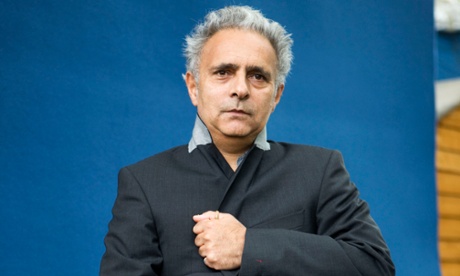
Hanif Kureishi is with us now!
Here he is at Guardian Towers:

Updated
Post your questions for Hanif Kureishi
From his early pornographic writing under the name Antonia French to the middle-aged couple rekindling romance in his 2013 screenplay Le Week-End, Hanif Kureishi has chronicled the sexual foibles and everyday emotions of Britain – and how they have been reshaped by every generation.
He’s ranged across page and screen: hit novels have included The Buddha of Suburbia and Intimacy, while screenplays for The Mother, Venus and his breakthrough My Beautiful Laundrette have all been equally lauded. Love + Hate, a collection of short stories and essays exploring affairs of the heart (as well as Kafka and immigration) was published earlier this month.
He is joining us to answer your questions on all of the above and more, in a live webchat from 11.30am BST onwards on Monday 22 June. Post yours in the comments below, and he’ll answer as many as possible.
Updated














It was a great pleasure for me to do this - thank you and goodbye.