England left their headquarters in Surrey on Thursday night for their last free weekend before we find out just where Stuart Lancaster’s team stand in the global pecking order only a year out from the World Cup. In the next month they play the two sides ranked above them, the one immediately below and a wrecking ball of an outsider, Samoa, who still sit comfortably in the top 10.
Autumns do not come much harder in the world of rugby and to keep pace with expectations Lancaster needs to win three of the four Tests. The bottom line is he has to beat either the All Blacks or the Springboks. Rugby’s gods could have been kinder.
In June it was the men who long ago organised England’s tour of New Zealand who helped undermine a summer of expectation – and five months on the diary could have been better. Had England been able to chose the autumn’s running order, they might have wanted Samoa first up, possibly with Australia next.
Instead, it’s New Zealand first up, nicely rested after bagging yet another southern hemisphere championship but fresh from Saturday’s gentle workout against the USA Eagles in Chicago. After that comes South Africa, who have just ended the world champions’ 22-game winning streak, followed by Samoa and finally Australia, a side with a new coach and who could look very different at the end of the Test series from the team who run out against the Barbarians on Saturday.
However, it’s not only Australia who are on the move and it’s worth looking at rugby’s landscape because, while it might be overstretching things to say it has been transformed, it’s certainly a very different place to the one England viewed a year ago.
New Zealand have again moved on – when don’t they? – but the big change has been the near revolution that has swept through Springbok rugby on the coat-tails of a 20-year-old fly-half. Handré Pollard made his debut against Scotland in June. Six games later he is at the heart of Heyneke Meyer’s Springboks and very much the architect of that win over the All Blacks at the start of this month.
Last year, when he was leading the junior Boks in the World Cup, Pollard looked no different from any other kicking South Africa fly-half. By the time he walked from the field at Ellis Park even dyed-in-the-wool All Black props such as Craig Dowd were purring they had just seen Dan Carter circa 2005 – and not without reason.
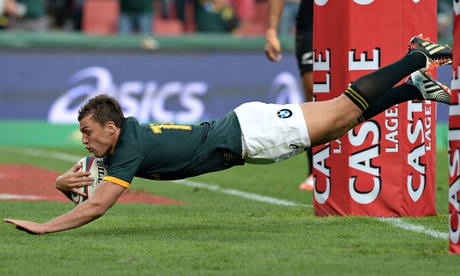
By half-time in Johannesburg, Pollard had scored two tries and made a third. The Boks were 21-13 up, 16 of those points to their young fly-half, who scored his first Test try by identifying and then stepping through a thicket of forwards before, 13 minutes later, scoring a second through a combination of evasion and power that culminated in bursting through the tackle of Richie McCaw.
When needed the guy has a boot of which Naas Botha would have been proud and in an old-fashioned way he can play 50 metres upfield with one spiralling kick. However, it was the way in which Pollard fashioned the game by running out from under his own posts to start the move that led to Francois Hougaard’s first try that caught the eye.
In a Test that had everything, including the inevitable fightback from New Zealand and a last-gasp penalty from some distant horizon to win the game for the Springboks, it was a performance that could easily have masked that by another player who could light up the autumn, Malakai Fekitoa.
If you haven’t seen the 22-year-old All Black then think Manu Tuilagi – but bigger. Fekitoa, born in Tonga, was in the side because of Ma’a Nonu’s broken arm and Ryan Crotty’s damaged face and spent the game bristling with aggression. He scored the first-half try to keep New Zealand in the game but it was a fortnight later, against Australia, that the centre displayed the sense of timing that seems to make good players comfortable on big stages.
Against Australia in Brisbane, the All Blacks were in danger of losing two on the trot when, 28-22 down and the clock about to go red, Fekitoa bustled his way over the Australia line and Colin Slade kicked the conversion to prolong the Wallabies’ three-year losing run against the All Blacks.
Of course that result was also overshadowed by what was to come next and in attempting to look for faces who might dominate the autumn it is hard to stray far from Michael Cheika, the coach who was put in charge of Australia less than a week after that Brisbane defeat and the resignation of Ewen McKenzie, which immediately followed it.
A year ago Lancaster’s England might have been looking at a South Africa seemingly intent on going backwards – based on the recalls for Victor Matfield, Bakkies Botha and Juan Smit – and an Australia intent on continuing self-flagellation. No longer. South Africa are unrecognisable from that ponderous, forward-dominated machine and Australia have a proven winner in charge.
Anyone smirking about Australia misfortunes only a year before the World Cup should remember Cheika led Leinster to their first Heineken Cup, his Waratahs are Super Rugby champions and, judging from his contract, he seems to have his bosses eating out of his talented hands.