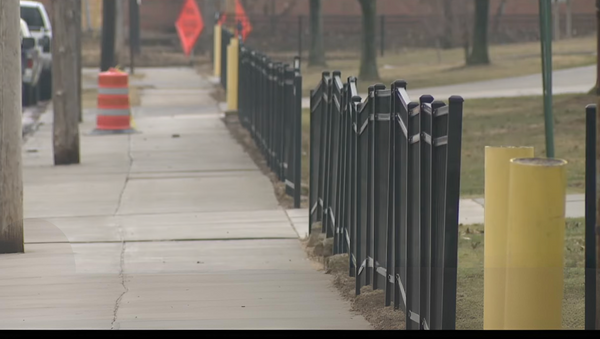
The vandalised white van – smashed windscreen and minus wheels and doors – drew quite a crowd.
“Not quite what you’d expect,” murmured the four middle-aged women on a day out from the picturesque village of Hamble, Hampshire, surveying the scene complete with abandoned fridge and overspilling bin liners. “It’s striking. But not like our streets. We live in a nice area,” they laughed.
Not very Hampton Court, either, with its Tudor palace and river backdrop.
This was Community Street, a recreation of Kensington Road in Bristol, a celebration of the Royal Horticultural Society’s Greening Grey Britain campaign, and a walk-through show garden at the Hampton Court Palace flower show, which opened its doors to the public on Tuesday on its 25th anniversary.
It looked incongruous nestling among the ostentatious multi-hued displays of perfect blooms, glittering water features, Pimm’s, champagne, ice-cream booths and stalls proffering an abundance of gardening riches which go to make up the world’s largest annual flower show.

Under a cloudless sky, in wilting heat, botanist James Armitage was pointing out the plantings – campanulas, scabiosa, sanguisorba and wild carrot, as dry ice puffed out at frequent intervals to represent pollution. “The hairy stems trap particles of pollution, contain it, and clean the air,” he explained. Bird’s-foot trefoil, dianthus and yarrow – “which you would think of as weeds” – help cool the air. “Looks like our lawn if we didn’t mow it,” observed David Whitehead, 68, from Romford, Essex, visiting with his wife Sylvia, 66.
“Thrilled, absolutely thrilled,” exclaimed Grenville Johnson, 67, a retired primary school headteacher, whose successful greening alongside his neighbours of the diverse, urban Victorian-era Kensington Road is the garden’s inspiration. Earlier, he was showing round members of a parliamentary select affairs committee keen to learn more of the environmental benefits of urban plantings. When the show’s over, the garden will be transplanted to the Kensington House St Mungo’s Broadway hostel.
For the garden’s creator, Nigel Dunnett, a professor of planting design and vegetation technology at Sheffield University, it’s part of a mission. He said: “Now, more than ever, it is essential that we champion the role of horticulture, gardens and plants as being in the vanguard of how we address the multiple challenges of climate change in our built environments. We need to fill our cities with plants, and to be radical and innovative in how we can do it. We need to start a revolution.”
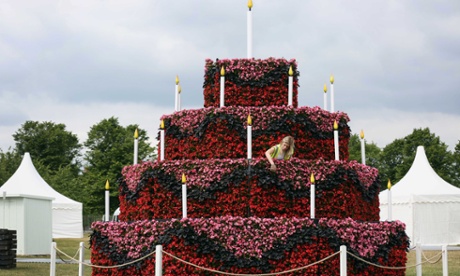
The climate was already proving challenging. Such was the intense heat, exhibitors were having to water twice a day instead of once. The new turf laid in a 25th anniversary maze, linking to the famous maze in the Hampton Court Palace grounds, was in danger of drying out without frequent irrigation throughout the day. A towering floral 25th birthday cake – a vivid creation of 3,456 red begonias and ipomoea – was plumbed directly into the site’s system, timed to be watered for five minutes every six hours.
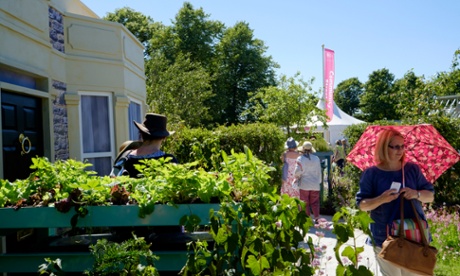
Parasols and sun hats were flying out of the Royal Horticultural Society’s shop. The society’s head of retail, Michael Rodberg, had 1,000 parasols on back order to refill his shelves, while a consignment of popular hats was on its way, too. “We’re well prepared – I hope,” he laughed. Every scrap of shade was utilised by the 14,000 visitors through the gates on Tuesday.
Over the course of this week, 140,000 visitors are expected to pass through the gates.
Hampton Court Palace flower show attracts world-class designers, but lacks the social cachet of Chelsea. Its charm lies in its accessibility, said the show’s manager, Dave Green. “Because there is a bit more space, people can build bigger paths. At Chelsea, you have to stand back and admire from afar. Here, you can have much more fun, get involved and enjoy it instead of being too scared to touch.”