Experts have said measures that can reduce the spread of the novel coronavirus risks in "Japan's nightlife areas," including bars and restaurants, will be the key to preventing another wave of infections, something likely to occur between now and the upcoming winter season.
The reason they are crucial is because the second national wave of infections occurred in July and is believed to have been triggered by cluster outbreaks in entertainment districts in Tokyo, including among workers who come into close contact with customers at bars and clubs.
The government is working furiously to come up with concrete measures that will thwart a third wave of infections, but there are an abundance of challenges.
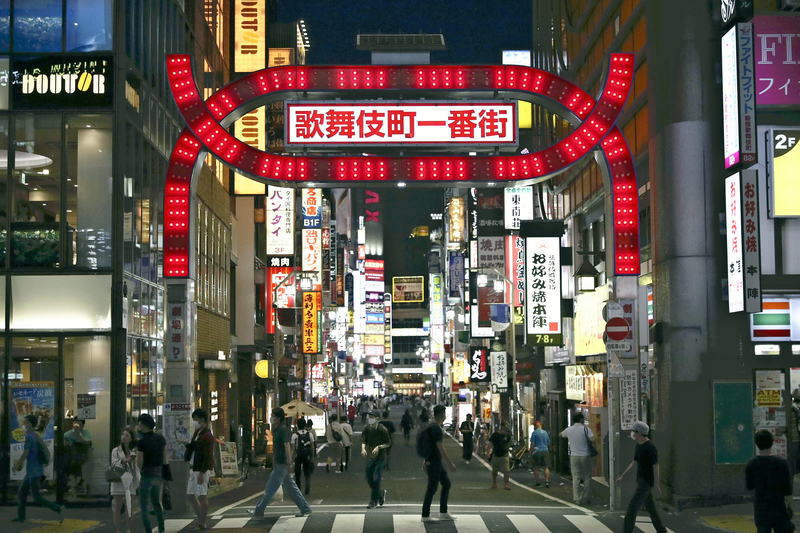
Kabukicho in Shinjuku Ward, Tokyo, is considered the major nightlife area in the country. A high number of infections was confirmed in early June at a host club there.
All the conditions for workers in those types of clubs make up a high-risk environment featuring the 3Cs -- closed spaces with poor ventilation, crowded areas and close-contact setting -- as hosts create a lively atmosphere by speaking loudly and staffers go home together to shared living quarters.
While the number of new infections is down considerably elsewhere in the country, there was a slow but steady rise in the number of cases in Tokyo, initially in nightlife areas.
For business operators in nightlife districts to implement measures, there have been distinct difficulties among the different establishments.
A man in his 30s, who manages a host club in Kabukicho, said he feared the business would have to suspend its operations.
"I ordered my employees not to identify themselves as working as hosts when infected with the coronavirus or asked at public health centers."
Said an official at Shinjuku Ward's public health center, which traces possible links in cluster infections: "There are many cases in which those working in nightlife districts would not respond to our inquiries, as they would say they were unemployed when we questioned them about their place of work."
The central government and the Tokyo metropolitan government also embarked on extending their support to the local public health center, which grew extremely chaotic while handling cluster infections, only to send these frontline public health officials into confusion because of failure to coordinate their efforts.
The infection spread throughout the country in July. Norio Omagari, director of the Disease Control and Prevention Center of the National Center for Global Health and Medicine, pointed to the first cases of coronavirus.
"The place that started off the [nationwide] spread of infections was in a nightspot area of Tokyo," Omagari said.
Analysis said from there, the virus spread to neighboring areas, other entertainment districts, and made its way to families and workplaces before spreading further to places such as hospitals and nursing-care facilities for elderly people.
-- Timely, large-scale PCR tests
The government's subcommittee on coronavirus measures considers the measures against the infection to be taken for entertainment districts in major cities as a top-priority task to prevent a third wave of infections, expected to hit between now and the winter season.
It established a working group in September and started examining the efforts being taken at various places in the country.
In the Matsuyama district, an entertainment area of Naha, where the infection spread at the end of July, large-scale free PCR tests -- which determine whether an individual has the virus -- were conducted on Aug. 1-2. The efforts serviced about 2,000 people, including those working at restaurants where the staffers come into close contact with customers.
Eighty-six who tested positive for the virus were either asymptomatic or had mild symptoms and were later placed in quarantine or isolated at hotels and other locations.
"We were able to stem the spread of the infections by taking a measure quickly," said Yoshihiro Takayama, a doctor at Okinawa Chubu Hospital in Okinawa Prefecture who took the lead in the large-scale tests.
Shinjuku's local government has repeatedly held talks with proprietors of host clubs in the ward and urged them to have their employees undergo the tests vigorously if they are suspected to have been infected while making it a condition that the name of their establishments would not be made public even when there are infected cases found as long as they have taken necessary measures properly.
More than 2,700 people, including those working at typical eating and drinking establishments as well as hosts and hostesses, underwent tests for the coronavirus between June and September. The number of infections, which totaled about 590 in July, dropped to as few as 23 in September.
Maki Tezuka, 43, runs a host club and worked to link public administrators with hosts to help curb infections.
"We were able to team up as both of us like Kabukicho and were able to share the wishes of making it as a locale where people can come with peace of mind," he said.
The working group will expedite its efforts to come up with effective measures, including developing key bases where those involved in nightlife areas can seek advice and gain immediate access to tests for the virus.
-- Challenges continue to mount
Still, there are difficult obstacles in making such efforts into a reality. Even in Kabukicho, where a symbiotic relationship has been built up between public administrators and business operators, those host clubs that have promised to have their employees undergo tests account for only half of the about 240 such businesses.
The city government of Yokohama started PCR tests for 841 such establishments in July, but so far only eight businesses have cooperated, with only 168 workers having undergone tests.
Also important are measures to be taken to prevent detrimental effects on businesses from rumors of infections at such places. In Kabukicho, where many infections were detected through mass testing, thanks to the cooperation of host clubs, the image of its being "an infection town" has taken hold, causing ill effects as significant as a decline in the number of customers at eating and drinking establishments.
Said Kenichi Yoshizumi, mayor of Shinjuku Ward: "We were able to curb the infections, thanks to the cooperation of hosts and others." But he racked his brain over the difficulty in taking measures against the infectious disease in the entertainment district, adding, "The figure, which makes a huge impact, has taken on a life of its own. It has given birth to fear of Shinjuku and public feelings of discrimination against it."
--Control of cluster sizes critical
Cluster outbreaks of the novel coronavirus are beginning to diversify in terms of origin.
The Cabinet Secretariat categorized the locations of the outbreaks nationwide in July, reporting 53 cases occurring in the workplace, 35 cases at educational institutions and 31 at dining establishments.
The average figures for those infected per case were 4.0, 6.7 and 4.0, respectively.
There was a cluster at an educational facility at which 41 people were infected.
According to the National Institute of Infectious Diseases, clusters have recently broken out at cram schools, construction sites and food factories in the Kanto region.
NTT Docomo Inc. said a cluster of infections broke out in Sapporo at a call center in late August. An outsourced employee exhibited symptoms such as coughing and fever and later tested positive. About 500 employees who came in contact with the employee were also tested and 27 of them were found to be infected.
The call center resumed operations in mid-September following a temporary shutdown. It is now taking measures to avoid crowding and closeness such as halving the number of workers at the workplace. However, prior to the outbreak, the center had made sure that its employees wore masks and the workplace was thoroughly ventilated.
Weeding out those infected is a difficult task, so it is important to limit the size of clusters as much as possible.
"If you are experiencing cold-like symptoms, suspect that you might be infected and refrain from any outings," said Koji Wada, professor at the International University of Health and Welfare.
"Employer cooperation is also essential. Getting through this winter is important to find a balance between infection prevention and social and economic activities."
Read more from The Japan News at https://japannews.yomiuri.co.jp/