On 12 January 2010, a magnitude 7.0 earthquake hit the Haitian city of Léogâne, 16 miles from the capital Port-au-Prince. It is estimated that 220,000 people were killed and 300,000 were injured. More than half of the government and administrative buildings, and 4,000 schools, were destroyed or damaged. Members of the Haitian diaspora share their stories of moving on after a tragedy.
Felix-Paul Michaud co-founded Seeds for Change
12 January is my birthday and I was preparing for my party when the earthquake hit. My first thought was that everybody was going to die. It felt like the end of the world because I did not understand what was happening.
After the earthquake, I worked as a carpenter supervisor with the Delaney Bay Fund in Léogâne. We provided shelter for people after the earthquake, and we built houses and furniture for schools. We also started a community clinic and helped to create a business directory for Léogâne.
I co-founded Seeds for Change with my wife, Christa. It had been my dream to set up an organisation since I was a child, but I started to think about it seriously after the earthquake. In the beginning, we didn’t know exactly what it would be called or what we would do. It took some time to figure out those things.
As a grassroots organisation, we work with smallholder farmers and rural communities wherever people tell us they need help. It’s important for us to work with the community and not just go and tell them what they need to do. Haitians have a lot of good ideas and we know our country. We need people to listen to those who can help to show us the way.
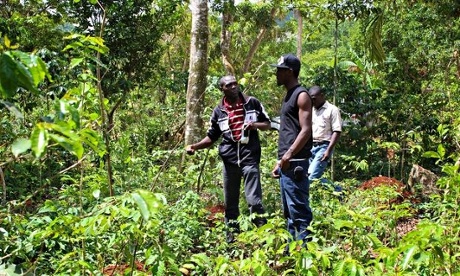
Agriculture is important in Haiti. In my community, we always have a garden to grow vegetables to eat and sell in the market. That’s how we survive. But now some people are cutting down the trees – they don’t have respect for the environment. But there is great international demand for the things we grow in Haiti; coffee, cacao, mango, banana. If we can teach people how to improve production and show them the long-term economic benefit then maybe they will stop cutting down the trees and earn enough money to send their kids to school, to have a good house, and to buy land. I think it’s important for young people to see that agriculture can be a good way to make a living.
I always wanted to do something to help others. I see my mom and aunt suffer a lot and work hard to give me a better life. Everyone should have the same opportunity to give their family a chance.
We have made a great deal of progress in a short time. The biggest challenge we have is finding money for the projects but we are not going to give up our dream. I was born and grew up in Haiti and although I now divide my team between Haiti and the United States, Haiti is my country and it will always be my home, not matter where I go in the world.
Rachel Pierre-Champagne set up Brac International’s Limb and Brace Centre
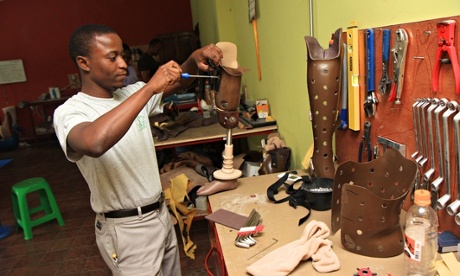
In the months after the earthquake, the need for a dedicated prosthetics and orthotics centre in Haiti was evident. At the time no one really knew the number of amputees or those with severe back and neck injuries, but now we know that about 4,000 amputations were performed in the weeks and months after the earthquake. According to the World Health Organisation, 800,000 people in Haiti live with some form of disability, 200,000 of whom are children.
I was working for a non-profit in New York at the time of the earthquake. I noticed my phone ringing but I had no idea why my friends kept calling me. It wasn’t until I checked my messages that I realised what had happened. Nearly all of my family lived in the US or abroad so it was a relief that no one I knew was hurt, but I was still in serious shock.
I heard about a man using Twitter to help respond to the emergency by collecting clothes and goods around Manhattan. I collected what I could, contacted him and he came to collect the donation. I thought that if he could do this, I should see what I could do as well. I got in touch with my friend Susan Davis, the president of Brac USA, and one month after the earthquake I arrived in Haiti to work in the response team as an assistant to Aminul Alam, the executive director.
We met with development officers, ambassadors, UN officials, NGO representatives and Haitian government leaders. We visited Léogâne – 90% of which had been destroyed – and downtown Port-au-Prince looked like a war zone. By mid-February the government had made a concerted effort to collect cadavers so I didn’t see any in the streets by the time I was there.
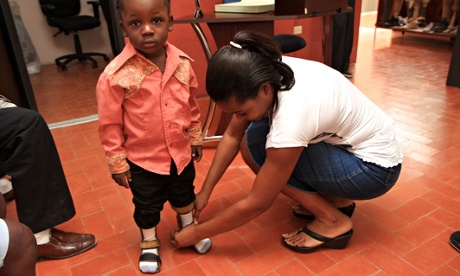
It wasn’t easy to get things done in those days but fortunately we were able to do everything to help Brac’s Limb and Brace Centre (BLBC) complete its registration as a foundation; we found a facility to operate the clinic, brokered a memorandum of understanding with the secretary of state for people living with handicaps, and hired the first few Haitian staff who would be trained by Bangladeshi expats. After seven months of preparation the centre opened in September 2010.
The BLBC serves as a referral center for patients in need of prosthetic and orthotic devices. As one can imagine, children are forever growing so they need continual upgrades and adjustments to their devices. As well as measuring, building and forming the devices on site, the centre provides counselling and physiotherapy to patients. One of the first and most memorable patients I met was a young girl named Renalde. She was nine years old when she lost her leg from leaping off the roof of her house as it was collapsing below her. During her time at the centre she remained so happy and spirited; singing songs and dancing her heart out despite the fact she was using a new prosthetic – most people would take months to get used to that.
The centre has treated more than 3,600 patients and it’s now fully managed by Haitian staff. Although I wasn’t there to see the clinic open its doors I am proud to have been part of a successful, but not easy feat.
The earthquake was a tragedy but you can see that so much has already improved. There is a new international airport in Cap Haitien, there are more paved roads in and around the capital and in the provinces, the price of housing is starting to go down, and there are parks and public spaces as well as government service programmes to keep the capital clean.
Disaster preparedness leaves much to be desired, though. I feel that those within political spaces have forgotten that there was an earthquake five years ago. The focus has been shifted from the general welfare and development of Haiti towards a power struggle amongst a few. I am certain that any documents drafted on disaster preparedness have been filed away in someone’s cabinet. The challenge is the ongoing effort to spread information and train local leaders so that every citizen is prepared if an earthquake hits again.
Read more like this:
-
How to ... mobilise a diaspora movement
- Ebola: the story of the Sierra Leone diaspora response no one is telling
-
Diaspora groups as development actors: levelling the playing field
Join the community of global development professionals and experts. Become a GDPN member to get more stories like this direct to your inbox.