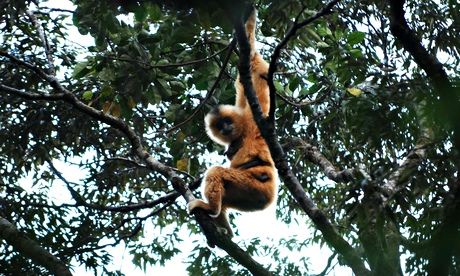
Scientists are racing to save a critically endangered ape species that lives only in the rainforests of southern China’s Hainan island. With 25 known individuals remaining, a disease outbreak or a strong typhoon could “massively impact” the species’s chances of survival, the scientists say.
Samuel Turvey, a senior research fellow at the Zoological Society of London, said the Hainan gibbon was “definitely the world’s rarest ape species, the rarest primate species, and one of the rarest mammal species. They’re kind of clinging on, literally and metaphorically, to patches of forest in the mountains which people haven’t gotten around to cutting down yet.”
He said both the species and its habitat were protected under Chinese law, but “the population is so low now that simply removing the threat isn’t enough … If by chance one or two of them die from disease, or a typhoon, their chance of recovery [would be] massively impacted.”
Turvey added: “The Hainan gibbon can become one of the world’s conservation success stories if everyone works together and the right steps are carried out.”
Hainan is China’s smallest and southernmost province, an island of rainforests, mountains and sandy beaches in the South China Sea. The gibbons – gangly creatures with small black faces and thick beige fur – live in the Bawangling national nature reserve, a 26 sq mile swath of rainforest more than 120 miles from the provincial capital, Haikou.
The reserve was home to more than 2,000 gibbons in the late 1950s, but poachers and loggers slowly encroached on the area, leaving only 30 or so left by 1980, when the Chinese government declared the park a protected area.
Greenpeace China’s forest campaigner Wu Hao said the island – one of China’s most biodiverse regions – lost 72,000 hectares of rainforest between 2000 to 2010, mostly to make way for rubber and paper plantations. “The plantations are still there, which is actually still a big problem for the nature reserve, for the gibbon and for other species,” he said.
In March, Turvey helped to organise a meeting attended by more than 100 experts – government officials, businesspeople, NGO workers – at an international forum in the Hainan town of Bo’ao.
“Firstly, we need to better know what’s happening on the ground in Hainan,” said Turvey. The gibbons often break from their social groups in adulthood, lowering the chances that they’ll reproduce. “We want to use visual monitoring, bioacoustics, things like that to get a more robust picture of what’s happening to these individuals, why they’re not forming social groups,” he said.
Experts are also searching for individual gibbons that might inhabit far-flung patches of forest, where none have been previously observed. “Every one of those gibbons is worth its weight in gold for conservation,” he said. “The more gibbons there are left, the greater the chances that we can recover this population.”