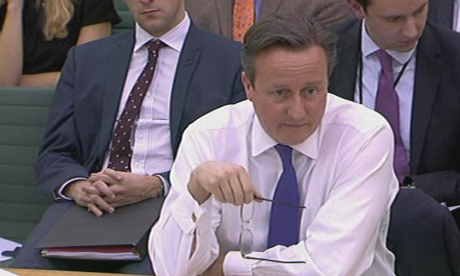
Cameron at the liaison committee - Summary
- Cameron says that a Sydney-style terrorist attack could happen in Britain “at any moment”. This is what he said when Keith Vaz asked him how close Britain was to that kind of attack.
The threat we face definitely includes those sort of self-starting, sometimes quite random attacks that could happen at any moment in Britain. We’ve seen, over the last few months, there have been a series of plots that have been detected and prevented that would have seen police officers, or other authority figures, murdered in cold blood, as Lee Rigby was murdered in cold blood. It is thanks to the brilliance of our policing and security services that these things have been prevented.
We can’t count on them to prevent it every time because it is one thing understanding the terror networks coming out of Pakistan or Afghanistan or Iraq and Syria, trying to monitor what they’re doing, who’s going and who’s returning. That’s one thing. But people who are self-radicalised on the internet, who then suddenly do appalling things, that is much more difficult to prevent.
-
He said the government had not done enough to challenge the narrative that draws people towards extremism. This is what he told Vaz.
If you are saying we are not doing enough to challenge the underlying narrative that has been the starting point for some people to be seduced from a moderate Islam approach to something that accepts the narrative of the extremists, I agree with you.
-
He said he was opposed to any more onshore windfarms. Confirming that the Tories would scrap subsidies for onshore windfarms after 2015, he said the public were “fed up” with them and that he did not expect any more to be erected without subsidy.
On onshore windfarms, I think the public are, frankly, fed up with so many windfarms being built that won’t be necessary. Now we’ve reached some 10% of our electricity by onshore wind, we don’t need to have more of these subsidised onshore. So let’s get rid of the subsidy, put them into the planning system and, if they can make their case, they can make their case. I suspect they won’t. And we’ll have a reasonable amount of onshore wind, we will have safer electricity supplies as a result, but enough is enough. I’m very clear about that.
That’s all from me for today.
Thanks for the comments.
Cameron says Cobra, the emergency committee, takes advice from scientists.
But it does not simply do what they say. There is a need for politicians to take political decisions beyond that, he says.
And that’s it.
I’ll post a summary shortly.
David Cameron says world did not respond quickly enough to Ebola outbreak and says "World Health Organisation does not function very well".
— Patrick Wintour (@patrickwintour) December 16, 2014
Q: What would you do if another country, like Pakistan, refused to take back someone considered a threat?
Cameron says the prisons are full of people he would like to return to their home country. So he believes in being “pretty tough” on this.
Keith Vaz goes next.
Q: The Sunday Times recently reported that passports were removed from 22 people, the entire family of someone suspected of terrorism involvement abroad. Is that the kind of thing the government will be doing?
Cameron says he does not know the details of this case. But he has confidence in what Theresa May is doing.
The police need a suite of powers to keep us safe, he says.
Sir Alan Beith, the chair of the justice committee, is asking questions now.
Q: Are we able to recruit enough Imams to serve in jails, to counter extremism there?
Cameron says his understanding is that they are.
Cameron says UK has done five times as much bombing of IS in Iraq as France
— James Tapsfield (@JamesTapsfield) December 16, 2014
This hearing has been shown on C-SPAN in the US.
British Liaison Committee w/ British PM @David_Cameron on Climate Change – LIVE on C-SPAN http://t.co/nkjZ33k3PB pic.twitter.com/myN1IohBmD
— CSPAN (@cspan) December 16, 2014
At the moment @JonelleHenry of @cspan is giving better coverage of @David_Cameron at the Liaison Committee than any UK counterpart.
— Mark Fox (@MarkFoxNews) December 16, 2014
Rory Stewart, the Conservative chair of the defence committee, goes next.
Q: To what extent is destroying Islamic State (Isis) in Iraq and Syria a priority?
It is a priority, he says. This is a terrorist body that runs a state, has weapons and has land.
We will not deal with the problem of tackling the terrorist narrative unless we fight Isis, he says.
Cameron says the new government bill saying public bodies have a duty to combat extremism will make a big difference.
Vaz turns to the dark internet.
Q; Shouldn’t you set up something like the Internet Watch Foundation, to allow people to report dark internet sites?
Cameron says the internet companies have become much better at dealing with child abuse images. They have blocked 10,000 search terms, and Google searches related to abuse have gone down 80%.
They have been slower at dealing with terrorist material on the web, he says.
Q: We don’t seem to have stopped people becoming radicalised.
Cameron says he agrees that the government has not been able to counter the extremism narrative.
But a lot has been done, he says.
We need everyone to rise up and say this is not acceptable, he says. When he makes this point, he is not getting at Muslims.
Q: I represent 15,000 Muslims. The problem is caused by a tiny minority.
Cameron says it is a minority of a minority of a minority.
Q: What is your message to people like the mother of Yusuf Sarwar, who cooperated with police when her son went to fight in Syria and then saw him sentenced to 12 years.
Cameron says he was not in the court room, so he cannot comment on all the evidence.
We have to allow the police and the prosecution service to work, he says.
Keith Vaz, the Labour chair of the home affairs committee, is asking the questions now.
Q: How important is this in your overall priorities?
Cameron says his twin priorities are economic security and national security. This is part of national security.
If you go back and look at his old speeches, the need to challenge extremism is an issue he has always raised.
Q: How close are we to a Sydney-style attack?
Cameron says the threat we face definitely includes the possibility of a random attack from a self-starter.
Plots to attack police officers have been thwarted, he says.
It is hard to prevent attacks from people who have been “self-radicalised”.
Cameron says he set up an extremism task force.
He likes bringing ministers together to work on a subject, he says.
Of all the things he’s done, he thinks this has been moderately successful.
The energy section of the hearing is over. Now the committee is tacking radicalisation.
Cameron says it is only when communities see other communities benefit from fracking that they will come round to supporting the idea.
David TC Davies, the Conservative chair of the Welsh affairs committee, is asking the questions now.
Q: Would fracking be allowed in national parks?
Only in exceptional circumstances, he says. But he says the government has not said what those might be.
He says he understands how concerned people are about fracking. That will only change when they see what it is like when it actually happens.
Updated
Cameron says the green groups do not want to hear anything good about shale gas.
Cameron says the shale gas industry has already committed that every site will have an environmental impact assessment.
Cameron says some of the green groups are opposed to shale gas because it is gas. They cannot bear the fact that it is a carbon fuel. They oppose it with a religiosity that is just wrong.
Cameron "I find some green groups are opposed to shale gas with a religiosity that is wrong. They cannot bear another carbon based source".
— Patrick Wintour (@patrickwintour) December 16, 2014
Updated
Cameron says one fracking well uses less water in its lifetime than a golf course uses in a month.
“Interesting fact,” he says.
Q: You are asking the public to take a lot on trust. Why was the shale gas report published by Defra so heavily redacted?
Cameron says he will look at that.
Going back to McIntosh’s question about self-monitoring of seismic activity, he says this does happen. But companies lose their permits if they do not report activity.
This is not an industry subject to under-regulation, he says.
Anne McIntosh, the Conservative chair of the environment committee, goes next.
Q: Will you put an end to the self-monitoring of fracking companies?
What do you mean.
McIntosh mentions a fracking company that carried on fracking after a minor earthquake.
Cameron says he thinks a robust system is in place already.
We need a sensible debate, he says.
When he looks at some of the emails .... Cameron tails off, but he implies that people raise unreasonable fears.
We need more myth-busting, he says.
David Cameron says he expects Australia will want to do more on climate change and will not want to be "the back marker".
— Patrick Wintour (@patrickwintour) December 16, 2014
Andrew Miller, the Labour chair of the science committee, says many of his constituents work for high-energy firms. But the government also wants to cut energy use.
Q: Do you agree that science is not finished until it is communicated?
Yes, says Cameron. He says he tells scientists he values the work they do. They are good at busting myths.
Cameron tells MPs he wants to end myths eg "fracking would be a disaster for the environment" or that GM leads to "fish-flavoured tomatoes".
— Jim Pickard (@PickardJE) December 16, 2014
But they should communicated these messages, because they are trusted more than politicians, Cameron says.
Cameron says he believes in cutting carbon at the lowest cost.
There have been disagreements in the coalition, but not huge ones.
The public is fed up with onshore wind farms, he says. He wants to cut their subsidy. Enough is enough, he says.
David Cameron: "The public are fed up with so many wind farms on-shore. Enough is enough and I am very clear about that".
— Patrick Wintour (@patrickwintour) December 16, 2014
Updated
Sir Malcolm Bruce, the Lib Dem chair of the international development committee, is asking the questions.
Q: Why is the £720m for the Green Development Fund coming from the aid budget? That’s not new money, because it’s from the aid budget.
Cameron says it is money that wasn’t in the Green Development Fund but is now.
Cameron says there is an argument in the aid world as to whether you should help the poorest people, or the poorest countries.
He favours helping the poorest people in the poorest countries.
Cameron says the Green Investment Bank should be the “first investor”.
There are plenty of other investors, like pension funds, also keen to invest in energy.
Adrian Bailey, the Labour chair of the business committee, goes next.
Cameron says he recently asked energy investors if Britain was a good place to invest, and if it offered long-term security. They said it was a good place to invest, he says.
The Green Investment Bank has plenty more spending to do.
Q: The problem seems to be that it is not spending enough.
Cameron says it has spent £1.6bn of the £3.8bn available.
Energy companies are very positive about investing in the UK.
Cameron says renewables in the pipeline will generate 10 per cent of UK energy: "Frankly I think that is enough for reasons of balance."
— Jim Pickard (@PickardJE) December 16, 2014
Cameron says the government is not subsidising fracking with a guaranteed price per hour.
It is a nascent industry. What the government is doing is giving it a tax break to help it get going.
The way you tax a new industry is different from the way you tax an existing industry, he says.
Joan Walley, the Labour chair of the environmental audit committee, is asking the questions.
Q: Don’t you accept that new nuclear power stations are being subsidised by the government?
No, he does not accept that, Cameron says.
The government wants to cut carbon emissions, but also to have a secure energy supply.
As part of that, it is right to have the regeneration of the British nuclear industry.
Without that, and without oil and gas, we would be in real trouble. The sun does not shine enough in this country, he says.
He says any subsidy is offered through a guaranteed price. But the price guaranteed for nuclear power is higher than the price guaranteed for wind power.
Cameron says the North Sea is a valuable industry for the UK. He hopes that carbon capture and storage will come about, so he hopes that gas will play a part in energy production for a long time.
Without gas, the country would have to rely on subsidised renewable energy and very expensive nuclear power.
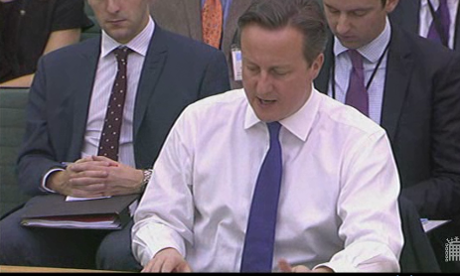
Cameron started his evidence by paying tribute to those killed in the attacks in Australia and Pakistan.
@David_Cameron begins session at Liaison Cttee paying tribute to those caught up in events in Australia and Pakistan
— BBC Parliament/DL (@bbcdemlive) December 16, 2014
"There is no belief system in the world that can justify" #pesharwarattack says David Cameron
— norman smith (@BBCNormanS) December 16, 2014
David Cameron says west now engaged in "struggle of our generation" following #pesharwarattack
— norman smith (@BBCNormanS) December 16, 2014
"The scale of what has happened in Pakistan simply defies belief, it's a dark dark day for humanity" David Cameron tells MPs
— Emily Ashton (@elashton) December 16, 2014
Tim Yeo, chair of the energy committee, goes first.
Q: Do you expect to continue with the carbon budget process?
Yes, says Cameron. A new decision is due by 2016.
But, he says, his only reservation is about keeping costs down. He does not know yet what new technology will become available.
David Cameron at the liaison committee
David Cameron is about to give evidence to the Commons liaison committee.
According to the committee, these are the issues due to come up.
Climate Change and new energy sources and technologies
The issues likely to be raised include:
· National carbon budgets and pricing
· Energy subsidies
· Green investment bank powers, the Green Deal, and policy co-ordination and stability
· The International Climate Fund and the Green Climate Fund
· Communication of climate science and risk
· Exploiting shale gas and fracking
· Local employment and skills
· Exploration and assumptions
· The impact on the landscape.
Radicalisation
The issues likely to be raised include:
· The Prime Minister’s Task Force on tackling radicalisation and extremism
· The Prevent Strategy and the Channel programme
· Terrorism Prevention and Investigation Measures
· Extremism in schools
· Foreign Fighters
· Radicalisation in Prisons
· Temporary exclusion from the United Kingdom
English votes for English laws - Summary and analysis
- William Hague, the leader of the Commons, has published a short command paper backing the principle of English votes for English laws (Evel) but revealing how little agreement there is within government about how it should happen. The paper only runs to 33 pages, and almost half of it relates to devolution measures already taken by the government that do not relate to Commons voting procedures. The paper proposes four Evel options (see 1.29pm), three Tory ones and one Lib Dem one, but does not say which David Cameron prefers. Hague has said that he wants a debate and vote on this next year, but he gave no indication today what MPs would actually vote on.
- The Conservatives have marginally firmed up their commitment to Evel. All three options would effectively give English MPs a veto over English-only legislation. (One is just described as giving English MPs “the decisive say”, but the difference between having a veto and having the decisive say is not clear). Previously one option has been the approach set out last year in the report from the McKay Commission. The commission floated several options, all of which involved English MPs voting on English-only matters, but the House of Commons as a whole having the last word. This approach was intended to encourage compromise where English MPs and the Commons as a whole disagreed. But Hague said all three Conservative options were “stronger and more binding” that what McKay proposed.
- Conservative MPs have warmly welcomed the principle of English votes for English laws. But, during Hague’s statement in the Commons, most of the Tory MPs who spoke out in support did not say which of the three Conservative versions of Evel they supported. It is not at all clear which of the options would attract most support in a Commons vote.
- Sadiq Khan, the shadow justice secretary, has reaffirmed Labour’s support for a modest version of the McKay plan. But he also accused Hague of a stitch up.
- Constitutional experts have urged the government to proceed cautiously.
-
David Jones, the Conservative former Welsh secretary, has expressed concerns about the impact of Evel on Wales. He said it would be “wholly wrong” to stop Welsh MPs voting on English matters that concerned them. Many people in Wales were heavily reliant on English services, he said. Addressing Hague he said:
Would you agree with me it would be wrong to equate the positions of Wales and Scotland? Do you as a former secretary of state for Wales himself acknowledge that large numbers of people in Wales are heavily reliant on services delivered in England and therefore it would be wholly wrong if the representatives of those people were to be denied a voice on issues which so clearly concern them?
Hague conceded this was an issue. He said it was addressed in the command paper.
Updated
Labour’s particular fears about the consequences of its introduction are greatly exaggerated. Were it to form, or be part of, a government made up of different parties in the next parliament, it is possible that Labour might, on some occasions, have to refine its legislative programme in the face of English opinion in the Commons. But what exactly is the democratic argument against it – or any other, UK government – having to do exactly that?
On the Daily Politics Lord Heseltine, the Conservative former deputy prime minister and prominent pro-European, predicted that one day Britain would join the euro.
We will join the euro. It is not [the view of the Conservative party]. It is a very personal view, which the establishment party wouldn’t agree with. If I have to parade my conviction; I have lived through every one of these European arguments where we have resisted at every stage the European direction, and in every stage we in the end have given in and joined.
I’ve taken the quote from PoliticsHome.
Updated
And the Green party are calling English votes for English laws “a cynical power grab by the Conservatives”. This is from a party spokeswoman.
“English votes for English laws” is rightly seen as a rushed solution, designed to appease the core Tory vote unsettled by the questions thrown-up by the Scottish referendum debate. That is why the Green party are calling it for what it is: a cynical power grab by the Conservative party.
The Scottish referendum shook the ground of politics in Britain yet the current proposals fail to address the fundamental issues raised during the campaign: voter disillusionment with business-as-usual Westminster politics and the democratic deficit that has emerged between parliament and the people. That’s why the Green party would push for whole-sale constitutional reform that includes greater powers for local and regional governments, total recall for MPs, a written constitution and electoral reform.
Plaid Cymru, the Welsh nationalist party, has issued its response to the English votes for English laws proposals. While it is in favour in principle, it thinks Wales needs further devolution. This is from Jonathan Edwards, a Plaid MP.
English votes for English laws seems reasonable. When considering the options put forward in the Command Paper, two key issues must be addressed.
The first is whether Welsh MPs are prohibited from voting on English measures that will impact on the Welsh budget. Clearly this would be unjust. With this in mind, some of the options in the Command Paper are more problematic than others.
Secondly, under any move towards English Votes for English Laws there will be a requirement to move towards a symmetrical devolution settlement where the four constituents parts of the British State have the same powers.
Without this, English Votes for English Laws would be very difficult to enforce due to there being several tiers of MPs.
Plaid Cymru believes in the simple principle of parity. By failing to address the mis-match between powers and funding in various parts of the UK, the Westminster parties are treating Wales as a second-class nation and will be judged for it at the ballot box in May.
The Constitution Unit, a research group based at University College London, has also said that the government should not rush into English votes for English laws (Evel).
This is from Professor Robert Hazell, its director.
The hard liners who want a complete English veto are playing with fire. Given the complexities, this cries out for a gradualist approach. All four commissions which have looked at this have recommended a soft version of Evel: allowing a greater English voice, but not an English veto. A softer version also reduces the risk to the Speaker, who will have to rule on what is and what is not an English law. The technical difficulties and the political risks all point towards taking this gently, and initially trying EVEL out on an experimental basis.
And this is from Professor Meg Russell, its deputy director.
There’s a real risk that the two main parties use this serious question as a political football in the run-up to the general election, with each defending a position that suits their own electoral interests, and seeking to embarrass the other. But such a key matter about the future of the UK’s political system instead deserves cool-headed nonpartisan consideration - involving voices beyond the parties, and citizens themselves. Labour’s constitutional convention idea would do this, but not start for months, and be too wide-ranging. The government should open up an inclusive conversation, on an adequate timetable, starting now.
The Electoral Reform Society has put out a statement saying, instead of having a vote on the English votes for English laws plans, the government should back a proper constitutional convention. This is from its chief executive, Katie Ghose.
The government has presented a shopping list of solutions to the English Question, demonstrating that even within the coalition they cannot agree on which solution is best. But that’s not surprising – the chances of cross-party agreement on such a partisan issue are never going to be very high.
In any case, trying to tackle a single constitutional issue in isolation is never going to answer all of the questions currently facing the UK, such as how power should be shared between the nations and regions, and to what extent power should be devolved to the local level.
There is a better way to approach this problem, one which doesn’t involve politicians squabbling behind closed doors as they drift further and further away from the public. A constitutional convention, giving citizens the lead in determining where power should lie, is the only way to make sure the UK reaches a lasting and legitimate settlement. And it’s the only way to untangle some of the intractable problems surrounding the English Question without descending into partisan bickering.
Four of the five largest UK-wide parties are signed up to a citizen-led constitutional convention to decide how the UK should be governed, including addressing the English Question. It’s time the Conservatives went beyond being ‘open’ to this idea and recognised the overwhelming support for giving citizens a say in where power should lie.
This is what MPs are saying about William Hague’s plans on Twitter.
From Labour MPs
Hague circumspect on excluding Welsh MPs from "English Laws". What is an English Law?
— Ian Lucas (@IanCLucas) December 16, 2014
Tories playing cheap politics on the Constitution - from Cameron on September 19th to Hague's dissembling today.
— Ian Lucas (@IanCLucas) December 16, 2014
Hague takes 10mins to tell Commons his committee hasn't actually agreed anything.
— John Denham (@JohnDenhamMP) December 16, 2014
We could have agreement on English devolution, elected second chamber and EVEL. Hague's partisan approach puts it all at risk.
— John Denham (@JohnDenhamMP) December 16, 2014
Raised with Hague decisions on spending/taxes by HoC affect debt & interest rates across UK so Scots MPs should vote on Budget/Finance Bill
— William Bain (@William_Bain) December 16, 2014
I have no say on Transport for London but can vote on transport in Yorks constituency of W Hague #theIlfordSouthquestion
— Mike Gapes MP (@MikeGapes) December 16, 2014
EVEL will accentuate diffferences and deepen divisons between the 4 nations and accelerate the break-up of the UK.
— Paul Flynn (@PaulFlynnMP) December 16, 2014
From Conservative MPs
William Hague wraps himself in the flag of St George and slays the Labour dragon. #EVEL
— Jake Berry (@JakeBerryMP) December 16, 2014
No ifs no buts English votes for English Laws NOW. #EVEL
— Jake Berry (@JakeBerryMP) December 16, 2014
In Chamber listening to William Hague putting forward options for "English Votes for English Laws" Bring it on!
— Therese Coffey (@theresecoffey) December 16, 2014
Why should scots MPs, elected by fewer people than me, vote on things that affect Thurrock when I can't vote on Scots matters. #evel
— Jackie Doyle-Price (@JackieDP) December 16, 2014
80000 electors in my constituency, some in Scotland have 40000. This inequality is quite wrong. Support http://t.co/ypAJvcja0P
— Jackie Doyle-Price (@JackieDP) December 16, 2014
Considerable divergence between the parties over English Votes for English Laws. Basic political justice is at stake.
— Steve Baker MP (@SteveBakerMP) December 16, 2014
From Ukip
Reality is devolving much tax power to Scotland will entrench Barnett formula, not make it less relevant over time as Hague falsely claimed
— Mark Reckless (@MarkReckless) December 16, 2014
This is what Hilary Benn, the shadow communities secretary, had to say about Hague’s plans on the World at One.
Hilary Benn says if PM really wants #evel he shd argue for an English Parliament #wato
— norman smith (@BBCNormanS) December 16, 2014
Labour’s Wayne David asks what consultation Hague has carried out on how a bill would be designated English-only.
Hague says the Speaker does not decide government policy. But, now the government has set out its ideas, he will consult John Bercow about how this could work.
Stephen McCabe, the Labour MP, asks if the Speaker would decide whether a bill was English-only.
Hague says it would have to be the Speaker, or some other impartial authority. It could be a panel of committee chairs.
Asked how many bills in this parliament would be affected by these measures, Hague says “a great many”. That is because these procedures could be applied to parts of bills, not just whole bills, he says.
Jason McCartney, a Conservative, says his constituents tell him that English votes for English laws is a matter of fairness.
Labour’s Kevin Brennan says the Conservative party is morphing into an English nationalist party.
Glyn Davies, a Conservative MP for Montgomeryshire, says almost all healthcare for his constituency is delivered from England. He would be worried about not being allowed a vote on English health matters.
Hague says at least one of the options in the command paper would allow non-English MPs to speak on these matters, and to vote at some stages.
Here are some highlights from the Commons exchanges I missed while I was going through the command paper. (See 1.29pm.)
Jack Straw: can I remind William Hague that it was his party's policy to OPPOSE devolution to Scotland and to Wales
— Chris Ship (@chrisshipitv) December 16, 2014
Jack Straw says #EnglishVotes is "a bigger issue in theory than in practice".
— Robert Hutton (@RobDotHutton) December 16, 2014
.@DavidBlunkettMP asks Hague "Wouldn't it be sensible to take a deep breath and consider these issues for the long term?"
— Paul Brand (@PaulBrandITV) December 16, 2014
Gerald Kaufman: it's not right to call Hague's proposals as a dog's breakfast because any sensible dog would rightly turn up its nose
— Chris Ship (@chrisshipitv) December 16, 2014
Labour's Gerald Kaufman says he will vote against #EVEL no matter which government tries to bring it in - "If it ain't broke, don't fix it"
— Paul Brand (@PaulBrandITV) December 16, 2014
"If it ain't broke don't fix it" says Gerald Kaufman. "It is broke" replies Hague. #EVEL
— Vicki Young (@VickiYoung01) December 16, 2014
We don't want a "rushed political stitchup" says Ben Bradshaw MP. How about a slow one then? #EVEL
— Christopher Hope (@christopherhope) December 16, 2014
It is time "to give the English the voice they deserve", shouts a passionate David TC Davies over Labour jeers #EVEL
— Christopher Hope (@christopherhope) December 16, 2014
Nick Brown calls #EVEL "Tory votes for Tory laws" and asks what are the Tories doing for regional devolution?
— Paul Brand (@PaulBrandITV) December 16, 2014
While criticising #evel Lab Newcastle MP Nick Brown slips in attack on his own party's devolution plans...calling them "superficial"
— Rob Merrick (@Rob_Merrick) December 16, 2014
.@BarrySheerman says "today I feel ashamed of the House" and way it's debating #EVEL - "not one of my constituents has ever been consulted"
— Paul Brand (@PaulBrandITV) December 16, 2014
William Hague says linking EVEL to House of Lords reform would be "a recipe to delay it for a very long time indeed".
— PoliticsHome (@politicshome) December 16, 2014
Labour's @JohnDenhamMP calls Hague proposals 'partial'. Hague responds: Labour can't walk away from cross party talks & call process partial
— Chris Ship (@chrisshipitv) December 16, 2014
Chris Bryant explains what William Pitt would do but William Hague is correcting him, out-Pitting him by at least a Younger
— ann treneman (@anntreneman) December 16, 2014
The 4 English votes for English laws options - Summary
There are four options for English votes for English laws (Evel) in the command paper.
Largely they are what we expected (see 9.13am), but William Hague has already rejected the weakest model of Evel, the one proposed by the McKay Commission. Under all Hague’s plans English MPs would have an effective veto over English-only legislation.
Here are the three Conservative options in the document.
1 - Banning Scottish MPs from voting on English-only laws. This is the most hardline option an this is what the document says about it.
A Bill would be certified by the Speaker as applying to a particular part of the UK.
Where it related only to England or England or Wales, the Bill would have its second reading in a Grand Committee, comprising all the MPs from the relevant nation(s).
The Committee stage would be similarly restricted, and Report and Third Reading would be governed by a convention whereby MPs from other nations did not vote.
Bills that dealt exclusively with English matters already devolved to the other nations would proceed entirely through an English-only process.
Legislation that covered areas which were both devolved and reserved would need to pass through two parallel processes, one for each part of the bill.
2 Allowing English MPs the final say over the details of legislation. This is what the document says about this.
Bills certified as relating solely to English, or English and Welsh matters, would pass as normal at Second Reading.
The Committee Stage would be taken by those MPs only, in proportion to their party representation in the House of Commons.
At Report stage the bill would be voted on by those MPs only
At Third Reading the Bill would be voted on by the whole House.
The command paper says this would give English MPs “the decisive say” over the content of English-only legislation. But in practice it looks like a veto, because bills cannot be amended at third reading. The House of Commons as a whole would have to decide whether to accept the changes proposed by English MPs, or to drop the whole legislation.
3 - Allowing English MPs a formal veto over English-only legislation. The command paper describes this as a “significantly strengthened” version of the McKay Commission proposals that would give English MPs an “effective veto” over English-only measures. It also makes it clear that this would involve English MPs having a veto over income tax rates (because this is a matter that will be devolved to Scotland). This is what the command paper says about this proposal.
Second Reading would be taken as normal by all MPs.
The Committee stages of English or English and Welsh only bills would be taken in Committee only by MPs from those countries, in proportion to their party representation in the House of Commons.
This procedure would also apply to the English or English and Welsh parts of bills that contained both English or English and Welsh only clauses, and UK wide clauses.
Report Stage would be taken as normal by all MPs
An English Grand Committee would then vote after Report stage but prior to Third Reading, on a Legislative Consent Motion. English or English and Welsh MPs would therefore be able to grant their consent or veto a bill, or relevant parts of it.
Such decisions would have the same status as those of the Scottish Parliament on devolved matters. A bill could not pass to Third Reading without passing the legislative consent vote.
Third Reading would be taken as normal by all MPs, but only if the legislative consent motion was passed.
The English Grand Committee could have other functions, including determining the distribution of expenditure within England, such as local government finance or police grants, and it could also have additional questions to Ministers in departments with English only functions.
The principle of requiring consent from an English Grand Committee could be applied to levels of taxation and welfare benefits where the equivalent rates have been devolved to Scotland or elsewhere.
And this is the Lib Dem proposal.
4 - Allowing English MPs a veto over English- only bills - with English MPs voting on a proportional basis. This is what the command paper says about this.
The Liberal Democrat starting point is that for measures which unambiguously affect England only and which are not devolved below the Westminster level, there should be a new parliamentary stage before third reading or equivalent, composed of MPs proportionately representing the votes cast in England to allow them to scrutinise proposals and to employ a veto if they so wish.
Updated
John Redwood, the Conservative, says England wants “simplicity and justice” now. Will Hague speak up for England?
Hague says that he hopes he is speaking for England, and for the whole of the UK.
Hague is replying to Khan.
He says the idea that Labour is leading the debate on this is risible.
For 13 years Labour did not give extra powers to the cities and towns of England.
He says he has discussed the government’s devolution plans with the leaders of Labour councils in England. Labour’s frontbench is out of touch with these leaders. Labour has achieved the feat of being out of touch with themselves, he says.
Hague says the McKay Commission produced a range of options.
But, since further devolution is taking place, is it necessary to have something stronger and more binding.
That is why the Conservatives and the Lib Dems are both proposing binding legislative consent motions.
Hague says the government is “open to ideas” on a constitutional convention.
No one is arguing that the work of the Smith Commission should be delayed while a constitution convention is held.
And, similarly, the English reforms should not be held up while a constitutional convention is held.
Sadiq Khan, the shadow justice secretary, is responding for Labour.
He says the party favours the approach to this set out in the McKay Commission report.
Does the government support Labour’s plans to devolve spending to the regions?
Does the government support the case for an elected House of Lords.
There should be no room for stitch-ups, he says.
Hague has finished his statement. I will post the full details of his proposals when I see the text of the statement, or the command paper.
But it is striking that all three of the options the Conservatives are backing are stronger than the plans proposed in the McKay Commission.
Hague says devolution has created the situation that allows MPs from outside England to vote on English matters, while English MPs cannot vote on matters outside England.
This is the so-called West Lothian Question. Both coalition parties agree it is an issue, he says.
The Lib Dems want English MPs at Westminster to have a veto over English-only issues. Their preferred method for this would involve the single transferable vote. But there is no support for this, so they want members of an English grand committee to be selected proportionately.
Hague says the Conservative still believe that equalised constituency sizes is necessary.
He says the Conservatives have set out three plans for English votes for English laws. All three are stronger than the plans in the McKay Commission report.
The first one would stop Scottish MPs voting on English-only bills. The advantage of this plan is its simplicity. There would be no need for a change to the procedure for dealing with bills.
The second plan would involve only English MPs voting on the amending stages of a bill. This idea was proposed by a commission chaired by Ken Clarke before 2010.
The third plan would involve English MPs voting on English-only matters at an early stage of a bill’s passage through parliament, as well as giving them a veto at a later stage.
Whatever option is accepted must produce fairness for the whole of the UK, he says.
Hague says the government supports localism, but it should not be a way of imposing new taxes.
And Westminster should remain the law-making body for England, he says.
Hague says there have already been significant changes in England, including elected mayors and combined metro authorities. The government has also produced plans for a Northern powerhouse. This represents the biggest attempt to devolve power to northern England for decades.
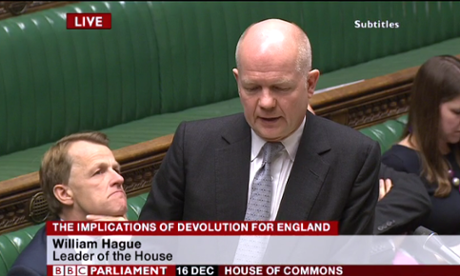
William Hague is making his statement now.
On 19 September David Cameron announced the Smith Commission, to take forward devolution to Scotland. Draft legislation for that will be ready by 25 January, he says.
Hague says the government wants to give the people of England, Wales and Northern Ireland more say over their affairs too.
The Welsh secretary is pushing forward plans to extend devolution to Wales. And the Northern Ireland secretary is pushing ideas for Northern Ireland, including the devolution of corporation tax.
Hague says today he is publishing plans for England.
Labour refused to cooperate.
The talks in Scotland and Wales have been on a cross-party basis. But it is only in England that Labour refuses to take a cross-party approach.
Steve Norris, the Conservative former transport minister, has used Twitter to express his support for English votes for English laws.
Doesn't justice demand that Scottish devolution means English entitled to similar rights? This is not anti-Scot. Simply fair and right. EVEL
— Steve Norris (@StevenJNorris) December 16, 2014
William Hague's statement on English votes for English laws
William Hague, the leader of the Commons, is making his statement about English votes for English laws shortly.
But that is not quite how he is phrasing it. The paper he is publishing is called “The Implications of Devolution for England”.
Lunchtime summary
- Lord Prescott, the Labour former deputy prime minister, has accused William Hague, the leader of the Commons, of a stitch-up by trying to rush through reforms that will restrict the rights of non-English MPs to vote in the House on exclusively English matters. Hague will be unveiling his plans at 12.30pm. I will be covering his statement in detail.
-
Labour has criticised some Lib Dem MPs for backing a government motion defending cuts to firefighters’ pensions after they signed a Labour motion opposing the proposals. The vote took place yesterday, and Labour’s bid to stop the reforms was defeated by 313 votes to 261 - a majority of 52. Afterwards Labour pointed out that some of the Lib Dems who signed its early day motion opposing the plans abstained, or voted with the government.
1/2 Lib Dems who supported @UKLabour motion on #firefighterspensions but then voted against: @duncanhames @johnhemmingmp @markhuntermp
— Labour Whips (@labourwhips) December 15, 2014
2/2 Lib Dems who supported @UKLabour motion on #firefighterspensions but then voted against: @iswales Mike Thornton & @DavidWardMP
— Labour Whips (@labourwhips) December 15, 2014
LDs signed @UKLabour motion #firefighterspensions & abstained Beith Brooke Burstow Campbell Crockhart Gilbert Mulholland Russell & Williams
— Labour Whips (@labourwhips) December 15, 2014
You can read all today’s Guardian politics stories here. And all the politics stories filed yesterday, including some in today’s paper, are here.
As for the rest of the papers, here’s the PoliticsHome list of top 10 politics articles, and here’s the ConservativeHome round-up of all today’s politics stories.
And here are two stories I found particularly interesting.
David Cameron is heading for a confrontation with his own party within days when he announces proposals to limit the power of Scottish MPs.
Conservative MPs warned the prime minister last night that they would accept nothing less than an outright ban on Scottish MPs voting on English issues ...
Mr Redwood said that a majority of Conservative MPs and most voters wanted an outright ban to balance the “lopsided” constitution. “Anything else would be insupportable,” he said.
One of Ed Miliband’s closest advisers has been identified as the person who approved a controversial document advising Labour MPs not to engage with voters on the subject of immigration.
Lucy Powell, vice-chair of the general election campaign, allowed the document revealed by The Telegraph to be sent to dozens of MPs which yesterday threatened to undermine Mr Miliband’s attempts to claim Labour was getting tough on immigration.
The “incandescent” shadow cabinet rounded on Mr Miliband privately as he was forced to distance himself from the controversial 33-page memo by openly criticising the official Labour Party advice.
Frank Field says England should have its own parliament
Frank Field, the Labour MP, has criticised Labour’s policy on English votes for English laws.
The voters recognise weasel words when they hear them. Labour’s offer of a major constitutional convention is a not very skilful attempt to kill the debate until after the votes are counted. This issue, once lost in the long grass, is where, I suspect, Labour will wish to keep it. But Labour has to accept the truth that the bonus that is gained from having Scottish MPs added to the English parliament now has a sell- by-date put on it by the Scottish voters themselves.
In an article for Standpoint magazine, which is not available on the web yet, he proposes a fully federal constitutional settlement for the UK - with England getting its own parliament.
An English assembly or parliament is the only way I see of answering Tam’s West Lothian Question in a manner that re-establishes equity amongst the four countries of the United Kingdom.
Each assembly—for England, Wales and Northern Ireland— should have the powers that have been, or are about to be granted to the Scottish Parliament. The remaining functions would be reserved for a senate (which would replace the present House of Lords). Foreign affairs, defence and the remaining Exchequer pow- ers would be exercised by a senate common to all four nations. This senate, I suggest, should be made up of two types of members. Two hundred and fifty or so would be elected by the voters from new sen- ate constituencies based on between six and seven current parlia- mentary or, as they would be called, assembly constituencies. Each one of these senate constituencies would return a senator. Whether they should be elected on a first-past-the-post principle, or on some other form of proportional representation, should be the basis for further debate. What must be ruled out from the outset would be the current system for EU elections, where the party hierarchy de- cides the order in which the candidates are elected, with voters re- stricted to a choice of voting for a political party but never a person. We must be able to elect our senators and they must be accountable to a known electorate and be known to that electorate.
On Twitter the Conservative MP Michael Fabricant says he supports the most hardline of the four version of English votes for English laws on offer. (See 9.13am.)
Report on English Votes for English Laws (EVEL) due out today. If legislation only affects England, only MPs for English seats should vote!
— Michael Fabricant (@Mike_Fabricant) December 16, 2014
According to the Spectator’s Isabel Hardman, some Tory MPs are meeting this morning to plan how they heckle Labour during this afternoon’s statement on English votes for English laws.
The good news for the Tories is that people favour banning Scottish MPs from voting on English-only matters. But the bad news is that they don’t regard this as a priority.
The cause of stripping Scottish MPs of some of their voting rights seems to be popular. A YouGov survey at the time of the recent referendum found that 72% of English electors want them banned from voting on England-only issues. Indeed 55% would go even further, and so something that no English politician has proposed: stop Scottish MPs from voting on tax and spending decisions.
Yet any party that made a big fuss about this might find the cause not so attractive after all. The danger emerges clearly from the YouGov/Prospect poll. We gave people a list of 18 things that Britain’s government could do over the next few years, and asked them “which four or five do you think are most important?” Despite all the publicity for the issue, and the apparent support for change, curbing the voting rights of Scottish MPs comes half way down the list. Just 23% regard it as one of the main priorities, a long way behind tighter immigration rules, spending more on the NHS, holding down energy prices and increasing the minimum wage.
And here’s a comment on the inflation figures from Cathy Jamieson, a shadow Treasury minister..
These figures show that plummeting global oil prices have led to the rate of inflation falling here in Britain
But wages continue to be sluggish, barely keeping up with rising prices. The latest figures show total pay up by just 1 per cent - the same as today’s CPI figure - and pay excluding bonuses up just 1.3 per cent.
While the Tories deny there is a cost-of-living crisis, the squeeze on living standards since 2010 means working people are on average £1600 a year worse off.
Labour’s economic plan will ensure we earn our way to higher living standards for all, not just a few at the top. Our plan to tackle the cost-of-living crisis and for more good jobs is also a key part of our tough but balanced plan to get the deficit down.
Here’s George Osborne, the chancellor, on the inflation figures.
CPI inflation hits 12 yr low of 1pc. #LongTermEconomicPlan now delivering growth, jobs, low inflation and rising pay cheques for families
— George Osborne (@George_Osborne) December 16, 2014
And here’s a comment from Danny Alexander, the chief secretary to the Treasury.
Falling oil prices have helped push inflation to its lowest level since 2002. This is a welcome early Christmas present to millions of families across the country. And, as the Liberal Democrat Treasury minister, I am determined that the continuing oil price falls will be passed on to consumers as quickly as possible and in full.
It has been confirmed that William Hague is giving a statement to MPs at 12.30pm about English votes for English laws.
Announcing today proposals on decentralisation within England & English Votes on English Laws. Fundamental issue of fairness for all the UK
— William Hague (@WilliamJHague) December 16, 2014
Here is the start of the Press Association story about the inflation figures.
Inflation fell sharply to a 12-year low of 1% in November as lower food and petrol prices kept a lid on the cost of living.
The Consumer Price Index (CPI) measure of inflation dropped more steeply than expected from 1.3% in October, the Office for National Statistics (ONS) said.
It means Bank of England governor Mark Carney only just avoids having to write to chancellor George Osborne to explain why inflation is more than 1% off its 2% target.
But the continuing slide in oil prices is expected to feed through to a further drop in CPI. Carney has already acknowledged that he is likely to have to write to Osborne in the coming months.
CPI has not been as low since September 2002 and was last lower in June 2002. It has now been at or below the 2% target for 12 months in a row.
November’s figures showed food and non-alcoholic beverages fell by 1.7% on last year, the steepest drop since June 2002.
Prices in this sector have been falling year on year for five months in a row - the longest such stretch since 2000 - amid fierce competition between supermarkets under pressure from Aldi and Lidl.
Motor fuel fell 5.9% as average petrol prices dropped by 3p per litre over the month and diesel fell 2.9p, both steeper falls than the same month last year. It comes as oil prices have sunk to a five-year low.
CPI inflation hits a 12-year low, at 1%
Here are the headline inflation figures.
- The rate of consumer price index (CPI) inflation fell to a 12-year low of 1% in November from 1.3% in October.
- The rate of retail price index (RPI) inflation fell to a five-year low of 2% from 2.3% the previous month.
Here is the Office for National Statistics news release. And here is the statistical bulletin with the full details (pdf).
For the record, here are today’s YouGov GB polling figures.
Labour: 34% (up 2 from YouGov in the Sunday Times)
Conservatives: 32% (no change)
Ukip: 14% (down 2)
Greens: 8% (up 1)
Lib Dems: 6% (down 1)
Labour lead: 2 points (up 2)
Government approval: -24 (no change)
According to Electoral Calculus, this would give Labour a majority of 14.
And Labour’s Graham Allen, chair of the Commons political and constitutional reform committee, has also criticised the government’s plans. He said the government should be pushing ahead with proper devolution for England.
The Hague Cabinet committee set up to look at the consequences of the Scottish referendum has instead focused on one tiny Westminster issue and deliberately missed the opportunity to bring planned devolution to England ... Government sees Parliament’s role as delivering for Whitehall not championing devolution to the localities of England.
Our politics is broken, it needs fixing. This is a moment for political leadership, not complacency and business as usual. Focusing on one partisan issue and ignoring the wider historic opportunities smacks of rearranging the green benches on the deck of the Titanic.
On Radio 4’s Today Lord Prescott, the Labour former deputy prime minister, described the government’s English votes for English laws plans as a “stitch-up”.
This is a stitch-up. They can’t get an agreement about it. They are rushing it before the election to make an election claim - English parliament for English MPs.
You can’t divorce England from the rest and make the English parliament a central English parliament without proper accountability to the people as we have given in Scotland, as we have given in Wales and have given in Northern Ireland.
In the interview he also mis-spoke at one point and called Ed Miliband “Red Ed” by mistake.
UPDATE AT 9.42AM: Listening to the tape again, it seems clear that Prescott calling Miliband “Red Ed” was a case of him mangling his words, and not intentional. I’ve amended the sentence above to make that clear.
You can listen to it here.
Updated
Early on Friday 19 September, shortly after it had been confirmed that Scotland had voted to reject independence, David Cameron announced in a statement from Number 10 that he now wanted a better constitutional settlement for England too and that he would stop English MPs being over-ruled on English-only matters by Scottish MPs. In other words, he was going to push ahead with English votes for English laws, or Evel, to use its horrible acronym.
As Nicholas Watt, Severin Carrell and Patrick Wintour reveal today, in the first instalment of their account of the inside story of the independence campaign (it’s excellent), Alistair Darling told Cameron in advance this would be a mistake.
Today we’re going to get a paper outlining the government’s plans. But the initiative has already been hit by problems. William Hague, the leader of the Commons, had to abandon plans to stage a vote on this before the end of November and the coalition parties still can’t agree on what should happen. As a result today’s document is expected to contain four alternative versions of Evel. In broad terms, this is what they are:
1 - Banning Scottish MPs from voting on English-only laws. This is the most hardline option.
2 - Allowing all MPs to vote on English-only legislation, but ensuring the English-only parts can pass if they are approved by English-only MPs. This would effectively give English MPs a veto over English-only proposals.
3 - Allowing English MPs to vote on English-only matters, but giving the final say to the whole House of Commons. This proposal, which was recommended last year by a government commission chaired by Sir William McKay, is intended to ensure that, where there is a disagreement between the English MPs and the House as a whole, a compromise has to be reached. Labour has recently adopted a version of this.
4 - Allowing a grand committee of English MPs to vote on English-only matters, with its members selected on a proportionate basis to reflect vote share at the election. This is the Lib Dem option.
Hague is expected to make a statement about this to MPs at 12.30pm. I will be covering that in detail.
Here is the agenda for the day.
9.30am: Inflation figures are released.
12.30am: William Hague is expected to make a statement to MPs about the government’s English votes for English laws plans.
Around 1.30pm: Steve Webb, the pensions minister, is expected to make a Commons statement about Post Office card accounts.
3.15pm: Alistair Carmichael, the Scottish secretary, gives evidence to the Scottish affairs committee about the Smith Commission.
4pm: David Cameron gives evidence to the Commons liaison committee about climate change and radicalisation.
As usual, I will be also covering all the breaking political news from Westminster, as well as bringing you the most interesting political comment and analysis from the web and from Twitter. I will post a summary at lunchtime and another in the afternoon.
If you want to follow me on Twitter, I’m on @AndrewSparrow.