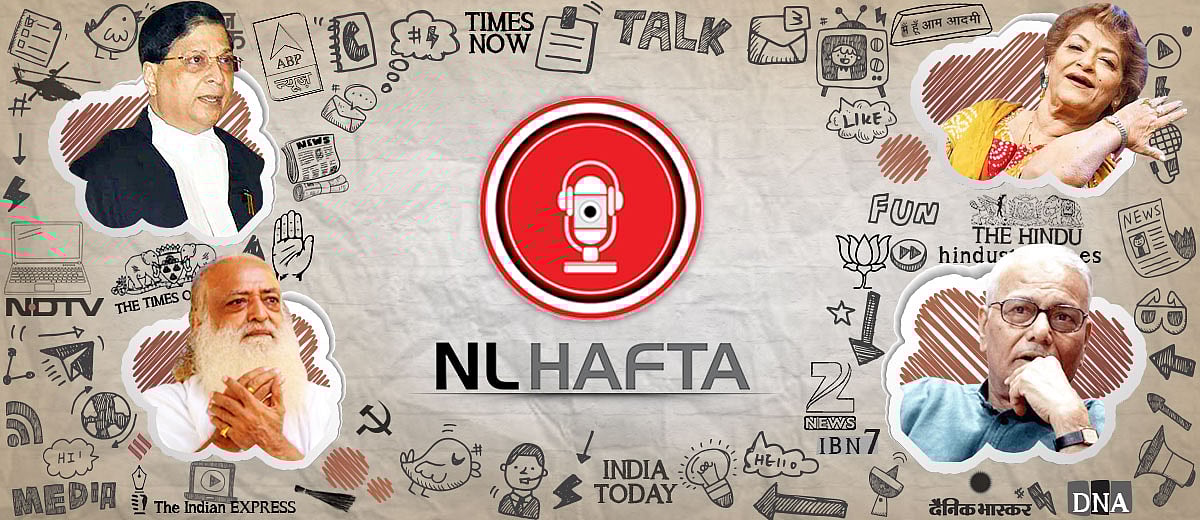
In this NL Hafta, Abhinandan Sekhri, Madhu Trehan, Raman Kirpal, Manisha Pande and Anand Vardhan come together to discuss Asaram’s conviction, Saroj Khan’s statement, Karnataka elections, formation of Bahujan Azad Party, Yashwant Sinha quitting BJP, and more.
On the apparent absence of violence after Asaram’s conviction, Madhu said: “I don’t think everything is peaceful. I read the judge had to go into hiring police. I read there’s been a reaction from the followers”.
While opining on capital punishment, Madhu also recommended a piece written in Hindustan Times by Ishita Manek on why she doesn’t support the death penalty. Her own experience of being sexually exploited in her childhood made her believe that instead of seeking revenge, she wanted an atmosphere that can help children report the crime and the criminal.
Giving his views on the verdict, Anand said, “I am not a supporter of capital punishment in any condition. So this is no exception. But there is a culture of knee-jerk political response to things and this is part of it. It may actually be counter to deterrence. If the punishment for raping and killing is the same, there is an incentive to kill. There is an element of seizing the narrative.”
Moreover, Manisha pointed out that since almost 90 per cent of child molesters are people the victims know, the death penalty will naturally make families reluctant to report against the victims. For Raman, “If u really want to deter such offenders, you need to have fast-track courts where nobody will be able to tamper with the evidence.”
In other words, as Anand put it, “The certainty of punishment is a better deterrent than the rigor of it.”
Moving on to Saroj Khan’s statement on the casting couch in the film industry, Abhinandan and Manisha disagreed on the implications of it. While for Abhinandan, two separate sentences were being joined and misconstrued, Manisha found no justification for such a remark in any circumstance. Madhu added, “I don’t think she should have defended any industry. The action is wrong no matter what.”
What was worse, as Manisha said, is that no Bollywood celebrity spoke against it.
Further, on the strategic importance of the Karnataka Assembly elections, Anand said, “It would be important only if a spillover effect is factored in: will it set a narrative for the general elections?” In addition, he said these elections will be a semi-laboratory for identity politics and also symptomatic of BJP’s ambition of getting at least once critical foothold in south India.
For Raman, “The election here is relevant because Karnataka is the only state except Punjab where the Congress rules. It is also a major election in a run-up to 2019.”
Abhinandan asks the panel to deliberate on whether the UP-based social media adviser from VHP who turned down the Ola cab because his driver was a Muslim, deserved coverage or not. Raman and Madhu feel such news shouldn’t be covered. She said: “I don’t think it deserves coverage because it legitimises it. It’s about one loony person tweeting. There are enough aunties and uncles doing crazy things.”
While Manisha thinks it should have been covered, “I would report it like a fun anchor story. I wouldn’t block it completely.” Anand calls it a “drawing room communal joke getting its way into social media.”
Moving on, the panel discusses the 50 IITians who left their jobs to form a party called Bahujan Azad Party, that aims to uplift the Dalits.
Abhinandan predicts the party will sink without even creating a ripple. Anand said: “It is a reflection of depletion of the brand IIT.” Raman questioned: “Why can’t technocrats be politicians?”
In the case of the impeachment issue, Abhinandan feels it got balanced coverage. Raman pointed out: “The parties didn’t give proper reasons to impeach the CJI. They didn’t draft their impeachment petition in a very legal way.”
Abhinandan asks the panel to elaborate on the rationale behind Yashwant Sinha quitting the BJP. To which, Madhu answered: “This is no country for old people. In politics, one has to at some point face reality that if you have become irrelevant or people see you as irrelevant, you don’t wait till you are dropped, humiliated and pushed out. You walk away with your head held high.”
Raman opines that Yashwant never had a mass base whereas Modi does. Hence, Modi didn’t find Yashwant relevant in today’s politics. Anand points out the difference between bureaucrats who quit to become politicians and those who join politics after retirement. All this and more on this week’s podcast!
Recommendations
Abhinandan Sekhri
Tougher isn’t better
NL Baithak podcast
Madhu Trehan
Anita Gets Bail: What Are Our Courts Doing? What Should We Do About Them?
Target: Journalists
Fake it till you make it: meet the wolves of Instagram
Manisha Pande
“A Monster In The Garb Of A Saint”: A Father Recounts The Challenges In Pursuing The Jodhpur Case Against Asaram
Raman Kirpal
Judicial quicksand
Rajindar Sachar (1923-2018): Man of convictions, not shy of a fight for what is right
India Needs More Personalities Like Justice Sachar
Anand Vardhan
The Scholar Whom Audrey Truschke Cites Finds Her Tweet ‘Shocking’
Others
NL Sena on Bellary Brothers
Blasting the past
Red Dust and Slow Death in Bellary
Bellary and the rise of Jindals
Bellary and the reign of Reddys
How a suicide exposed a rot in Karnataka
Produced by Shubham Mishra (@ShubhamMishra__ )
Recorded by Anil Kumar
Audio switching by Samarendra K Dash
You can also listen to all our podcasts on the Newslaundry App and get updates about all our podcasts via Twitter and Facebook.
Android: http://bit.ly/2jTtG3x
Newslaundry is a reader-supported, ad-free, independent news outlet based out of New Delhi. Support their journalism, here.