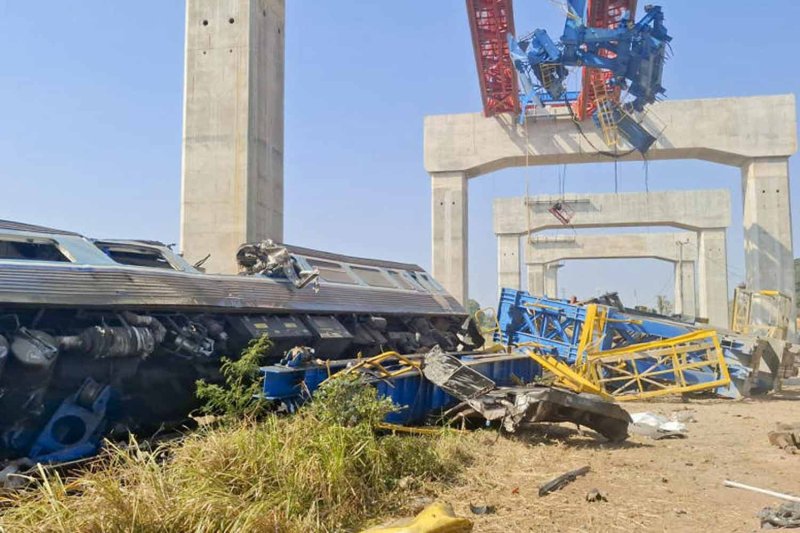
Habitual construction malpractice caused the huge gantry crane of a high-speed railway project to fall on an express train in Nakhon Ratchasima in January, according to the Transport Ministry. The accident killed 31 people and injured 71 others.
The conclusion on the cause of the tragedy came from a thorough investigation led by the Engineering Institute of Thailand, Jirapong Theppitak, deputy permanent secretary for transport, said on Tuesday.
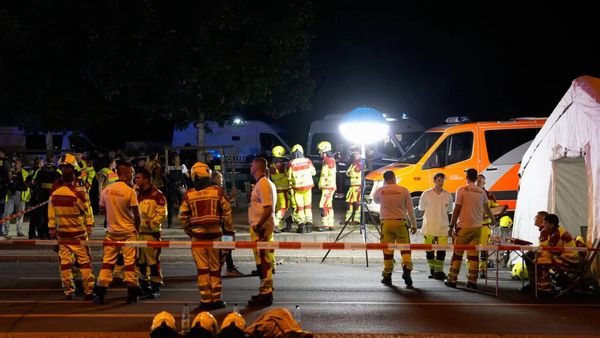
He referred to the probe into the launching gantry fall in Si Khiu district on Jan 14 when 30 train passengers and a construction worker were killed, 71 other people were injured, three train carriages were damaged and the lower northeastern railway services were closed for 10 days.
According to Mr Jirapong, before moving the launching gantry, engineers and workers should have moved its middle support to the next of its front support to help bear the load on the front support but failed to do so.
On Jan 14, as the launching gantry was moved, its front support, which bore a load of more than 700 tonnes, was overloaded. Its post-tensioning bars snapped, and the gantry collapsed and fell on a moving express train.
“It was not the mistake of a single worker but a systemic failure by all parties concerned,” Mr Jirapong said.
The investigation found that Italian-Thai Development Plc, the contractor, failed to move the middle support before moving the gantry. Its field engineers and foremen admitted that they regularly overlooked the compulsory safety practice for seeing no risks.
Moreover, a field engineer let construction workers start work without waiting for daily work permission and did not inform a construction supervisor of the work start. The field engineer claimed that the construction supervisor arrived late.
The contractor did not ask the State Railway of Thailand, the project owner, to suspend train services when the overhead construction was active although the safety practice was required by contract. The gantry fell on the Bangkok-Ubon Ratchathani express train.
Also, the contractor failed to replace post-tensioning bars every 60 rounds of use though being required to do so. The contractor also failed to check the safety of its cranes quarterly as required by law.
The construction supervision consultant (CSC) of the project failed to field an engineer and safety personnel at the construction site around the clock as required by contract. The CSC never checked the safety of the launching gantry, the probe found.
The probe also found fault with the State Railway of Thailand (SRT). The state enterprise overly assigned a project engineer to supervise the construction of five construction contracts of the Bangkok-Nakhon Ratchasima high-speed railway project, instead of only one contract.
Consequently, supervision was relatively lenient compared with construction for other contracts of the project in which one engineer was assigned to supervise one contract.
The SRT let the CSC to take responsibility for the safety of the construction alone, especially for the construction over the conventional train service in Si Khiu.
“In conclusion, the death of 31 people did not result from bad luck but because of all the parties which were aware of problematic systems but chose to ignore them,” Mr Jirapong said.