Dhaka is one of the fastest-growing cities in the world, with a population of more than 14 million people. Nearly 5.6 million live in communities without adequate access to clean, safe water and sanitation. Lack of public toilets has huge implications for the health of the population, with women, children and people with disabilities the worst affected.
When H&M customers purchased gift cards during H&M’s Holiday Campaign 2013, they were contributing to transforming lives for millions of people in Bangladesh. The number of purchased gift cards secured a donation from the H&M Conscious Foundation, supporting a three year programme with WaterAid to construct new public toilets and regenerate existing facilities in 30 locations across Dhaka city. Mohakhali market and Gabtoli bus terminal are two sites where work has been completed.
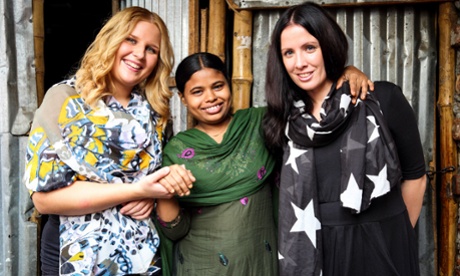
Last year, H&M employees Sissi Kaupinnen and Katja Linnaranta travelled to Bangladesh, to see the impact that donations from the H&M Conscious Foundation are having. The visit helped them understand how WaterAid works with local partners, delivering transformational public sanitation services for Dhaka’s low-income population.
“My first impression of Dhaka was the noise and the traffic,” says Linnaranta, 36. She works in the H&M store in Varkaus, Finland, and travelled to Bangladesh in November with her colleague Kaupinnen, 25, to see how the Foundation’s donations are changing people’s lives. “I couldn’t have imagined beforehand how bad the water and sanitation issues would be.”
Kaupinnen agrees, saying, “I found it really shocking ... The lack of safe water and toilets is making people really sick in Dhaka. The city has such a big population, but so few toilets.”
A substantial proportion of Dhaka’s low-income population are industrial workers, most of whom work in garment factories. Roughly 2 million more commuters, pedestrians and floating populations (those who reside in a given population for a certain amount of time for various reasons, but are not generally considered part of the official census count) are also deprived of good public sanitation services.
The public toilets in Dhaka are currently badly managed and not in a usable condition. A study commissioned by WaterAid in 2011 revealed that, out of 47 public toilet blocks in Dhaka city, three quarters did not have facilities suitable for woman and children, with more than a third of toilets located in very unsafe locations. On top of this, almost 60% of the toilets did not have a reliable water supply, and more than 80% had no lighting.
Across Bangladesh, access to water, sanitation and hygiene education is one of the major challenges to achieving poverty reduction and human development goals. The donation from H&M Conscious Foundation will help to address long-standing issues the country has in meeting its development objectives.
While Kaupinnen and Linnaranta were in Bangladesh they visited the Gabtoli bus terminal – one of Dhaka’s main transport hubs, where thousands of people pass through every day. Many travel long distances without access to adequate public sanitation services. Although there are some public toilets at the terminal, they are dirty and in a state of disrepair. Women often won’t use them as the facilities aren’t gender-separated, so are typically male-dominated.
WaterAid opened the first public toilet under the project in May 2014, including facilities for disabled people. Nargis Pervin, 30, who has run a small water stall in Gabtoli for over 10 years, has already seen the positive effect of the toilets on her business.
“Since the new facilities have opened, I haven’t needed to go home,” she says. “It has made life a lot easier and I don’t lose customers so trade is better too.”
The newly constructed public facilities at Gabtoli will improve the lives of commuters and local traders every day. Since these were installed, the Dhaka City Corporation has also begun to improve existing services, demonstrating how this project will help to influence changes to public sanitation across Dhaka and other cities in Bangladesh.
For Kaupinnen and Linnaranta, seeing the projects funded by H&M Conscious Foundation first hand is something they will always remember, especially the way the donation is helping to change the face of public sanitation services in Dhaka.
“The difference between the old public toilets and the renovated ones is amazing,” says Kaupinnen. “Now the toilets are clean, they’re safe, and there are facilities just for women – with locks – so everyone can go to the toilet safely.”
“I’m glad I’ve seen the work of WaterAid and how they make people happier every day by simply providing safe water and clean toilets. WaterAid and the H&M Conscious Foundation are doing really important work in Bangladesh.”
Content on this page is paid for and provided by H&M, sponsor of the sustainable fashion hub