Team sheets often contain hidden subtexts but it is only occasionally that they double as managerial suicide notes.
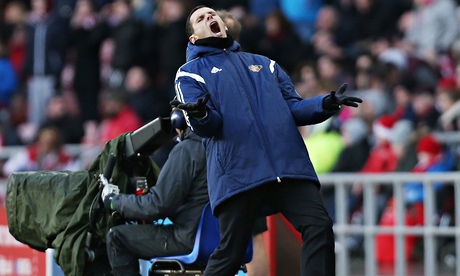
When Gus Poyet put pen to paper before Sunderland’s recent 1-1 draw at Hull City he effectively challenged his board to sack him. The Uruguayan’s selection was hardly as headline-grabbing as Ruud Gullit’s decision to leave Alan Shearer on the Newcastle United bench for a Tyne-Wear derby back in 1999 but it proved similarly provocative.
Poyet had picked four central midfielders across the middle of a 4-4-2 formation and named three centre‑halves in a defence also featuring a specialist right-back at left-back. The doubts concerning his tactical acumen and the negativity of his mindset long harboured by Lee Congerton, the sporting director, began spreading to other members of Sunderland’s hierarchy and although the team somehow scrabbled a fortunate draw that day a fuse had been lit.
It would lead to Ellis Short, the owner, supervising the hunt for his fifth manager in six mainly traumatic years and Congerton embarking on the formidable two-fold task of recruiting a temporary firefighter to stave off relegation while also courting potential long-term appointments.
With last Saturday’s 4-0 thrashing at home to Aston Villa confirming that the manager could not be permitted to muddle through until the end of the season, let alone relied upon to avert relegation, there is a sense that Poyet is definitely relieved and perhaps even secretly rather delighted to have been sacked and paid off by Sunderland.
It all rather begs the question: how did it come to this at a club bankrolled by an American billionaire which routinely attracts crowds well in excess of 40,000 to its magnificently appointed home on the banks of the river Wear?
In the months before Poyet started working on his exit strategy and began blaming everyone from his players to Congerton to the fans and, finally, the media for Sunderland’s ills, he hinted darkly that a fundamental flaw at the club was undermining everything and everybody.
“There’s something wrong here and I need to find it before I go too,” he said last spring, echoing something Niall Quinn, then serving as chairman, reflected on back in 2006 when the Irishman lamented the presence of “gremlins” at the Stadium of Light.
If some Byzantine behind-the-scenes politics hardly help, the immediate problems stem from a series of well‑intentioned but ultimately flawed choices on Short’s part. Having worked with two traditional British managers in Steve Bruce and Martin O’Neill – appointments heavily informed by Quinn – the American financier became convinced that a European-style director of football system was the way forward.
Unfortunately his first appointment in the role, Roberto De Fanti, proved so disastrous Short is understood still to be mentally beating himself up about hiring him. The same goes for Poyet’s predecessor, Paolo Di Canio.
Equally perplexing was the arrival of Poyet at a time when Steve McClaren – a man Sunderland would now welcome with open arms – was available. If Di Canio’s atrocious man-management camouflaged some brilliant coaching, Poyet’s volatility was accompanied by paralysing tactical caution.
Granted Poyet presided over last season’s miraculous escape from relegation but it came after he reacted to a 5-1 defeat at Tottenham by offering to resign. There is a strong suspicion that, rallied by the influential Lee Cattermole, a group of underachieving players were primarily responsible for belatedly dragging themselves to safety.
Poyet’s firefighter replacement will need to harness Cattermole’s galvanising influence if relegation is to be avoided but the longer-term man may want to reduce the influence of a powerful cabal of senior professionals.
It does not help that a club featuring a greater turnover of players than any other in the Premier League in the past five years has not seen a player bridge the gap between academy and first team since Jordan Henderson and Jack Colback broke through six years ago.
Congerton’s installation was intended to rectify such problems and the former Hamburg technical director has impressed in often difficult circumstances. Poyet, despite his frequent moans about a lack of autonomy, had a big say in transfers, sabotaging Congerton’s summer attempts to sign Micah Richards and Toby Alderweireld while being permitted to recruit the ineffective Will Buckley, Sebastián Coates, Ricardo Álvarez and Santiago Vergini.
With Adam Johnson suspended while police investigate allegations he had sexual relations with an under-age girl and Emmanuel Giaccherini injured, such inadequate signings leave Poyet’s immediate successor confronted by a vulnerable defence, a lack of midfield creativity, no effective wingers and a collective shortage of pace. Even Sir Alex Ferguson might struggle to keep Sunderland’s class of 2014-15 out of the Championship.