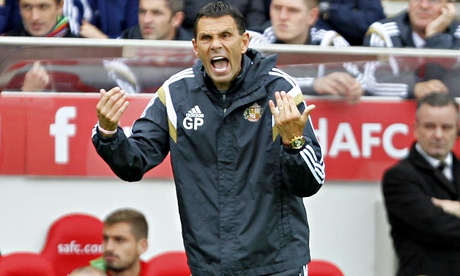
Gus Poyet has always prided himself on his maths. As a schoolboy in Uruguay Sunderland’s head coach became a star pupil in the subject after developing a fascination with the complexities of algebra and geometry. “I like trying to work out crazy mathematical problems,” says a man who must wish he could transpose an uncanny ability with equations, both abstract and quadratic, to the tactical arena.
As Sunderland prepare for West Bromwich Albion’s visit on Saturday Poyet is finding the task of balancing attack and defence surprisingly difficult. Should a damaging home league defeat by QPR and a hapless FA Cup exit at Bradford be followed by another reverse, the already lively debate regarding his future will only intensify.
A brief outbreak of fighting among fans occupying the away end in West Yorkshire last Sunday highlighted the schism between the critics who believe Ellis Short, Sunderland’s owner, should sack the manager and those who feel Poyet represents the best hope of avoiding relegation.
Considering Sunderland are currently two points above the bottom three – luxury compared to last season when they consistently remained in the drop zone until a near-miraculous 11th-hour escape – the sense of impending crisis could be viewed as premature.
Unfortunately it has been manufactured partly by Poyet himself. As if the team’s record of only two league wins at home all season – and four in total – was not bad enough, the head coach has made some extraordinarily provocative comments of late.
With Lee Congerton enjoying a reprieve from the not so subtle public barbs the Uruguayan frequently directed his way until Sunderland’s director of football masterminded Jermain Defoe’s signing last month, Poyet accused supporters of “living in the past” while craving “kick and rush” football before training his guns on the north-east press.
Claiming – falsely – that reporters had twisted his words, he appeared very much a man honing an exit strategy, almost provoking dismissal, only for such conspiracy theories arguably to be undermined by the publication of his bizarre open letter to the fans who had sung “Gus – it’s always our fault” at Bradford.
“Let’s make sure that we don’t let anyone to break our relationship,” wrote the head coach in a missive posted on Sunderland’s website on Thursday. “I invite you all to be stay positive, to be strong, closer to each other and keep believing.”
By Friday he faced a slightly disgruntled local media. “We didn’t misquote you,” said one reporter. “That’s your opinion,” Poyet replied, clearly desperate to change the subject and declining an invitation for an off-the-record “clear the air” chat.
The letter had been written at his London home on Monday. “I don’t know if it was right or wrong, it was my instinct, I felt it was needed,” he said. “I follow my instincts a lot. My instincts have worked well in my life. I’m not going to change.”
Kevin Kilbane, the former Sunderland winger turned BBC pundit, is among those who believe a rapprochement is overdue. “There’s big pressure on the manager now,” he says. “Sunderland didn’t play well against QPR and losing was a massive blow. They were totally dominated by a League One side in the Cup and they’re facing a team bang in form on Saturday.”
Two points and one place ahead, West Brom have taken eight points from their past five league games and it will be intriguing to see if Poyet attempts to counter Tony Pulis’s side with Emanuele Giaccherini and/or Ricardo Álvarez. Tellingly Sunderland’s two most creative players have been marginalised this season. Admittedly that pair have suffered assorted injuries but Poyet’s attempts to instil a measured, controlled, methodical passing style are undermined by a lack of overall invention and some alarmingly defensive game plans.
He claims the crowd’s impatience is the problem. “Everybody wanted the players to play the ball forward, let it bounce and get corners. Getting corners was more important than making passes” was his complaint after the QPR defeat.
Others identify a coach so obsessed with not being beaten that the team defend far too deep and make too many sideways passes as the root of Sunderland’s ills. Perhaps afraid of getting caught on the break, players often appear unwilling to press opponents, while Poyet’s initial reaction to Defoe’s need to play in a front two was the introduction of a back five. When, on Friday, someone inquired if a more attacking mind-set was required he replied: “But what if we lose 5-0?”
Roy Keane had many faults but the sight of Sunderland’s former manager issuing Andy Reid with thumbs up signs when the team’s old playmaker tried but failed to deliver killer passes spoke volumes. Reid’s imagination proved pivotal in keeping Sunderland in the top division in the spring of 2008; maybe Giaccherini could do something broadly similar? After all a side featuring £50m worth of talent in Adam Johnson, Jack Rodwell, Steven Fletcher, Connor Wickham and Giaccherini alone should be capable of achieving mid-table stability.
If crowds regularly in excess of 40,000 do not deserve to be patronised by a coach who sometimes gives the impression his heart is in London, Poyet was undeniably parachuted into an extremely difficult situation 16 months ago. In succeeding Paolo Di Canio he became Sunderland’s sixth manager in five years and was left to pick up the pieces following Roberto De Fanti’s disastrous seven-month incarnation as director of football.
While Congerton, a former Chelsea chief scout and Hamburg technical director, has subsequently brought stability, strategy and some decent signings to a club that has experienced a bigger turnover of players than any other in the division since 2009 there are concerns that, despite boasting a Category One status academy, no homegrown youngsters have graduated to the first team since Jordan Henderson and Jack Colback, both now departed, broke through six years ago.
Short has shown Poyet considerable support and talked an invariably volatile character out of resigning following last April’s 5-1 thrashing at Tottenham, persuading him he could choreograph survival.
The hope in the boardroom is that Sunderland’s resident mathematician can repeat the feat this season but doing so will surely demand a radical tactical recalibration.