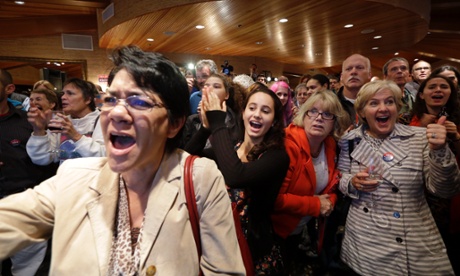
Voters in Washington state have overwhelmingly approved a measure that strengthens gun controls, a result hailed as a revolt against the inaction of politicians afraid of the National Rifle Association.
The ballot initiative, the only significant gun control measure in this year’s midterm elections, attracted the support of nearly 60% of voters. It puts in place one of the most comprehensive sets of background checks for buying a firearm in the US.
A rival initiative to block any gun control laws not imposed by federal law failed.
The sponsor of Initiative 594, Cheryl Stumbo, who survived a 2006 attack on the Jewish Federation in Seattle, which killed one person and wounded five, said the campaign “has shown Americans that a citizen movement can act to reduce gun violence if our elected leaders won’t”.
“This movement is here to stay,” she told a victory rally.
Among those who campaigned for the initiative was the former Arizona member of the US Congress, Gabrielle Giffords, who was shot in an assassination attempt by a mentally ill man in 2011.
“Washington voters showed that when Americans are given the chance to vote to close the loopholes that let guns fall into the wrong hands, common sense wins. They also showed that while the gun lobby can intimidate politicians, it’s a lot harder to intimidate America’s voters,” said Giffords.
The victory for Initiative 594 will expand background checks to close what is commonly known as the “gun show loophole” which allows individuals to buy firearms privately, such as through classified advertising or at gun shows, without a background check to ensure they are not a convicted felon, do not have a history of domestic violence or have not been diagnosed with severe mental health problems. Until now, Washington state has only required checks for guns bought through licensed dealers, in line with federal law.
The Washington Alliance for Gun Responsibility, a coalition of organisations backing tightened gun control in the state, was launched in the wake of the Sandy Hook elementary school shooting in Connecticut two years ago, in which 20 children and six adults were murdered. Activists said that after a national outpouring of grief, politicians still failed to take any action on gun control because they were afraid of going up against the financial and political power of the National Rifle Association.
Four other state legislatures – Colorado, Connecticut, Delaware and New York – imposed widened background checks after Sandy Hook, but the Washington state legislature did not act even though opinion polls showed popular support for the move. Campaigners accused politicians of cowering before the NRA.
Initiative 594 drew considerable financial backing from Bill Gates, the co-founder of Washington state-based Microsoft, and another billionaire, the former New York mayor, Michael Bloomberg. His Everytown for Gun Safety Action Fund injected about $2m to support the initiative.
The NRA spent $490,000 to oppose it. During the campaign, the NRA expressed concern that a popular victory for gun control in Washington state, backed by large amounts of outside money, could spread to other states.
That is exactly what its backers intend.
In the Seattle area, the initiative won 75% of the vote. Seattle’s mayor, Ed Murray, hailed it as an example to other states.
“As the first state to pass this by popular vote, Washington has sent a message of hope to other states that progress is possible: We can act to prevent gun violence,” he said. “Our goal has never been about finding a single solution that will end gun violence once and for all. Instead, our goal has been to enact a sound system of commonsense rules that can, by working in concert, make an enormous difference.”
Everytown for Gun Safety is already gathering signatures for a gun control ballot measure in Nevada and planning similar initiatives in Arizona and Maine.
Opponents put a competing initiative on the ballot as a spoiler. The Initiative 591 campaign sought to play on fears that expanded background checks meant the establishment of a gun registry in the state that could be used by the government to confiscate weapons. It also said that rules on transferring firearms would mean that a hunter could not lend another hunter his gun. But after initially doing well in opinion polls earlier this year, support for Initiative 591 fell back to 45% in the election.
The chair of the 591 campaign, Alan Gottlieb, threatened a legal challenge to the new restrictions and said he would also press the Washington state legislature to cancel or weaken them. That may prove difficult given the overwhelming support among voters who have shown their disdain for politicians they regard as beholden to the gun lobby.