RAJKOT: Spotted a snake in your backyard? You have two options — either let it slither away or you stay well out of its reach as rescue operation now may take more time than earlier.
Thanks to the forest department, its new guidelines issued on March 30 this year for snake catching is restraining volunteers from doing their work. In fact, the department’s intention to save the snakes has only bitten the volunteers as well as general people.
There are around 2,000 volunteers engaged in these activities all over the state and many of them are part of NGOs. In any such situation earlier, whenever a call goes to an NGO, the volunteers rush to the spot and successfully rescue the reptile within minimum time so as to avoid confrontation with human or cause harm to its own safety.
However, the new guidelines mandate that calls will have to go through the taluka forest wildlife warden, who will send a bona fide rescuer to do the job, thus taking a lot of time in the process and endangering lives.
According to the new rules, volunteers will have to register first, their names will be scrutinized by the respective circles of forest department and thereafter undergo a 15-day training by GEER foundation before they get a photo ID card which they will have to carry in rescue operations. They will also need to have a life insurance cover of Rs 10 lakh.
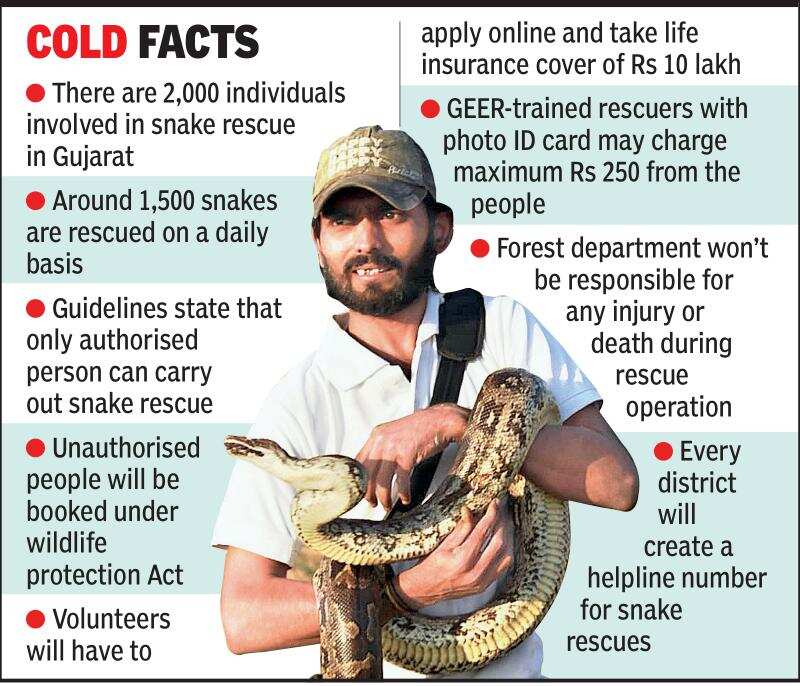
Sources said the execution of these new guideline is very slow, and that except in Ahmedabad, no training has been started anywhere. Again, even if the forest department starts training in all the districts immediately, it will take a minimum of over a year to train all the people.
Snakes are found around human habitation in areas like Jamnagar, Porbandar, Junagadh, Amreli, Bhavnagar and in most parts of south Gujarat. Of the snakes that get rescued, 40 percent are poisonous, rescuers claim. Cobra, Indian krait, Russell’s viper, bamboo pit viper are some of the venomous species found commonly in Gujarat.
For the past three decades and more, Lakhota Nature Club in Jamnagar has been engaged in rescuing snakes and its team of 42 rescuers save around 300 snakes in a month. These activities are done in coordination with the forest department and the NGO also provides the rescue data to the department every year.
However, recently the NGO gave an advertisement in a local newspaper stating that rescue work of snakes have been stopped owing to the new guidelines of the government. “If any of our (NGO’s) members is found doing this work, it will be considered an activity going against the organization and their membership may be cancelled,” the ad stated. It also furnished an address of a local forest office for the general public to contact in case of need.
Earlier, the NGO had a WhatsApp group where people could place a call and get help within minutes. President Suresh Bhatt tld TOI, “We did this to avoid any controversy and clash with new guidelines. We want the forest department to execute this guideline immediately and start training rescuers as soon as possible.”
“It’s not possible for the forest department to attend to every call and rescue snakes. General public calls us, not the forest department,” said Vikram Gadhvi, founder of Gujarat snake conservation society.
“If a person has to inform the department first and it will then inform us, the entire procedure will consume precious time which will increase possibility of a snakebite or the reptile being killed out of panic,” explained Gadhvi, adding that many individual rescuers are still doing the risky job despite the guidelines. These wildlife lovers are doing this to save the reptiles from harm even at the risk of being prosecuted while waiting to get authorisation, he stated.
Gadhvi also sent a letter to the chief minister last year demanding compensation for family members of rescuers in case of death from snakebite and also for providing free government treatment for volunteers who get injured in such rescue operations.
“The government, without asking me, made a wrong interpretation of my suggestions. They (authorities) have made the Rs 10 lakh life insurance cover mandatory for rescuers. Volunteers put their lives into risk and no insurance company has policy to cover such risks,” Gadhvi added.
Talking to TOI, principal chief conservator of forest, Shyamal Tikadar, said, “There are certain confusions with the guidelines. We will work it out.”