A special court has handed down life sentences to 11 people for their part in a massacre of mostly Muslim citizens during a mob riot in India.
The court in Gujarat imprisoned almost half of the 24 people convicted for the killings for the rest of their lives, while 12 more received seven-year sentences and one man received a 10-year sentence.
Known as the Gulbarg Society killings, after the compound of bungalows where Muslims were living, the 2002 attack was called "the darkest day in the history of civil society" by the court.
Those convicted, who were mostly Hindu, were described as going on a "rampage" after a group of Muslims were believed to have started a fire on a train which killed 60 Hindu pilgrims.
The retaliatory attacks 14 years ago on Muslims in Ahmedabad, in India's westernmost state, were part of wider riots in which 1,000 people are believed to have been killed, with 69 murdered in the Gulbarg Society compound.
Some of the victims, who were reported to be middle- and upper-class business families, were hacked with machetes and then burned to death by the mob.
One of these was Ehsan Jafri, a former Indian National Congress party MP, who is understood to have repeatedly tried to call the police but to no avail, before the mob broke into the buildings and systematically killed residents and destroyed homes.
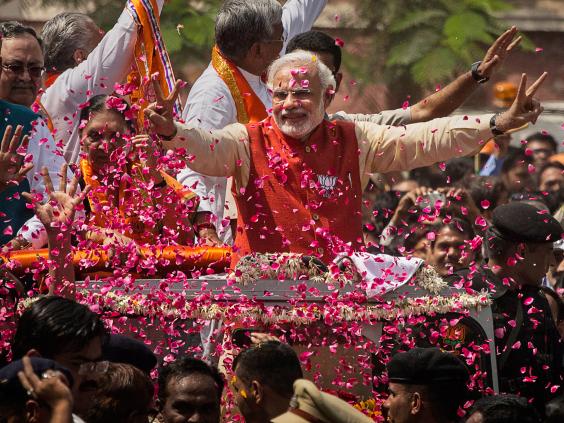
Accusations at the time also swirled around Narendra Modi, chief minister of Gujarat in 2002 and now prime minister of India, for failing to prevent the riots because of Hindu nationalist sentiment on his part - accusations which have since been dismissed.
Hindu and Muslim relations in the south Asian subcontinent have long been strained, particularly since the partition of India into Pakistan and Bangladesh in 1947 by the British.
Rising Hindu nationalism in the form of the ruling Bharatiya Janata Party (BJP) has led many Muslims to voice fears of further discrimination in employment and before the law, but Mr Modi said in 2015 that the nation would only prosper "when Hindus and Muslims unite and fight" against poverty rather than one another.