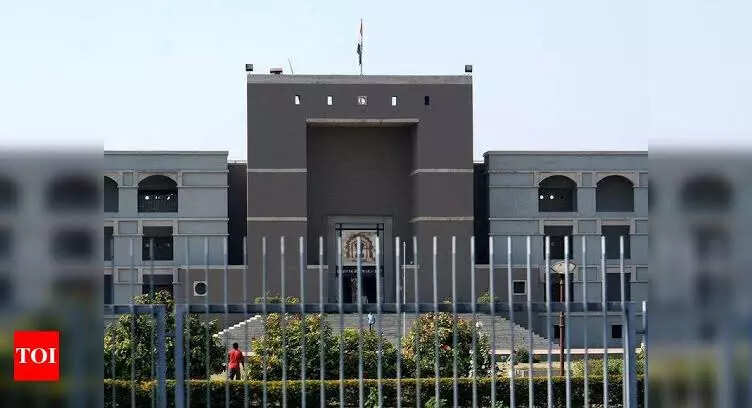
AHMEDABAD: The bench of Chief Justice Vikram Nath and Justice Biren Vaishnav opined that according to the June 2021 amendments to the Gujarat Freedom of Religion Act, interfaith marriage followed by conversion would amount to an offence and would attract penal provisions.
“Prima facie on a plain reading of Section 3 of the 2003 Act, we feel that marriage inter-faith followed by conversion would amount to an offence under the 2003 Act. Marriage itself and a consequential conversion is deemed as an unlawful conversion attracting penal provisions”.
The judges observed that from the perception of the common man, merely because conversion occurs because of marriage, “it per se cannot be held to be an unlawful conversion or a marriage done for the purpose of unlawful conversion”.
On shifting the burden of proof on to the accused to establish that the marriage and later conversion had not taken place on account of any fraud, allurement or coercion, the court said, “This again puts the parties validly entering into interfaith marriage in great jeopardy.”
It further recorded, “Prima facie interfaith marriages between two consenting adults by operation of the provisions of Section 3 of the 2003 Act interferes with the intricacies of marriage including the right to the choice of an individual, thereby infringing Article 21 of the Constitution.”
In an interim order, the HC stayed the provisions in response to two petitions filed by Jamiat Ulama-e-Hind and an activist, Mujahid Nafees of the Minority Coordination Committee. Their lawyers raised various issues and stressed that the changes to the anti-conversion laws deprives a person of his or her right to choose a partner for marriage. It is a direct attack on the right to privacy. Besides, making a law aimed at restraining a person from embracing another religion by marriage is also in violation of provisions of Article 25 of the Constitution.
The state government maintained that the law will apply only when elements of force, allurement or fraudulent means are found in conversion. The court asked on multiple occasions whether the law aimed at prohibiting interfaith marriages.