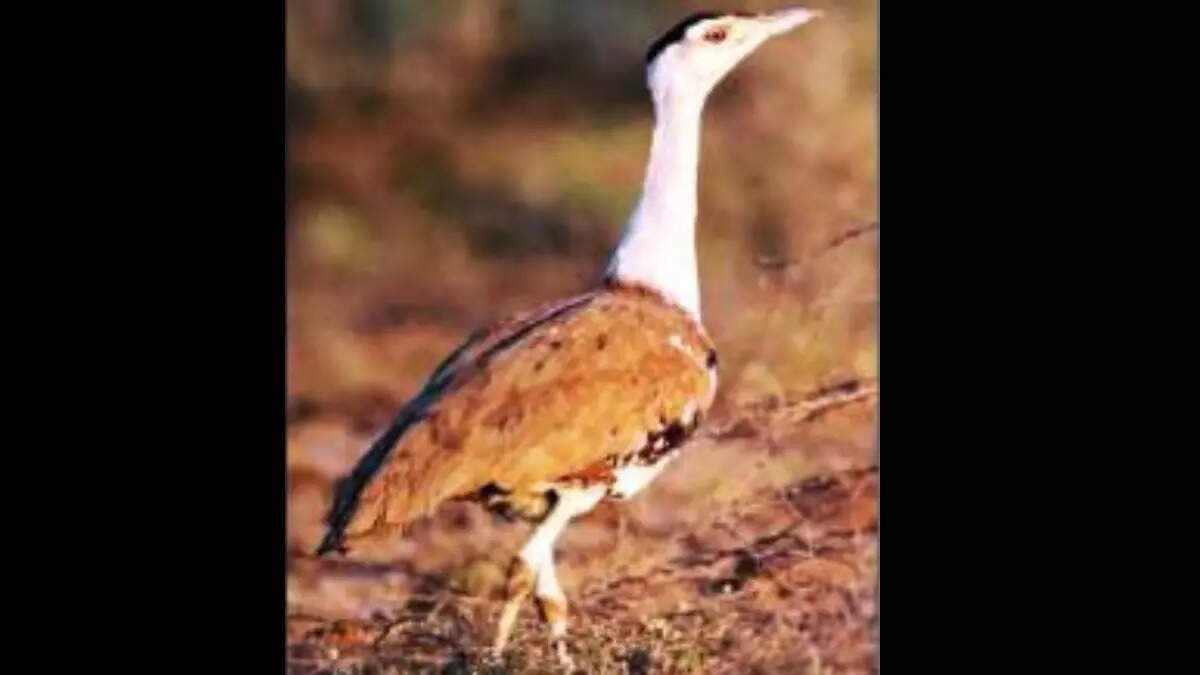
RAJKOT: While bird lovers were saddened that the exotic Great Indian Bustard (GIB) species vanished from Kutch, hopes were revived on Sunday when forest officials sighted four females in Kutch. However, amid the sliver lining, dark clouds of uncertainty still loom large on their fate as these were all female birds while no male bird was spotted along in the group.
In July, union MOS for environment, Ashwini Kumar Choubey had stated in a reply to a question in parliament that the bird is no longer sighted in the sanctuary area. GIB sanctuary in Kutch is spread two square kilometre, but these four birds are found outside the sanctuary area. According to forest officials, the birds are moving in a 1,000 sq km area spread in Kutch, Rajasthan and some parts of Pakistan.
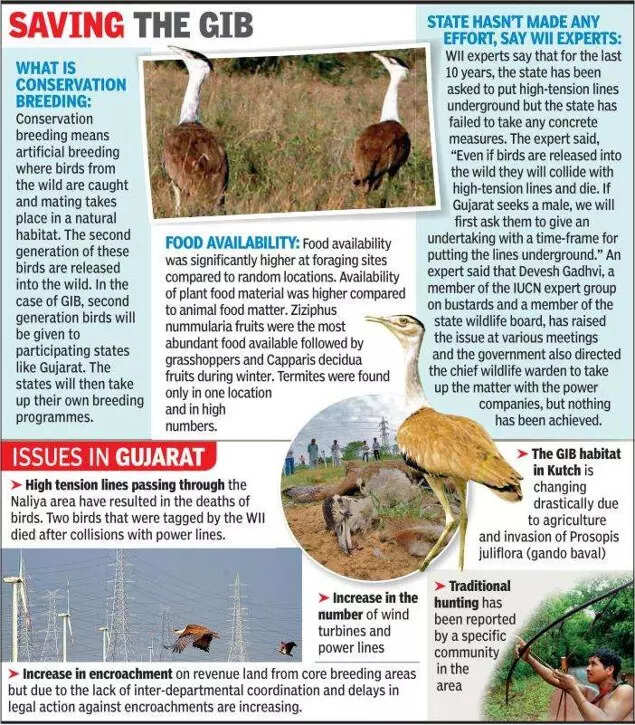
GIBs are listed as critically endangered and it falls under schedule 1 of wildlife protection Act. Compounded by deaths taking place from adult birds crashing into the power lines in Kutch, the species is slowly getting erased from Gujarat’s map.
Talking to TOI, chief conservator of forest Kutch, Anita Karan confirmed that four female birds of the species were sighted near Naliya grasslands. “We have always maintained that there are four GIBs in Kutch. However, the future of the species is grim as these are only female birds. Gujarat is a part of the breeding and conservation programme of this bird,” she said.
Forest department sources claim that there are around 80 to 120 GIBs in Rajasthan, but they can’t take the risk to bring males in Kutch for breeding. There are several reasons for the fear, but the major reason is the threat to their life because of the high tension power lines. As the species is listed under critically endangered category, the state forest department does not want to take any risk.
A conservation programme of GIB was started by the central government, in which artificial incubation is employed to create progeny from the eggs laid by these birds in the wild. As these birds would have human imprint, they can’t be released in the wild. They will be released into the wild with the other wild birds to increase their population only after the third or the fourth generation.
Tushar Patel, assistant conservator of forest Kutch (west) said, “We have proper habitat for GIBs in Kutch, from where progeny in future will be released. They will be put with the wild birds so that they too learn the art of hunting. But till that time, our role is to prepare a good habitat for the GIBs.”
According to the forest department, a lot of work has to be done on ground to prepare habitats in Kutch to relocate the GIBs here.
GIBs feed on insects, fruits and crops, but with farmers in the region using inorganic techniques of farming with pesticides etc, they will have to be convinced to to change to organic farming for the betterment of the birds. Again, rampant encroachment of revenue Gauchar land in feeding as well as livestock grazing in the grasslands of the reserve forest have to be controlled, besides changing the overhead power lines to underground cables to avoid birds’ collision.
Adult GIB male birds weigh anywhere between 11 and 15kg, while adult females weigh around 4 to 7kg. The birds live in the grassland and scrub and prefer to nest in the tall grasslands.