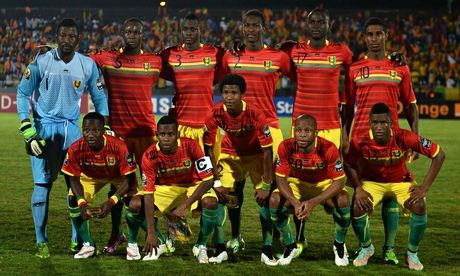
The footballers of Guinea say they were exiled and made to feel like they had “the plague” because of the presence of Ebola in their country when they played their qualifying matches for the Africa Cup of Nations. Members of the squad have told how they were stigmatised and abused.
“We don’t want you here, you have the virus,” airport workers told them as they landed – even though most had flown in from Europe where they play club football. “Ebola! Ebola!” rival fans shouted at them.
“I could understand them being cautious, but it was too much,” said Kamil Zayatte, the captain. “Uganda was the worst. Usually we travel with 50 people – players, managers, medical staff, coaches and so on – but they told us we could have only 18 players and four coaches, and we had to make an official protest.
“Then they locked us away in a private compound with a military guard. We couldn’t even go on to the street. The supporters screamed at us ‘Ebola! Ebola!’ It was terrible.” The team’s French coach, Michel Dussuyer, said some treated the players “as if they were like the plague”.
Against the odds, however – and despite not being allowed to play a single qualifying game on their own territory – Guinea earned a place in the finals, which are now taking place 2,000 miles away from their homeland, in Equatorial Guinea.
Sunday’s quarter-final against Ghana in Malabo will bring Guinea to a standstill as the nation follows its team, known as the Syli Nationale (National Elephant), on television and radio. Special screens have been put up around the capital Conakry.
“Everybody will be watching,” said Zayatte, who plays in England for Sheffield Wednesday. “Not just football fans, but grandparents, children – the whole country. We have to win for them. We must give the people something to cheer after all that has happened.”
Nearly 2,000 Guineans have been killed by the Ebola virus, in the border regions with Liberia and Sierra Leone. Schools have been closed for months, and people have been warned to avoid large gatherings – but there is no chance of that happening at present.
The economic impact has been devastating too. Unicef sent a director there nine days ago and Sherif Mohamed Abdallah, who represents a group of businessmen in the country, said: “If we are not careful, we may proclaim the end of the economic sector in Guinea before the end of Ebola.”
There have already been outpourings of joy on the streets of Conakry because of the football – and a tragedy. After the Syli’s first group game, a 1-1 draw against Ivory Coast, the players were downhearted because they had led, and felt they should have won. “We were despondent, but the people at home were celebrating and partying because for them it was a very good result,” said Zayatte. “My phone didn’t stop ringing with people wanting to congratulate us.”
News came through later, however, that three people had died when a grenade went off in a packed bar. It was thought to have been a crazy prank that went wrong, or the result of an argument between an ex-military man and a friend.
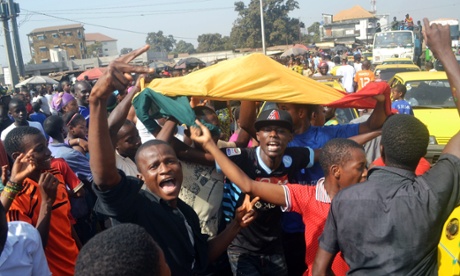
The Syli then also drew their other two group games 1-1, which left them level with Mali. Under tournament regulations, officials had to draw lots to decide who went through. Guinea’s minister of youth, Moustapha Naite, was dancing and screaming in the conference room when Guinea “won” the draw, pitting them against Ghana in the quarter-finals. “No one expected us to be here,” he said. “We had to qualify outside of Guinea. We are so happy.” The news led to more wild celebrations on the streets of Conakry.
Because they could not play their home qualifying games in Guinea, the Syli relocated to Casablanca. There is a close relationship between Guinea and Morocco, but it was a strange gesture by the Moroccans to invite them – they withdrew as hosts for the Cup of Nations, at two months’ notice, because of fears about Ebola. “I wish I was a Moroccan official, then maybe I could explain it,” said Junior Binyam, media director of the Confederation of African Football. “It makes no sense.”
Equatorial Guinea stepped in to save the tournament – a personal decision by Africa’s longest-serving ruler, Teodoro Obiang, who has ruled the tiny, Spanish-speaking nation since 1979.
But there are further obstacles to Guinea’s progress. Defender Zayatte has been injured, as has the man who usually partners him, Florentin Pogba. That has left a local league player from Conakry and a youngster who plays in the French fifth division (if he is fit) to take on Ghana’s star forward, Asamoah Gyan – the highest-earning African sportsman ever.
Gyan used to play in the Premier League for Sunderland, but moved to al-Ain in the United Arab Emirates for a pay rise. He earns about £150,000 a week and his private fleet of cars includes a Rolls-Royce, a Bentley, a Hummer, a BMW and two Porsches. He earns in a few days as much as Guinea defenders, Fode Camara and Abdoulaye Cissé, earn in a year. Cissé had a swollen knee last Friday, so Guinea could yet lose another defender.
No matter the adversity, the Syli say they are up for the challenge. Their star player, midfielder Ibrahima Traoré, is known locally as “the Messi of Guinea”. Traoré, who plays in Germany for Borussia Mönchengladbach, said: “We have amazing team spirit. We must win. We owe it to our people.”