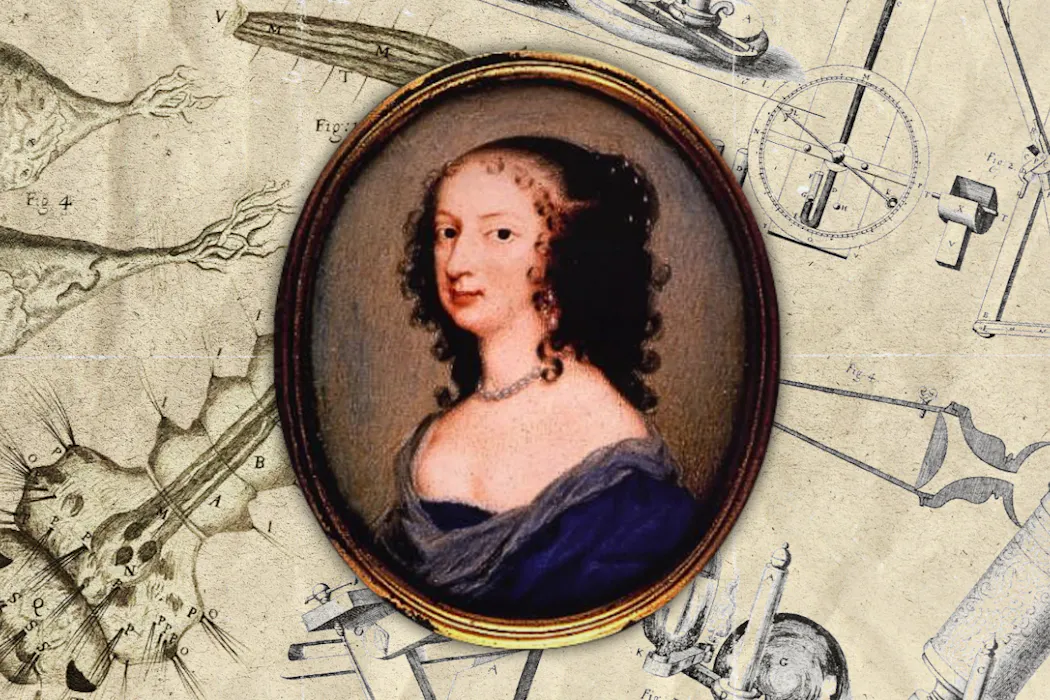
The Blazing World is a testament to how far the written novel has travelled in the past 400 years. A literary time capsule, it holds within it the origins of a genre we now call speculative fiction.
Written by Margaret Cavendish, a wealthy iconoclast who advocated for women’s educational opportunities, and published in 1666, The Blazing World is a strange work. Testament to this, its full title is The Description Of A New World Called The Blazing-World, written by The Thrice Noble, Illustrious, and Excellent Princess the Duchess of Newcastle.
The novel follows the journey of a woman who lives by the sea and is abducted by a travelling merchant from a strange land. His boat swiftly heads to the Arctic, where it threads between the ice and all the men on board freeze to death.
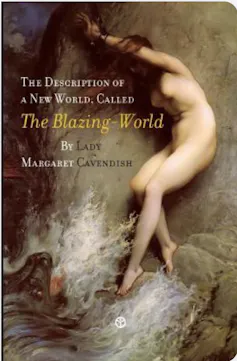
The North Pole of Earth is connected to the Pole of The Blazing World. Here, the hapless lady crosses into an alternate landscape where she is rescued by gentle bear-like creatures. These creatures deliver her as a gift to their emperor, who believes her a goddess (perhaps because she manages to learn their language so quickly) and marries her.
From here, the empress swiftly rises to a position of power. She travels through the land, interrogating representatives of all the various “peoples” who rule over their domains. These human-animal chimera include bear-men, worm-men, fish-men, geese-men, ape-men and lice-men.
The empress is the antithesis of a picaresque hero. Rather, she is an entitled figure with a thirst for new knowledge, unreflective about adopting an imperialistic leadership role in countries where she has only recently arrived.
Sci-fi or fantasy?
At the time, Cavendish’s book was written, European literature was dominated by playwrights, including Shakespeare and Ben Jonson, and poets, among them the three Johns: Donne, Milton and Dryden. Prose fiction, having flourished in older works such as The Decameron and Don Quixote, had fallen into the doldrums.
The Blazing World is sometimes called the first “science fiction” novel, but it has less reliance on science and more on fantasy or speculation. Science is present in swathes of information about the flora, fauna and geography of this new land, but such world-building – along with a central “what if” question – marks it as possibly the first work of speculative fiction.
The novel asks us: what if another world was an appendix to our own, populated with hybrid creatures specialising in different areas of science and technology?
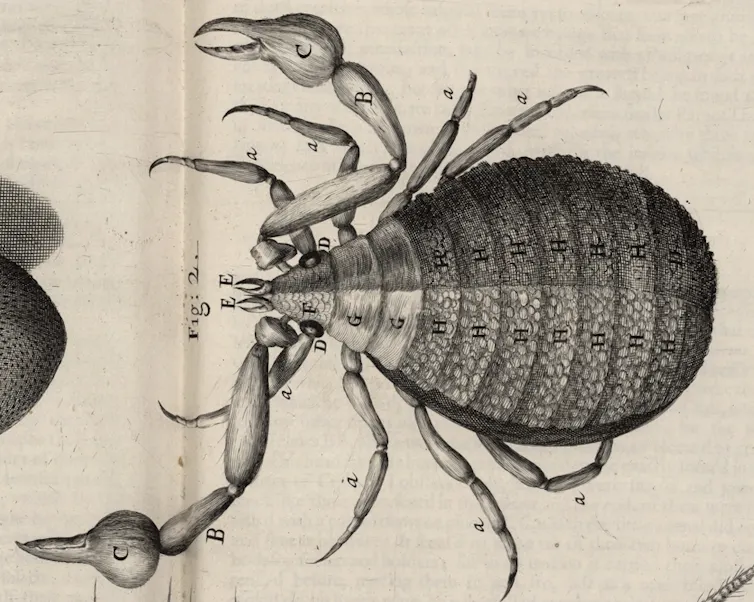
Interestingly, the science in the work includes the relatively new technologies of the microscope and the telescope. In 1665, Robert Hooke, curator of experiments at London’s Royal Society had published Micrographia, which included copperplate engravings of insects, rocks and plants in detail not previously seen.
After viewing lice in the microscope, the empress in the novel curtly asks if the microscope can stop the lice from biting the “poor beggars”. She quickly loses interest when she discovers that this solution is “below the noble study of microscopical observations”.
In an empowering and metafictional move, the empress is joined in the last third of the book by Cavendish herself, who adopts the role of a scribe known as The Soul of the Duchess, delivered to the Empress by the Spirits.
A trailblazer
Margaret Cavendish was an astonishing woman for her time. She loved fashion and put great effort into breaking gender conventions and wearing unconventional clothing. Her portraits are resplendent.
She was from a wealthy family and received a basic education, but began writing books at the age of 12. She entered the court of King Charles I at 20 as maid of honour to Queen Henrietta Maria, at a time of social unrest. During the English Civil War, her family home was ransacked, and she and her mother were paraded through the streets of Colchester and imprisoned. She later followed the heavily pregnant queen into exile in Paris on a ship under attack by Cromwell’s forces.
In France, she met the Marquess of Newcastle, William Cavendish, and married him, despite a 30 year age gap. The couple lived in Paris and Antwerp for 15 years, during which time Margaret met the key intellectuals of the age. These included philosophers Thomas Hobbes, Rene Descartes and Pierre Gassendi. The latter studied the atom, a topic which influenced The Blazing World.
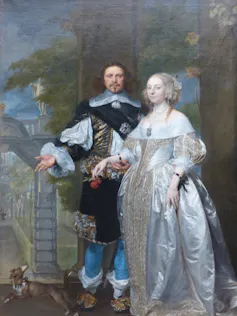
In 1660, the couple returned to England and were rewarded with the title of Duke and Duchess of Newcastle. Cavendish wrote various works which advocated educational opportunities for women at a time when only 10% of women had a basic education, compared to 30% of men.
The mid-17th century witnessed a small rise in publication of works by women authors, but these were mainly on childbearing, motherhood and religion. By comparison, Cavendish’s work was scandalous and cerebral.
Before The Blazing World, Cavendish wrote a radical play, The Female Academy (1662), which imagines a cloistered group of educated women who operate as an oracle of knowledge. Both works offer contradictions and raise more puzzling questions than they resolve about female education and gender roles.
In the 17th century, it was rare for women to publish under their own name, so Cavendish was a celebrity on that basis. Samuel Pepys’ diary tracks some of her antics and comments on her later play The Humourous Lovers (1667). “The whole story of this lady is a romance,” he notes, describing her play as “the most ridiculous thing that ever was wrote.”
Science and metafiction
The Royal Society was an exclusive and patriarchal hub of learning in 17th-century London. Cavendish takes a stab at this male-dominated society by interrogating the bear-men and commanding them to destroy the telescope:
your Glasses are false Informers, and instead of discovering the Truth, delude your Senses; Wherefore I Command you to break them, and let the Bird-men trust onely to their natural eyes, and examine Cœlestial Objects by the motions of their own Sense and Reason
Despite her criticisms of science, Cavendish was fascinated enough to write poetry about atoms and was the first woman invited to visit the Royal Society in May 1667.
Her admission was narrated by Pepys, who was excited by her appearance, despite her “not saying anything that was worth hearing”. His diary captures the moment when she is shown experiments with colours, loadstones, microscopes and liquors, one of which “turned a piece of roasted mutton into pure blood”.
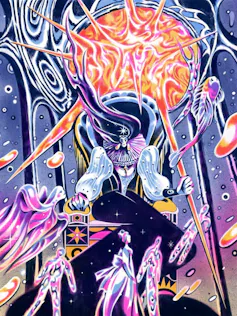
The novel draws on this experience, but the narrative goes on and on. Its lengthy circumlocution and dizzying, chapterless form has much in common with perplexing modernist novels.
In the third part, The Soul of the Duchess – Cavendish’s alter ego – quickly becomes the favourite advisor to the empress. Firm friends, they travel back to the Earth together, going to the theatre, visiting royalty and having a look around.
The Empress does not wish to stay in her native country, considering that she “did not enrich” that part of the world, so she and the Duchess return to the Blazing World. They journey on ships, which sink beneath the sea and travel across the Arctic Circle. Shortly thereafter, the Soul of the Duchess returns to Earth and spends her time telling stories of the empress, the bird-men, lice-men, ape-men and other human-animal chimera figures.
Margaret Cavendish draws outrageous pictures, indulging in grand speculations with an awfully conceited protagonist. Still, her novel foreshadows the Enlightenment, when the natural sciences fully blossomed.
She published 23 books in her lifetime, dying suddenly in 1673. She is buried in Westminster Abbey, with a marble effigy of her laying in a lavish gown, holding a book and pen. The inscription reads “This Dutches was a wise wittie & learned Lady, which her many Bookes do well testifie.”
The Blazing World is an amazing vision which ends as bewilderingly as it begins, making the reader’s head spin. A novel of this vintage by a woman is something to value and uphold for its achievement. It is a testament to anthologists and determined readers of women’s writing that the work survived in print for centuries.
This article was originally published on The Conversation. Read the original article.