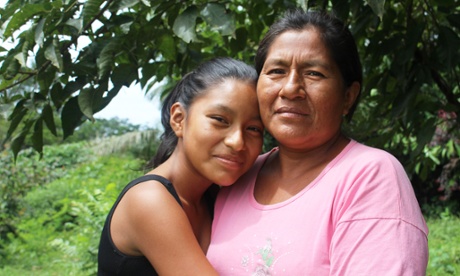
When Juana Payaba Cachique, the former president of the community of Tres Islas, walks into the open-air meeting space, a respectful silence settles over the room. By now, the journalists and visitors who have traveled here to learn about sustainable forest-based businesses have heard about the tortuous legal battle she fought, along with her sister Vilma and other community leaders, to defend this region of the Peruvian Amazon, known as Madre de Dios, from the ravages of gold mining. Her fight took her to the highest court of Peru, where she successfully defended the land rights of the Ese-Eja and Shipibo indigenous people in a landmark case that has become a beacon to other indigenous groups throughout Peru.
“As leaders, we have to think about the future and our children,” says Cachique, reflecting back on her sometimes harrowing journey. “We can’t think about ourselves.”
As Tres Islas leaders fought external threats to their land, the community began to address a complex challenge within: the question of how to balance the sustainable use of forest resources with the economic needs of the community. As one of six indigenous groups in La Asociación Forestal Indigena de Madre de Dios (Afimad), a local forest and farm management organization, Tres Islas has been working with the Rainforest Alliance since 2009 to conserve 76,000 acres (31,000 hectares) of land surrounding Madre de Dios through sustainable forest business development.
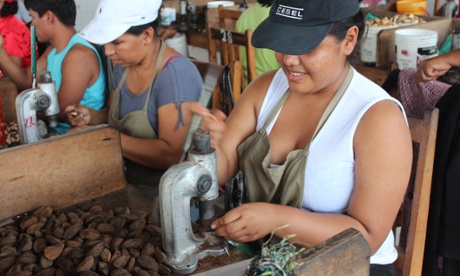
These initiatives protect this region’s abundant wildlife and support local livelihoods through the sustainable production of Brazil nuts, timber and palm fruit – all of which grow naturally in the rainforest. Through local training programs, community members have been learning how to manage their forests more sustainably, add value to their end products, access new markets and increase their incomes. These revenue-generating activities also provide important economic incentives to local communities to protect their rainforests. For these reasons, such initiatives are vital to the long-term health of the precious ecosystem that Cachique, Afimad president Martin Huypana and other residents of Tres Islas have fought so hard to protect – and to the continued self-determination of the indigenous people who live here.
A long road
The battle to defend Tres Islas against the negative impacts of increased mining began in 2010 (in the early years, Tres Islas residents themselves likely participated in small-scale mining activity). At the time, a public road cutting through Tres Islas had become a popular route for miners. An influx of new miners “not only destroyed the communal territory, but also brought an increase in bars and introduced child prostitution to the area,” Cachique says.
“There was always mining here, but it got to the point that there were miners here 24 hours a day,” she recalls. “They were destroying trees because they didn’t live here. It wasn’t their home, and they didn’t care about the land the way we did.”
The indigenous communities of Tres Islas have constitutionally protected rights to the land, but they quickly realized that in order to ensure the safety and well-being of their community, they needed to find a way to physically block the road frequented by miners. Cachique and a few other local leaders took matters in their own hands by closing off the thoroughfare. First, they built a fence and a toll, both of which were quickly felled by the miners. Next, they blocked off the road with boulders, only to have the miners return with a bulldozer.
The miners were not easily discouraged. Two mining companies immediately contacted local law enforcement, suing Cachique and other Tres Islas community leaders in an effort to force them to reopen the road. Tres Islas lost the initial court battle.
“I was really disappointed when we lost,” Cachique says, “but I knew we were going to win eventually.”
The Tres Islas leaders appealed the ruling, but they were defeated again during a second trial. Cachique and other community leaders worked to escalate the case to a higher Peruvian court to fight for the protection of the community’s constitutionally guaranteed land rights.
Eventually, Cachique traveled to Washington, DC to promote her cause and her husband stayed behind and cared for their 10-year-old daughter. “I went to the Inter-American Commission for Human Rights because we didn’t think Peru saw the problem the way we saw it,” she says.
Her trip to the United States tipped the scales. Peru’s Constitutional Court finally took the case and affirmed the community’s land rights in September 2012. Tres Islas was permitted to keep the road closed and protect their land from further encroachment. The victory was an enormous relief for Juana, who had received a stream of threats from mining officials throughout the three-year ordeal.
“A group of people with courage may prevail with the leadership of a brave and committed person,” says David Llanos, manager for the Rainforest Alliance’s training programs in Madre de Dios. Not only were Juana and her sister Vilma a catalyst for the indigenous community of Tres Islas; the legal case set a critical precedent for Peru’s 1,500 indigenous tribes by establishing their land rights in the country’s highest courts.
Through its work with Afimad and the Rainforest Alliance, the Tres Islas community has made substantive gains in developing sustainable forest-based businesses. But there is more work to be done to increase their market reach and ensure that these businesses can provide viable income streams for the next generation.
“We still need a lot of help because there are many things we want to do to achieve our financial and sustainability goals,” says Huypuna. “It’s really important to have partnerships with NGOs like the Rainforest Alliance. Please tell your countries that there is a community in Peru that is taking care of the forests for them,” Huypuna says.
Content on this page is provided by the Rainforest Alliance, supporter of the Vital Signs platform.