Military action won’t work
Your article by David Kilcullen – West must resolve to combat Isis (17 July) – demonstrates the validity of Georges Clémenceau’s warning, “War - a thing too serious to entrust to military men”. There are two classic principles of war that the author does not address: first is to know your enemy and second is to know your own realistic capabilities.
As for the first, we must recognise that Isis represents a phenomenon with which the military have little experience. This is a deeply fundamentalist religious war that has been going on for 1,300 years.
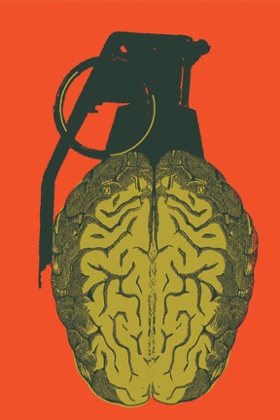
Second, as an ex-US air force fighter-pilot, I know that air forces have typically oversold their tactical capabilities to politicians who have minimal ideas of military “realities”. Isis is smart – it disperses forces and hides in cities. Air power has not been able to supplant boots on the ground, and putting boots on the ground would be foolish in the extreme.
So what is to be done? First, learn the lessons of history – you cannot change religious beliefs with bombs. Second, don’t abrogate complex political decisions to the military-industrial complex. Third, stop selling arms to anyone in the Middle East. Finally, deal with the Palestinian-Israeli conflict, because without doing so the hatred will never stop.
David Reed
Boulder, Colorado, US
Self-deception on warming
So, according to Laurence Tubiana, France’s climate change ambassador, the switch to a greener economy will involve “massive [green] acceleration” (Fossil fuel industry must ‘implode’, 17 July). Well, that certainly sounds great but I have strong misgivings about such statements of “green-growth”. Yes, what exactly does “acceleration” mean? Do we want our sunbeds and frappucino machines to be powered by renewable energy?
And what does talk of “investment” in the low-carbon economy mean? Does it mean, for example, more electric cars so that we can cruise around in “clean” vehicles, focusing in on the small percentage of electricity produced from wind and solar sources while ignoring the rest from nuclear and coal?
While the conclusions drawn in this article are frighteningly correct, the solutions being proposed are simply pie-in-the-sky. I will not believe that we are serious about preventing climate change until we finally agree to put our money where our mouth is. The obvious way to do this is to simply tax and regulate the “damaging factors” out of our economy.
This sounds draconian but if governments were brave enough to “take our consumerist toys away”, then local economies and supportive local societies would flourish and we would be a lot happier. You might take your holiday in Blackpool rather than in Bangkok and you might find yourself stitching shirts rather than peddling stock-futures but what is an economy for, if not to let the work of its members to provide for the needs of its members?
If we were prepared to step back from some of our pollution-intensive practices, then we would see that life could be better. Not easier, but better.
Alan Mitcham
Cologne, Germany
• Despite robust scientific evidence, we continue to cause global warming (eg, Plunging oil sets off new global contest, and Arctic oil drilling is ‘insane’, says Gore, as Shell exploration nears, 24 July). An important corrective can be found in the book A Perfect Moral Storm by philosopher Stephen Gardiner.
Gardiner’s says that our first moral tragedy is passing on the cost of climate change from the most affluent to the poorer citizens of the world. Second, the present generation is tempted to pass the problem on to future generations. Third, our poor grasp of science, international justice and the human relationship to nature helps to facilitate inaction. As a result, we are engaging in wilful self-deception, while the lives of future generations, the world’s poor and even the basic fabric of life are at stake. Gardiner concludes that we should wake up to this ethical failure, and demand more of our institutions, our leaders and ourselves.
Let us hope that whichever political leaders attend the Paris climate change conference in December have a broad grasp of the ethical issues involved.
Bryan Furnass
Canberra, Australia
Antipodean socialism
As an aside to Laurence Blair’s fine article on the failed Australian paradise in Paraguay in the 1890s (17 July), it’s worth pointing out that Australian utopian socialism didn’t only fail in South America but lost its way in the antipodean motherland as well. In that decade, colonial Australia had, as part of its makeup, a strong idealistic belief that it was possible to avoid the evils of the class-ridden old world in favour of a cooperative existence in the new.
That idealism was smashed by the colonial elites of the day. The compromised socialism that survived is what we have to live with down under today in an even more compromised form.
Terry Hewton
Adelaide, South Australia
Corbyn and the Labour party
The Jeremy Corbyn putsch seems unstoppable (24 July). Other UK Labour leadership candidates are faced the with the horrific prospect that their flight to the right isn’t as popular as they believed.
At one point in the leadership election I was pretty sure that, although I mostly agreed with him, I wasn’t going to vote for Corbyn. There were a couple of reasons, including the purely emotional one that he puts my teeth on edge, but mostly because I’m pretty sure he’s not got what it takes to lead the party to victory.
It’s a strong argument. But I don’t have any confidence that any of the other candidates has what it takes to get Labour elected either.
What I do know is that following the Tory-lite approach lost us the election. So I may as well go for a party leader who will at least return some sanity to this incessant drift to the right and who will set up Labour as a party with some soul and ethics again. If we are going to go down again, then let’s go down fighting for something worthwhile.
Ian Richardson
London, UK
Certainly not a failure
Nicholas Lezard’s review of the book National Service: A Generation in Uniform 1945-1963, entitled A failed experiment (17 July), does not explain who conducted the “experiment”, what its purpose was nor how it failed. Instead Lezard has produced a very lopsided rant about the negative aspects of National Service and not mentioned the positive side.
I went through National Service from 1946 to 1948, aged 19-21, and spent most of it in the Middle East. It was a very beneficial experience that led to a propensity to travel for much of my life and a university degree, which I could not have got without government financial assistance. I never had to face the barbed wire and alsatians Lezard mentions as obstacles to buying bags of chips. Certainly, privacy was at a premium, but so it was in boarding schools.
The main complaint was having to leave a girlfriend, but I never heard of any suicides, which Lezard states were “frequent”. My brothers and a couple of friends went through National Service and their experiences were similar.
Peter Browne
Ottawa, Canada
Briefly
• Like Umberto Eco as mentioned by Oliver Burkeman (10 July), many a student has entered my office with a look of wonderment on their face and with the same exclamation: “Have you read all these books?” My two stock replies, recycled randomly: “Yes. Every word” or “What do you mean by read?”
Stuart McKelvie
Sherbrooke, Quebec, Canada
• Can we ever understand a need to spoof unreal characters (May the fan force remain with you, 31 July)? What would psychology have to say? Maybe some sort of replacement therapy, a desire to achieve recognition outside of standard bounds. And what about spoof spoofs? The brilliant film Galaxy Quest is a dead-pan take-off on Star Trek. Unbeatable.
E Slack
L’Isle Jourdain, France
• How ironic to read (17 July) that a 1920 US law requires that all goods shipped from the US mainland to the US commonwealth of Puerto Rico be carried exclusively in US-registered vessels. Back in the late 1700s a rather similar British colonial law caused a group of highly disgruntled Bostonians to protest this restrictive trade practice by dumping a cargo of British shipped tea into Boston Harbor — with rather significant results.
David Bouvier
Gabriola, British Columbia, Canada
Email letters for publication to weekly.letters@theguardian.com including a full postal address and a reference to the article. Submissions may be edited for publication