Reimagining communities
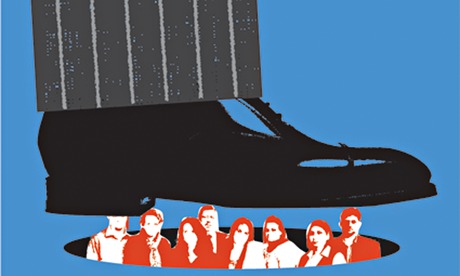
I read with interest the article Towns fear life after Walmart (12 February). I have seen towns in North America where the centres were hollowed out after big stores set up on their edges. That process was demoralising for small businesses and, in the long-term, for communities. The resulting jobs were very low paid, without skill, and often short-term.
Once the transition was made, people thought it would last. But Walmart acts only in its own corporate interest. In the meantime a lot of talent has been wasted. The local food and local goods movement emerged to counteract the big box stores and has been successful especially at creating food markets. But small companies producing high quality local goods are scarce, and can only succeed if they have a new kind of business plan and the support of their communities.
In less wealthy countries, many people still eke out a living making things and growing food so the marketplace seems vibrant even if the economy is poor. But in North America people have become passive, working for large companies of all kinds, and there is a lack of growth from the bottom up in local communities. Some places latch on to something that works and brings in tourists, but others just go downhill. It is sad but there has to be a public will to remake communities.
Time will tell what happens to towns after Walmart leaves, but people need to think differently about the future. In environmentally challenging times, hi-tech gizmos will not be enough.
L MacDowell
Toronto, Ontario, Canada
Poverty and population
As an irreligious medical student in 1951 I chose the fecund city of Dublin and its appropriately named Rotunda hospital to undertake a month’s internship in obstetrics (Ireland on brink of change as church power wanes, 26 February). My first patient presented with her 14th pregnancy, and my attempt to time it by asking the date of her last period met with the reply: “Sure, in 1936 I think.”
Most babies were then delivered at home, when the links between religion and poverty became apparent. I found some families living in a single room with no running water, yet with religious icons festooning the walls.
Later, Mary Robinson, herself a Catholic, became president of Ireland and persuaded politicians to allow the prescribing of contraceptives, perceiving the link between overpopulation and poverty.
Pope Francis could make a great contribution to humanity by consenting to widespread distribution of contraceptive technologies. He would gain even greater approval of his flock by allowing priests to marry and opening the priesthood to women.
Bryan Furnass
Canberra, ACT, Australia
An economic SOS
I suggest that Owen Jones’ call (19 February) for the left to develop a coherent alternative to current austerity is likely to be realised by people outside the political establishment. Yet those outsiders need to be close enough to the system to be within the earshot of our politicians, whose focus is usually on shorter-term matters.
The economics journalist Paul Mason, in his recent book Postcapitalism, seems to have developed such a coherent alternative. I have been a practising economist for 30 years and I am amazed that this book’s comprehensive scope, depth of analysis and way forward has not been taken up in a big way – particularly so when newspapers are calling for such an alternative to be put forward.
We need newspapers such as the Guardian Weekly to be the town criers on this issue. Without that how are politicians going to digest it and take the lead before the hard-hearted and the myopic rise to fill the vacuum? This is an SOS.
Tony Camenzuli
Mardi, NSW, Australia
Science of radioactivity
As Hiroshima and Nagasaki fade from our memories, the generation culpable going to the grave, Australia’s advance towards nuclear waste (19 February) starts to make financial sense. Not only will they make money simply doing what no one else wants to do, but as the safety regulations creep into line with the science of radioactivity then that work will itself get cheaper.
Current regulations emerged from the culture of fear surrounding 1945 and then the cold war. The Fukushima nuclear power plant disaster fuelled public paranoia, but we can’t resist the benefits of nuclear medicine. It reveals the diverse mechanisms with which the human body, indeed all living organisms, handle radiation: either repairing damaged cells or removing them.
As soon as the International Committee for Radiological Protection brings regulations in line with knowledge, those Australian contractors will make a huge saving on the day-to-day costs of storage and be laughing all the way to the bank. Where there’s muck, there’s money.
Richard Crane
Vallon Pont d’Arc, France
Detroit’s techno hard times
How could Ian Wylie (19 February) talk about the Detroit music scene without mentioning Detroit techno? His revelation about the role of pianos in relation to Motown was fascinating, but wouldn’t it have been interesting to find out about the music that was made in the city when industry – and prosperity – deserted the downtown area?
True, the techno scene in Berlin is significant, but with Detroit a simple before and after would have shown how strongly the built environment influences music, from upbeat, commercially viable Motown in boom times to a darker, raw and uncompromising sound with a devoted but minority following in hard times.
John Cooper
Vancouver, British Columbia, Canada
Botswana’s uncertain future
In the Review article Shine starts to fade on Botswana’s diamond dividend (12 February), the failings that an apparently thriving regional economy has failed to address – from the “mud huts and shacks with few amenities” in which the bushmen now live to the failure of corporate social responsibility, from “the stricken...pipeline to a botched $1.2bn power station contract” – are all the direct result of failed technologies.
It’s often difficult to foresee the ill effects of new technologies. But no foresight is required to see that none of the supposed solutions to Botswana’s predicament amount to anything more than business as usual. The technological juggernaut regenerates itself at the expense of planetary ecology and the local populace. More grist to the mill.
The tourism industry is, as always, touted as the ideal successor to other failed industries. But which aspects of tourism promote ecological sustainability - increased air traffic, hotel construction, roads and other essential infrastructure? Coal and iron ore are proposed for energy and steel production. Aren’t these what we’re supposed to be leaving in the ground?
Might not Botswana take this opportunity to move away from the western myth of industrial development toward a more equitable, sustainable economy that benefits its people without detriment to global ecology?
Andrew Hallifax
Örebro, Sweden
Housing and ownership
With regards to the article Under-35s in the UK face becoming permanent renters (19 February), there is a further economic consequence of the UK housing shortage. When the 18-34 year age group eventually die, most will still be renters. In common with the present trend many will be in debt, but will not have significant assets with which to pay it off. Consequently, they will be passing debts on to their children (if they have any), not assets. Who will pick up the bill? The Treasury, ie taxpayers!
Malcolm March
Dorchester, Dorset, UK
• The story on housing affordability in the UK begs the question: why do we need to own a home? As the side-piece by Dan Hancox sagely comments, the future for the young and mobile at least will be living “under someone else’s roof”. Since this seems inevitable, why not cast off the postwar millstone of home ownership as a lifetime goal? It is something that bedevils buyers and investors, as well as policy-makers.
Noel Bird
Boreen Point, Queensland, Australia
Briefly
• We shouldn’t get too upset at developments in computing power and software that enable machines to beat humans at complex games such as chess and Go (12 February). These are games with clearly defined rules that are simplicity itself compared with the real world. Computer modelling too often includes poorly known relationships, and every day we read of its failures to predict outcomes in fields as diverse as climate change and financial markets because we don’t have the knowledge enabling us to model them accurately, not because of insufficient computing power.
David Barker
Bunbury, Western Australia
• Noah Berlatsky’s column (On drama, 19 February) covers the re-emergence of counterfactual fiction and drama, whereby “what if’s” are reimagined as having actually occurred. Such imaginative fables, Berlatsky explains, ‘help us understand the world’ by bringing to life other possible outcomes. This surely is one of the reasons for local interest in Canadian playwright Alix Sobler’s recent play The Secret Annex, which depicts a 25-year-old Anne Frank as having survived the Nazis and living in post-war New York.
Richard Orlando
Westmount, Quebec, Canada
• In Cosmic Classroom (12 February), we were told that Tim Peake is “the first official British astronaut to carry out a space walk”. Are we to infer that there are a few unofficial Brits wandering around up there?
Anthony Walter
Surrey, British Columbia, Canada
Email letters for publication to weekly.letters@theguardian.com