Toward the next intifada
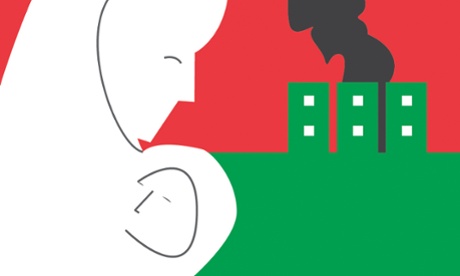
I found Peter Beaumont’s piece (Dark clouds form over Israel and Palestine, 16 October) very insightful. I hope that recent events in the Israeli occupied West Bank have awakened more people to what’s really going on in Palestine and have helped them to see who are the oppressors and who are the oppressed in this situation. And that this will embolden more people to speak up and do something to help and support the Palestinian people. Because Palestinians have already suffered far too much, for far too long, the loss of their homeland, displacement, ethnic cleansing, dispossession, cruel abuses, atrocities and hundreds of thousands of deaths.
The west cannot remain indifferent to the plight of the Palestinian people and be silent because Jews were persecuted by others during the second world war. Why must Palestinians continue to pay the terrible price for this past tragedy, which was nothing to do with them? An injustice committed against one people does not justify an injustice inflicted against another people. Without justice, respect and the restoration of Palestinian rights there will be no real peace in Palestine. Let’s not ignore cruel repression or allow the maiming and deaths of thousands more Palestinian children, women and men to go unnoticed and without doing something to stop this gross mistreatment.
Steven Katsineris
Hurstbridge, Victoria, Australia
• If young girls “joining in clashes” with Israelis are wearing keffiyehs to hide their identities, then the Guardian isn’t doing them any favours by publishing a photograph of a girl who I would instantly recognise as my daughter if I were her mother. Or do all almond-eyed women wearing a head covering look the same?
And why, then, are the boys wearing keffiyehs as well? The reason is that they help protect from the teargas systematically fired by Israeli soldiers in any situation they construe as threatening.
This may seem a trivial point given the horrors of what’s going on, but it’s the kind of toxic detail – suggesting that Arab girls are afraid of their parents –that spreads biased perceptions about human beings involved in any conflict. And quoting the opinion that these girls are acting out of “romantic” ideas doesn’t help: were the women resisting occupation in the second world war being “romantic”? And how would they be feeling now, if that occupation were still in place 60 years on?
Ilona Bossanyi
St Sardos, France
TPP, business and democracy
Thank you for allowing Brenda the Civil Disobedience Penguin to explain the Trans-Pacific Partnership (First Dog on the Moon, 16 October). Whereas one can understand the need for industrial and technical standards between countries to be harmonised, thus promoting better trade relationships, it does seem the agreements currently under discussion go far beyond mere technicalities. Thus the TTP and its big brother, the Transatlantic Trade and Investment Partnership, seem set to undermine the democratic processes of nations concerned. This surely cannot be right. We must be on our guard to ensure that, to paraphrase Abraham Lincoln: government of the people, by big business, for big business, shall not be allowed to take over the world.
Derek Malpass
Hohenthann, Germany
Dawkins’s human failings
With attention brought to Richard Dawkins in particular and atheists in general, the review of Dawkins’s book, Brief Candle in the Dark (2 October) may be the crack in the door to attract balanced comments from the silent throngs of people who understand what the gaping hole in Dawkins’s life is and how he can be a challenging scientist to other scientists but has next to nothing to offer people in general.
With his well-developed intellect he has produced theories and books but neither the ideas nor the books address the matrix of his humanness within which they were created: feelings, emotions, intuition, spirit and inner truth. The Unknown has been squeezed out completely! The Tao symbol, a circle divided with a gently s-shaped line into equal halves, symbolises life and its pairs of opposites that we work, play and create with every day of our lives.
Mary MacMakin
Kabul, Afghanistan
US and campaign financing
I wonder if Timothy Garton Ash has been in hibernation, given how out-of-date and limited his comments on campaign financing were (9 October). He missed the bigger picture: that one of the key problems holding the US back is the wilful misreading of its own constitution. This produces not only the idiotic Citizens United decision, but also the crazy political stance on unrestricted personal access to guns.
I don’t doubt that scheming politicians are trying to find “bendable” phrases in the constitution that will help to abort any action on climate change or the mass extinction of fauna and flora that is under way.
The supreme court reflects the biases and lack of foresight of the presidents who appointed them. One answer to the question at the top of the article is: the US will repair its damaged democracy only when the present supreme court is replaced by a sensible group of thinkers with human perspective.
I doubt Churchill would still make the optimistic remark about America doing the right thing. Instead he might say “World: don’t hold your breath”.
David Hinkley
Santa Barbara, California, US
Canada doesn’t need a wall
Canada doesn’t need to build a wall along its border with the United States (16 October). One exists already – the wall of indifference.
Americans, for example, are far more interested at the moment in Donald Trump and its own coming election than they were in ours, which resulted in the young and attractive Liberal Justin Trudeau being elected prime minister by a vast majority, after the long 10-year reign of staid Conservative Stephen Harper.
Perhaps now with the re-emergence of the Trudeau name, which harks back to the heady era from the 60s, 70s, and early 80s, with all its pizzazz and glamour, American indifference may change to perhaps a passing squint.
Richard Orlando
Westmount, Quebec, Canada
Saving the Cornish language
I read Jessica Elgot’s recent article Pride of Piran (23 October), about efforts to preserve and promote the Cornish language. Here in Australia minority languages have withered and died at a rate that rivals, I would guess, that of animal species’ extinction. Six extinct Aboriginal languages are listed on a single page of my Australian Oxford Dictionary.
Let me suggest two practical solutions. First, call global tenders for Cornish call-centre contracts. Within a year there will be hundreds of Cornish speakers in India, the Philippines and other countries that specialise in this service. Second, establish a special immigration quota for which applicants must pass a written and oral examination in Cornish.
John Standingford
Adelaide, South Australia
Hope for humanity yet
I read Oliver Burkeman’s columns before meeting him recently at my son’s wedding in upstate New York. His review of Geoff Colvin’s book Humans are Underrated (9 October), about things we should never yield to computers, reaffirms my loyalty.
Burkeman rightly agrees with the author that cheek-by-jowl contact between judge and accused, therapist and patient, teacher and student, is irreplaceable. But does being beaten down by the meaninglessness of existence preclude striving for greater humanness? If so, why? If we’re certain of defeat, why resist the beating? Why don’t we jaded adults emulate our children’s hopefulness? Must there be a point when we give up fighting to become more human?
Weddings and other feasts with the friendly give hope all is not relinquished to computer technology.
Gerald Mikkelson
Lawrence, Kansas, US
• The juxtaposition of Oliver Burkeman’s musings on human redundancy in the jobs market with the Shortcut Humans told not to have sex with robots (9 October) suggests that at least the oldest profession will continue to provide job security in the future.
Kirsten King
Cologna Veneta, Italy
Briefly
• Procrastination is indeed a waste of time (16 October). It’s called Parkinson’s Law: “Work expands so as to fill the time available for its completion’’ (1955).
Priscilla Trench
London, UK
• Your article about small snails found in China with shells only 0.86mm high (9 October) suggests that 10 of them could fit in the eye of a needle. At 8.6mm that eye, although not large enough for a camel, would be quite sizeable. Did you mean a bodkin?
Anthony Walter
Surrey, British Columbia, Canada
Email letters for publication to weekly.letters@theguardian.com