Empathy in the Trump era
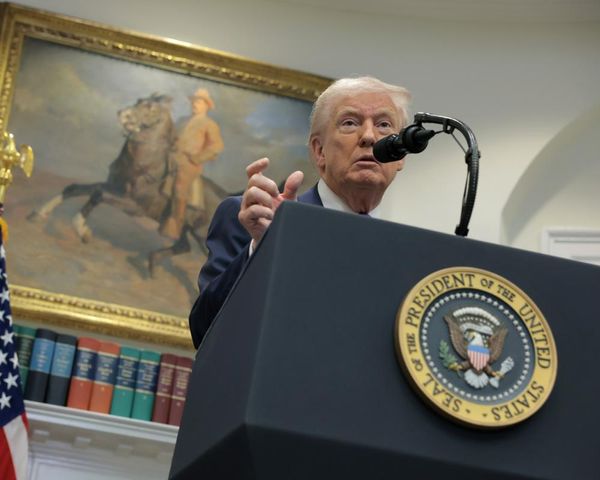
Anyone who is even in remote contact with talking and texting devices rarely enjoys a Trump-free day any more. Hence the humour we can apply to this phenomenon in these “dark times” (Steven Johnson, 17 February) is a very welcome form of comic relief.
Those who have a distaste for satire and farce may want to attempt more compatible ways to defend themselves against this Twitter-enhanced, overbearing reality. Ways that include reviving their formerly dormant political conscience-with-responsibility, or simply reacting with a moral disdain so strong that it stonewalls any chance of contamination.
Then there is the way of empathy, a polar opposite to disdain, a literary device often used by our great writers to reveal the unhappy, often tortured lives of those of their characters who are trapped by their own inadequacies, and the tragic consequences of despair that result.
The writer Steven Wineman suggests that in regard to Trump, such empathy can reflect the better angels of our nature. Trump, says Wineman, “goads, he badgers, he offends, he provokes. He invites us to respond at his level of discourse.” He adds that the president “appeals to the worst selves of his adversaries”. But Wineman cautions that “we can’t afford to fall into the trap of counter-demonising our demonisers”, and reminds us that empathy and compassion are not only tools of resistance, but ways of “safeguarding the humanity of those who resist”.
Richard Orlando
Westmount, Quebec, Canada
• Richard Wolffe’s account of Donald Trump’s recent farcical press conference (It would be funny, if it weren’t so alarming, 24 February) clearly delineates Trump as many of us see him – an incompetent clown attempting to juggle nuclear balloons. The counterpoint was provided in the same issue by Geoffrey Kabaservice in his quest to discover why so many otherwise intelligent Americans support Trump.
The parallel with the Brexit vote has been made many times, but it bears repetition. Worldwide many voters are sick and tired of the false debate between establishment politicians from slightly-to-the-right-of-centre and those from almost-left-of-centre.
What is the solution for those of us who perhaps secretly support this lemming-like rush toward anarchy, but deeply distrust the deranged – or simply deluded – demagogues who have seized this opportunity to promote their own inscrutable personal and political ends? Not an easy question to answer: however, if we fail to debate our available alternatives in a constructive manner, we may one day wake up to find we have left it too late.
Noel Bird
Boreen Point, Queensland, Australia
• Donald Trump’s recent press conference (24 February) is not an episode from a dystopia by Orwell or Huxley. Rather, it is arguably closer to a (hypothetical) scene from Pirandello’s play Enrico IV, in which the protagonist, a modern Italian aristocrat, falls from his horse and awakes believing he is an 11th-century Holy Roman Emperor; his entourage conspires to keep him in this delusion. Tom Stoppard has provided an English version (Grove) of the play.
In a West End/Westside production, Alec Baldwin could play the title role in a Harpo wig. The Saturday Night Live cast could play Trump’s family and White House Staff. Leslie Jones could play the black reporter, while Senator Al Franken, who has reported that his Republican colleagues in the Senate have expressed doubts about the president’s mental health, could play the doctor Dionisio Genoni or Baron Tito Belcredi, the protagonist’s nemesis and rival in love (who also caused him to fall off his horse). This should prove more vastly fun than any adaptation of 1984 or Brave New World.
Jeffry Larson
Hamden, Connecticut, US
Germany and the left
While polls might indeed fuel the German left’s hopes (24 February), these have been shattered for over 100 years. Two things are noteworthy. First, it remains imperative to understand that Germany has not one but two lefts. One is the mighty Social Democratic party (SPD) left and the other is the radical left.
Second, throughout history, the radical left’s hopes have been smashed by the SPD over and over again. In 1914, the radical left hoped the SPD would not support the looming war, but this hope was shattered. The SPD signed up to war. After the first world war, in 1918-19, the radical left hoped for basic democracy, and an end to militarism and capitalism. This hope was again destroyed as the SPD betrayed the revolution. Many workers were killed by Gustav Noske and Friedrich Ebert’s SPD.
At the end of the Weimar Republic, in 1933, the radical left hoped for a call to arms to fight Nazism. Again, this hope was smashed. A few days after Hitler’s takeover, the German left vanished into Nazi torture centres and early concentration camps.
Fast forward to recent times and you will find the continuation of a history of shattered hopes and dreams. Only a few years ago, the radical left and the SPD had a solid majority in my home state of Hessen. But the SPD destroyed the hopes for a left state government by enabling an arch-conservative to become state premier.
Finally, during the last federal election, in 2013, the SPD won 193 seats and the radical left 127, together reaching 320 and thereby easily beating Angela Merkel’s conservatives, who won 311 seats. But the hopes for a government of the left were once again crushed mercilessly by the SPD. Instead of a progressive government, the party supported Merkel.
What can we learn from this history of shattered dreams? Even if the SPD’s rising star, Martin Schulz, wins, it does not look good for the hopes and dreams of the left, given this sad history.
Thomas Klikauer
Riedstadt, Germany
Science and the non-physical
Book reviewer Ian Thompson (10 February) says that science has never been about certainties. However, that doesn’t stop him from repeating the misleading metaphors that physics “underpins” the rest of reality and that atoms are the “building blocks” of the universe.
These phrases are misleading because they don’t distinguish between necessary and sufficient conditions. Physics studies the necessary physical conditions of the universe, but it is the addition of the non-physical sufficient conditions (such as mind and spirit) which are essential for understanding reality. The belief that physical conditions alone explain reality is just as much a false “cosy certainty” as the non-scientific ones that scientists complain about.
Stephen Porsche
Vancouver, BC, Canada
Trudeau’s vote winner
How ironic that Canadian prime minister Justin Trudeau is quoted by a correspondent (Reply, 17 February) in support of moving from first past the post (FPTP) to proportional representation, as a means to “help with gender equality”.
As reported in the issue’s World roundup, Trudeau has now jettisoned his solemn campaign commitment that “2015 will be the last election held under first past the post”, having decided that the FPTP system, which secured his parliamentary majority despite only 39% popular support, wasn’t really so bad after all. And, rather than announce this reversal himself, Trudeau appointed the twentysomething Karina Gould as a junior minister and then made her do it.
David Josephy
Guelph, Ontario, Canada
The classical gender divide
Touchingly old-fashioned conductor Vasily Petrenko (Women step up to the podium, 24 February) disapproves of female conductors not only because they would be better making a home for their families but because they distract musicians. We love his assumption that musicians are by definition male. What do you bet there’s the odd female oboist or double bass producing bum notes because she’s got the hots for Mr Petrenko?
Joyce and George Schlesinger
Durham, UK
The price of church unity
Giles Fraser is rightly scathing in his critique of the bishops of the Church of England and their insipid report on same-sex marriage (24 February). Their “self-imposed anxiety” concerns maintaining their corporate identity, but they have probably been influenced by the need to maintain the unity of the Anglican communion. The acceptance of a report advocating gay marriage in church might have led to secession of the African provinces.
We give too high a priority to maintaining unity. Progress is made only when division is recognised honestly and worked through with mutual respect. Gandhi once said that even if you are in a minority of one, the truth is still the truth.
Graham Davey
Bristol, UK
Briefly
• Regardless of its insight, the article on Drew Barrymore (17 February) only featured because she is famous. We have millions of humble heroes with stories to tell. Why not write about people of real cultural significance, such as my mum’s friend who moved back to the UK with her brain-injured boy because your broken NHS offers him more than our NZ health system? Stop your celebrity worship; you can do better than this.
Henrietta Sushames
Wellington, New Zealand
• We note in World roundup of 17 February that the number of monarch butterflies wintering in Mexico has dropped by 27% this year. Meanwhile, in Auckland we are inundated with monarchs. We have never seen so many in our surrounding area, and in the local nursery. This may be the result of people planting Swan plants (Gomphocarpus physocarpus) which monarch butterflies love, and breed on.
Mary Buckland
Auckland, New Zealand
• In your 13 January issue, both Pankaj Mishra and Wolfgang Streek have intelligent analyses of the dire state of the capitalistic world, but like most others these days have left out what has come to be the blind spot. The thinking that led to communism must be taken into account now for any solution. We ignore Marx at our peril.
Sarah Montagu
Florence, Italy
• So the UK government said it would accept 3,000 lone child refugees, but that turns out to mean just 350 (17 February). Then, to quote Macbeth, “be these juggling fiends no more believ’d / That palter with us in a double sense, / That keep the word of promise to our ear / And break it to our hope”.
Mark Harvey
St Denis de Cabanne, France
Email letters for publication to weekly.letters@theguardian.com – please include issue dates and headlines for articles referenced in your letter