The real cost of bombing
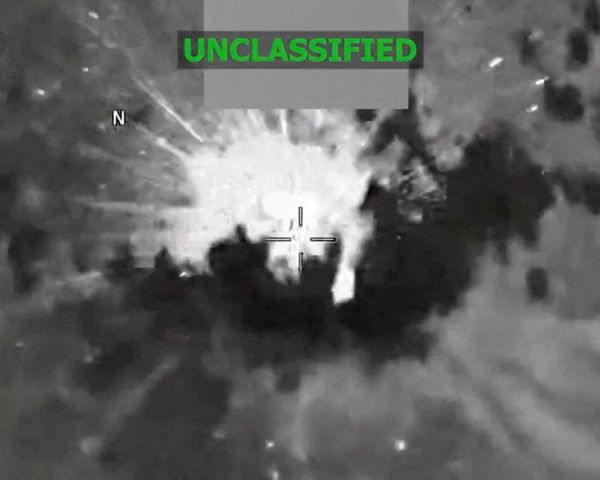
The use of one of the US military’s largest non-nuclear explosive devices – the Moab – to kill jihadis in Afghanistan is baffling in more than just military and economic terms (21 April). What is consistently overlooked, besides the effect on the natural world, is that the dropping of the bomb also involved the destruction of the vast resources – human, material and financial – that were utilised in its development and manufacture.
This has an economic cost that is disregarded by conventional economics. The American corporations were paid, the US government recorded the production as a positive contribution to GDP and the country got richer, right?
Wrong. The effort expended to create this destructive force can also be argued to have destroyed previously existing wealth in the form of resources that could have been used for beneficial purposes.
Geoff Naylor
Winchester, UK
McGuinness’s legacy
The piece on the future of Ireland after Martin McGuinness (14 April) paints a picture that is not shared by all those from Northern Ireland. To refer to him as “a hero” and “a towering figure in Irish history” presents an idealised perspective in denial of his past as a terrorist and key figure in the IRA.
Brexit has crystallised questions about the future of Northern Ireland: whether the province will stay in the UK or consider becoming part of a united Ireland. Yet it is presumptuous to ponder these issues when the political future in Northern Ireland has yet to be decided. Talks on resurrecting a power-sharing government may fail, raising the possibility of another election in Northern Ireland or even direct rule from Westminster.
Whatever the outcome, it is hoped that it will be in the best interests of Northern Ireland.
Una Williamson
Bexley, NSW, Australia
• Lisa O’Carroll is right to advance the view that Martin McGuinness’s concentration on “the things that join us in a common humanity” is the way forward at a time of “extraordinary upheaval in Northern Ireland”. Certainly that approach aligns with the thinking of the Martin McGuinness I met in Adelaide in December 2000.
He was here on a largely unheralded visit as Northern Ireland’s education minister in the new power sharing arrangement to draw attention to the progress being made in the implementation of the 1998 Good Friday Agreement.
This was minister of education McGuinness – not the McGuinness of the bombs and bullets: a prime example of someone who was yesterday’s terrorist and today’s statesman.
McGuinness showed strong empathy for the young people of Northern Ireland and the need to repair the damage done to them by the conflict. These young people, he said, “want to lead a normal life … in a society where there [aren’t] soldiers and military vehicles driving about all over the place – where there [isn’t] death on the streets.”
Let’s hope his legacy can carry the day at a time when peace in Northern Ireland does indeed remain fragile.
Terry Hewton
Adelaide, South Australia
The importance of protest
In her article Protest and Persist (7 April), Rebecca Solnit quotes LA Kaufman’s claim that the first significant action against nuclear power occurred in 1976. In the early 1960s the Pacific Gas and Electric Company (PGE) proposed building a nuclear power station on Bodega Head, about 65km north of San Francisco.
PGE had already dug the hole for the core of the reactor before a group of protesters, led by Joe Neilands and the Sierra Club, got wind of the proposal. They mounted a protest that led to PGE abandoning the plan. Geologists who examined the excavation on Bodega Head at the behest of the protesters reported that the San Andreas fault ran through it.
Tony Warren
Vancouver, British Columbia, Canada
Celebrating Easter
Peter Ormerod’s justifiable rant (14 April) about the absurdity of chocolate Easter eggs overlooked the Easter bunny. In Australia we celebrate of all things the fertility and fecundity of our worst-ever vertebrate pest.
Twenty-four wild rabbits were brought to Victoria in 1859. By the turn of the century about 2 billion ravaged the countryside despite massive episodes of shooting, trapping, poisoning, fumigating, warren ripping, corralling and netting fences. Only the myxoma virus in 1950 ended the rabbit plagues.
Several Australian chocolate manufacturers now celebrate the Easter bilby, a native burrower, rather than the rabbit. Some materially support bilby conservation and rabbit control while others treat it solely as a marketing opportunity.
Cute as it is, the bilby will never be domesticated and has little to do with Easter. But if can come to symbolise a rebirth of nature after man’s foolishness, then it could be a very good thing.
Bruce Munday
Mt Torrens, South Australia
Briefly
• Curious juxtaposition of the two headlines (Opinion in brief, 7 April): We must check invasive species. But not daffs, and How to spot a narcissist? The daffodil is, of course, the large yellow Narcissus.
Anthony Walter
Surrey, British Columbia, Canada
Email letters for publication to weekly.letters@theguardian.com please include issue dates and headlines for articles referenced in your letter