Globalisation is no answer
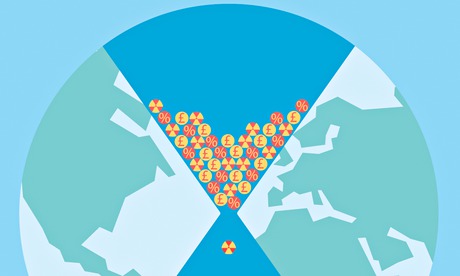
Has globalisation hit the wall? (29 May). Yes it has, up to a point. It is no longer widely believed to be the panacea for the world’s ills. But the more pertinent question is: can the world survive globalisation?
No one can reasonably deny the systemic despoliation of the environment since the rule of global deregulation and for-profit privatisation. The air, soil and water are poisoned and degraded. Species are made extinct at a great rate. The level of waste increases to endanger life at all levels. Public services are defunded and abandoned as tax evasion by the rich increases. The global food system produces more and more disabling and contaminated junk. Lethal military production increases. Perhaps most dismally, the vocational future of the next generation is being driven to collapse.
Surely it is time to address globalisation as a cause of our plight, not a universal global goal.
John McMurtry
Guelph, Ontario, Canada
• Against trade liberalisation initiatives such as the Trans-Pacific Partnership (TPP), Heather Stewart identifies a public backlash motivated by consumers worried that multinational corporations will be given too much control. The US wants the TPP to counter the growing economic clout of China rather than to improve prosperity. In Australia and New Zealand, consumers are unhappy with the TPP not only because they are worried about multinationals or being caught in the middle of a geopolitical standoff. They are also rightly nervous that TPP negotiations are conducted in complete secrecy.
When even senior government personnel and member of opposition parties are excluded from TPP proposals, a public backlash is inevitable. The campaigns against globalisation are also symptomatic of a loss of trust by a voting public.
Jan Noordhof
Christchurch, New Zealand
We must tax energy heavily
I read your editorial Keep it in the ground (29 May) encouraging organisations such as the Gates Foundation to divest from fossil fuel. While I find this campaign most worthy in every sense, I feel that both the Guardian and many other campaign bodies are unfortunately tip-toeing around the elephant in the room. To keep it in the ground, you need to decide to actually not burn it and, although the talk is all about putting up wind turbines and photovoltaic panels, this will only cover part of the reduction needed. The quickest and most obvious path to emissions-reduction is to actively reduce demand.
We need to put heavy taxes and stiff regulation on our polluting activities in order to get things under control. Of course such measures would be enormously unpopular, but what other option does the planet have? A few extra wind-turbines will not help if we are still flitting around in SUVs or jetting off to go shopping in New York.
Spiralling fuel prices would certainly close down many overstretched corporate air networks, depriving us of a lot of cut-price deals. But then innovative local small-scale commerce would need to step into the breach to cover the shortfall, which would be the best possible solution.
So let’s open our eyes and give our governments a mandate to really push us to change our lifestyles.
Alan Mitcham
Cologne, Germany
• As the Guardian editorial clearly points out, it is morally difficult, if not impossible, for ecologist groups to be associated with – or even worse – to profit from oil companies. They have practically no choice. However, the important issue is whether other groups should do the same. Divesting will not reduce the consumption of oil nor the oil companies’ real profits.
In fact, if the practice of divesting is widespread, shareholder meetings will not even have a minority of climate-concerned investors to challenge the oil companies’ worst policies. This is regrettable and harmful to the ecologists’ cause. Potentially lower oil share prices due to divesting may attract investors who only care about profit and dismiss ecology totally.
It will also make it easier for some fast-developing countries such as China to buy these shares in order to control more oil companies, because these countries badly need oil. On balance, divesting seems to be a necessity for some ecologists but, in reality, it is simply a gesture of very doubtful practical utility.
Francois Jeanjean
Ottawa, Canada
Cultural damage is a tragedy
Regarding the article Will the ancient wonders of Palmyra be spared destruction? (29 May): the comment that “disproportionate attention” has been paid to the ancient ruins compared with the human tragedies concerned me. Neither the human tragedy nor the loss of priceless cultural heritage has received anything close to sufficient attention outside of the Middle East, but in reality the two tragedies should not be compared. They are different sides of the same human tragedy.
Destruction of cultural heritage is akin to destroying the memory of humanity, and there is a long history of people going to great lengths to both protect and rebuild cultural heritage. To consider that such destruction is not worthy of attention to the same extent as the human tragedy is akin to considering that the physical body of a human is more important than a mind and memories. Cultural heritage – including ancient ruins – is our mind and memories, and is equally important. Ironically it seems only those intent on destroying cultural heritage, such as Islamic State, who seem to really appreciate this.
Caroline Sandes
London, UK
America’s belligerent habit
“To redefine the truth of the past” or to remedy our “selective hearing” over the Iraq wars, as Gary Younge puts it, would require the stature of a Robert McNamara (his Wilson’s Ghost) – ie Dick Cheney or Donald Rumsfeld or Tony Blair to come clean in a sincere mea culpa (29 May). But there remain many folks in the US who regard the Vietnam war as a virtuous one, as all US military involvements are virtuous, by definition. Benjamin Franklin’s adage “There never was a good war or a bad peace” has not caught on.
RM Fransson
Wheat Ridge, Colorado, US
• In his article America still avoids the truth over Iraq, Gary Younge has written the best simile I have ever read: “The troops may have left, but the fallout from the conflict lingers in the American polity, clinging to its elites like stale cigarette smoke to an Aran sweater – it stinks and they just can’t shake it.” This is so very true!
Molly Radke
Poulsbo, Washington, US
Property is not a commodity
Melissa Davey’s article on the Australian government’s decision to revoke Norfolk Island’s autonomy (29 May) raises an important issue: when does government have the mandate to override the will of the majority in a referendum?
Clearly the concept so succinctly demonstrated in the words of Lisle Snell, chief minister of Norfolk Island, is totally alien to the Tony Abbott government: “We don’t see property as a commodity. We are caretakers of the land – we are nothing without our land.”
Perhaps the original caretakers of Australia, the indigenous people, had the right idea all along?
Noel Bird
Boreen Point, Queensland, Australia
Surgery can save a city
You could have mentioned an example closer to home in Open-heart surgery to save Medellin (29 May). Düsseldorf buried the multi-lane dual-carriageway that separated the city from the river in 1993. Of course, people opposed the project at the time. It started to win prizes even during the planning, and continued to do so after completion.
The Rheinuferpromenade on top of the tunnel was finished two years later and has since won the hearts of Düsseldorfers, who stroll, cycle, skateboard, sit outside cafes and bars, and enjoy festivals all year round by the river Rhine. It has been so successful that the city is talking of extending the tunnel northwards.
Peter Lancashire
Düsseldorf, Germany
Briefly
• As a foreign observer, I am amazed that the summary of Tony Blair’s premiership (29 May) says not a single word of his definitive and courageous undertaking of the Northern Ireland question, which ended a terrible situation that previous Conservative governments were unable to address. Whatever the internal problems of Labour may be, this achievement under Blair remains a major historical step not only for the UK but for the whole of Europe as well.
Jean-Marie Gillis
Wezembeek-Oppem, Belgium
• Britain was never “an island apart”, as noted in your editorial (29 May). It was settled by the many Europeans in the Roman armies; by the Celts, Jutes, Picts, Normans, Huguenots, Jews and other Europeans, including Poles, during and after the first and second world wars. And also by Africans, West Indians and other peoples from the Caribbean and other colonies.
Marika Sherwood
London, UK
• It seems that whoever attached the headline Netanyahu struggles to keep his spinning plates in the air to Peter Beaumont’s article (29 May) has never seen the act. The plates spin, but remain firmly grounded.
Nicholas Houghton
Folkestone, UK
Email letters for publication to weekly.letters@theguardian.com including a full postal address and a reference to the article. Submissions may be edited for publication