That's all folks
Thanks for participating vicariously in this Guardian grammar masterclass. It was great fun and it wouldn’t have been the same without you. Sorry for the typos: I’ll fix them in a minute. Let’s do it again.
Updated
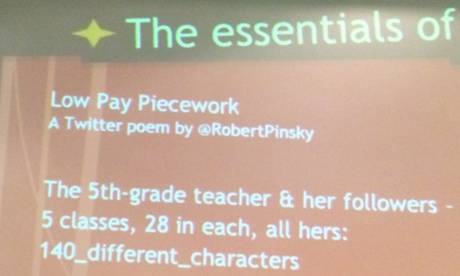
As the audience disperses I’ll leave you with this Twitter poem, which packs a lot in to its 140 characters while also posing questions about the limits of grammar and social media.
Updated
Marsh is waxing lyrical about The Great Gatsby’s closing lines: “So we beat on, boats against the current, borne back ceaselessly into the past,” which could not be written in emojis.
I know
With that name would it have been too much to expect them to ... sigh ... pic.twitter.com/kSRAmPMnVD
— Martin Williamson (@mogodonman) September 4, 2014

Events are drawing to a conclusion. David Marsh is blaming the Queen for confusion between “you and me” and “you and I”. The Queen’s “my husband and I” is responsible. You heard it here.
Forsyth says he heard a story about Ted Turner, who was involved in the process of making Jurassic Park. When asked what they should call the movie, he suggested “Dinosaurs” only to be told by one of the script writers that it was too obvious. “What do I know? I came up with Cable News Network,” he said.
Updated
When you break the rules of grammar for effect you need to make sure that everyone knows that you know you’re doing it. Break the rules of grammar so they stay broken, he says. Sounds like good advice.
A Brazilian in the audience says he learnt American English and wonders how he can clamp down on his Americanisms? “Don’t let anyone pull you up on this stuff unless they also speak perfect Portuguese,” says Forsyth. “Besides, most English-English speakers can’t always tell the difference.” David Marsh says that the Guardian now has more readers in the US than it does in the UK. When someone in the New York office writes that “something happened Thursday” he doesn’t always have the time or energy to fix it. Forsyth replies that he has heard the expression “bloody hell, mate” a lot recently in the US as a result of Britain’s “crushing media dominance”. Ha ha.
Updated
If you’re writing in the first person present tense, how can you use grammar in characterisation, an audience member asks? “Arsenal, they’ve got a good team this season. Chelsea, they haven’t got the strength and depth,” Forsyth comes back like a shot. I wonder what that question was about?
Forsyth: Grammar is how the English language actually is. It is the agreement “this is how we are going to use the English language”. General usage is right. Breaking the rules of grammar can have massively beautiful effects but you have to know when you’re doing it.
Updated
How the hell does one “speak daggers” he asks? And “Curiouser and curiouser”. This is catachresis.
If you wander around the Guardian offices, he says, you will find “disabled toilets” although the toilets are not themselves disabled. Breaking the rules for effect is something that has been done over and over again. “We was robbed.” “Love me tender.” “Hope springs eternal in the human breast.” “Do not go gentle into that good night.” It works on a subliminal level, he says, now citing TS Eliot. “Let us go then, you and I.” It should be “you and me”. Maybe the niggle makes a thing stand out? The Greeks called this “inalogy” he says, although I’m not sure if I’ve spelled that correctly. “Thunderbirds are go.”
Other examples of this include Star Trek’s: “Space. The final frontier.” Imagine how much less impact it would have had if it began: “Space is the final frontier,” or “This is space, which is the final frontier.” And then there is Churchill’s: “In war, resolution. In defeat, defiance. In victory, magnanimity. In peace, goodwill.” And, of course: “Me Tarzan. You Jane.” Which was never actually said in a film, he says.
Updated
The split infinitive being a bad thing was first proposed in an anonymous American tract in the 18th century. Shakespeare does it: there is no reason not to do it. ALSO there is no reason why a sentence has to have a main verb in it. He cites the first sentence of Bleak House. It runs: “London.” That, he says, is how to write a first line.
Updated
i before e, except after c. Actually, only 43 English words obey that rule, and 923 words don't! #grammarfun
— The Best Bit (@thebestbit_com) September 6, 2014
According to the bible and Shakespeare you can use “less” for a number, says Forsyth. Tesco and Shakespeare are at one here.
Updated
But there are times when the less/fewer rule - anything you can count is “fewer” - sounds wrong. “One fewer mouth to feed,” for example. Although I’m not sure that is an example of things you can count.
Updated
Forsyth: i before e except after c is a complete load of cobblers. And lots of people get upset about “five items or less” at the supermarket.
Updated
And here comes Mark Forsyth to talk about the elements of eloquence, which is also the name of one of his books. He has a schoolmasterly tone and his hands clasped behind his back: a commanding stage presence mitigated only by the fact that he has dropped the battery for his microphone.
Updated

The audience award goes to Anne Corbett, who spotted this on the way to the Guardian’s canteen to get a coffee at break time. With a special hat-tip the Guardian’s Human Resources department. Yay guys! Something to be onboarded on Monday?
Updated
Steven Poole’s book is called Who Touched Base in My Thought Shower? It sounds like a hoot.
You definitely get judged if you don’t speak the lingo in a corporate environment, says an audience member regretfully. David Marsh adds that “jargon” originally meant the noise that birds make.
Updated
An audience member says that she is going to find a way of merging the Jesus facepalm into the meaning of “stakeholder” - a word she hates - online. Poole says that originally the word “stakeholder” meant the only person in a situation who wasn’t involved: they were literally holding a stake - a piece of wood - instead of taking part. Somewhere along the line the meaning flipped. Poole: People do MBAs mainly to learn the kind of jargon that alienates and bamboozles people who haven’t done MBAs. Poole advocates a policy of relentless mockery when faced with this jargon, while still managing to keep your job, ideally.
Updated
How does one keep up to date with these linguistic innovations, asks a member of the audience? Browse the internet, look at the emoji on your phone. The Urban Dictionary, suggests Andy Bodle from the back of the room.
Updated
I wish this liveblog had emoji right now.
Updated
Facepalm is an image with grammar to it, says Poole. Sometimes a situation is so stupid that only a double facepalm, or a Jesus facepalm will do. And there is also headdesk. The internet is enriching our language, insists Poole. And judging by the mixture of hilarity and fascination from the audience, he’s making a really good case. “When Godzilla give you facepalm you know the fail is epic.” You can follow him on Twitter @stevenpoole
Updated
Apparently there is now an emoji-only version of Moby Dick. “You wouldn’t necessarily be able to follow the detail of the plot very closely,” admits Poole as the audience giggles a lot. “But it’s early days.”
Updated
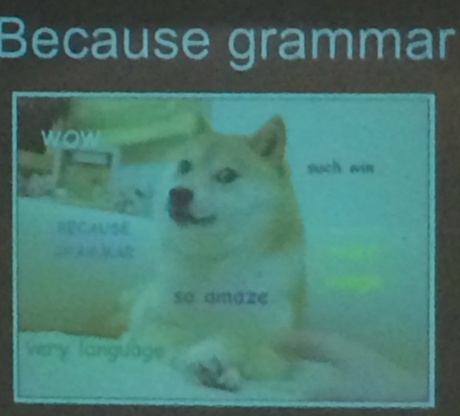
Bahahahaha! This is an example of the Doge meme, on this occasion by Stan Carey on his blog Sentence first.
Updated
Great journalistic questions to which the answer is no. “Has the internet killed grammar?” Poole points out that if the internet had, in fact, killed grammar it would have been impossible to write that headline. A good point, well made.
These days, if you wrote “Can I have a cheeseburger?” in the context of a lolcat, you would be making a grammatical error, says Poole.
Updated
How many people actually laugh when they lol online? *metaphysical question of the day*
Newbie is not internet slang, says Poole. It originated in the US military, meaning a recent arrival. But n00b - substituting the o for the numeral 0 (because it’s funny), is.
Updated
Poole has found a letter from Lord Fisher to Winston Churchill dating from 1917 that includes the expression OMG. This stuff is gold dust. Does WTF ever stand for the Word Taekwondo Federation these days?
Poole suggests that if one is applying for a job, on the whole one does not write “LOL. I is amazeballs”. This talk is turning out to be full of useful information. For instance, TTYL is internet shorthand for “talk to you later”.
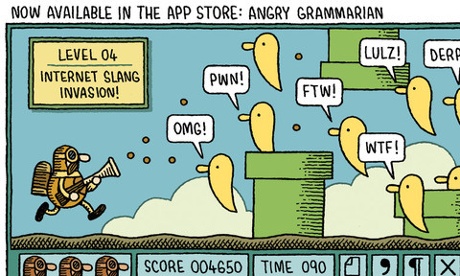
Poole: Returning to McCrum’s idea of grammatical violations. Derp (which is a bit like “doh!”) FTW (for the win) and amazeballs were recently singled out by the editor of Gawker as not respectable language used by normal adults. But Poole knows people who use things like wtf (what the fuck?) or pwn, which started out on the web as “I own you”, as in “I beat you”, but was mispelled and has morphed: pwning is now a thing.
Updated
Poole: And what about video games? Are they destroying literacy? Is one thing REALLY replacing the other? Perhaps it is a question of the people who say these things not knowing the nature of what young people are doing on the internet. He has a screen grab of a video game called Phoenix, in which you are invited to play the role of a lawyer. It’s a very wordy game.
Updated
Poole: Can you alternate skim reading with a “deep dive”? There are a lot of long articles - essays - on the internet these days, for instance in Aeon and Matter, because paper magazines exist less and less. Maybe the problem is the fonts on the screen and the adverts that obscure the screen, or the horrible comments underneath that often leave a bad taste in the mouth? People read Harry Potter, Game of Thrones, David Mitchell’s output... These are all examples of long reads (or “books” as we still call them).
Updated
Are we losing our deep-reading brain? This question was posed by a group of people advocating a “slow reading movement” which is apparently akin to the slow food movement. Have our brains lost the habit, he is asking, and mentions tl;dr This is, apparently, an internet expression that means “too long, didn’t read”. Poole enjoys the use of the semicolon there.
Updated
Poole has brought up the “listicle”. It makes some people anxious, he says, that prose is dissolving into a choppy sea of bite-sized paragraphs. He has - of course - a “top nine things that you need to know about listicles”.
David Marsh has introduced Stephen Poole, who apparently is a composer as well as an author. The title of his talk is Facepalm: language and the internet. He has begun by citing Robert McCrum, the Observer’s literary editor, on fears about language in social media. “Loose, informal and distressingly dispeptic,” is McCrum’s description of it. He went on to describe the “violence” it does. But Poole says that people said much the same things about radio and television.
Updated
@guardianclasses #grammarfun terrible delivery by TKMaxx Sheffield. pic.twitter.com/pqcLDIdivS
— CuddleBarge™ Captain (@ThatManMatt) September 6, 2014
Oh. TK Maxx *tuts loudly*
#grammarfun pic.twitter.com/1Vm3U5G1Jc
— Rachel Radford (@patch2006uk) September 6, 2014
Bahahahaha! This might be my favourite. #hashtagfun
Updated
There will now follow a collection of grammar mistakes tweeted in over lunch...
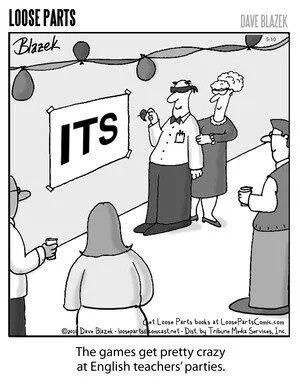
Here's a great proofreading error! #grammarfun pic.twitter.com/oKlmCM1638
— Jane Smith (@wordsmithsuk) September 6, 2014
Updated
There is a grammar joke on its way. Drum roll... “The past, present and future walked into a bar. It was tense.” Boom-tish!
David Marsh says that on one of his days off the phrase “a lady in a business suit called Marion” made it through the Guardian’s defensive mesh of sub-editing. The word lunch has come up a few times now and Ramon, who is managing the session, is holding up a piece of card with the words “five minutes” on it so the speakers can see.
Updated
Andy Bodle describes the agony of being a newspaper subeditor who has spotted an error in a fellow sub-editor’s work. Verrrrrrrry awkward, he says. Still, I’m not proud, Andy, so do your worst and we can talk about it over coffee.
Updated
Tweet your pics of grammatical errors w/ hashtag #grammarfun to our live blogger Emma http://t.co/5amayL8Dmz pic.twitter.com/QBtME779NY
— Masterclasses (@guardianclasses) September 6, 2014
Send in pics of the grammar errors that drive you wild.
David Marsh says the biggest dispute he’s had since he took over as Guardian style guide editor was with the Observer over single or double quote marks: the Observer said it wasn’t prepared to give up single quote marks because they’d been using them for 200 years. In the end a compromise was effected, in which the Guardian got its way over double quote marks, in return for giving up the way it wrote dates.
Updated
There are two kind of grammar police, Bodle says. The Dixon of Dock Greens and the military kind armed with automatic weaponry. But grammar shaming doesn’t work any better than slut shaming or obesity shaming does. It’s not productive. And now Bodle is asking audience members what their favourite subjects were at school. Usually it’s to do with the teacher, says Bodle. If teachers have a passion for their subject it can make all the difference. So how do you get people to be passionate about language? Lynne Truss and Stephen Fry are doing their bits. But humiliating people for making mistakes doesn’t work: the best way it to make a joke and make it clear that you love language because it’s fun.
Updated
Eliminating inconsistencies means you can understand people better but it also slows the process of linguistic evolution.
Bodle: The final objection to grammar, though, is that it is boring. And here objectors are on firm ground. Grammarians have very little authority to tell other people they’re wrong. Language has been compared to wine by Virginia Woolf and to a prostitute queen by George Sand. There are parallels between the way languages work and the way evolution works. (This is getting complicated. There are diagrams illustrating developmental patterns. In the language diagrams “novels by Will Self” have their own category.) In the cases of both language and evolution, change happens because of copying errors and mutations, processes triggered by geographical isolation.
Updated
Bodle: Phishing emails are getting better but knowledge of spelling and grammar are still the best ways of telling phishing emails from the real thing. The common mistakes that produce the most misunderstandings are rarely rocket science. Misplaced apostrophes are big. As are homophones. Apparently the Guardian recently had an incident of “climate poofing” within its august pages.
Updated
Bodle: I once had a job at a publisher which was to sift manuscripts and some writers can’t actually write. But in 99% of cases if they can’t do grammar they can’t do the other stuff - characterisation, plot - either. The audience is liking Andy’s slideshow, consisting of daft paragraphs culled from erotica he was asked to copyedit. Suffice to say, sloppiness of grammar equates to sloppiness of thought. If you want to see the slides, come to the next masterclass.
Updated
Bodle: Most anthropologists say that the great leap forward that took place about 100,000 years ago happened almost exclusively because of our rich and complex communication system. Tools, art, use of fire: all these were enhanced by language. Grammar wasn’t taught to anyone but the social elite until the 20th century. And yet most of us can get our point across: we have a shared context and a common knowledge of recent events. There are many non-linguistic ways of communicating: pointing, facial expressions. Grammar is important partly because people judge you on your use of English: employers have to sift applications and are not allowed to do so by gender, age or race, so inevitably communication skills rate highly. Online daters also have a surprisingly high standard of grammar, he says. He has quotes suggesting that even people who are bad at spelling and grammar themselves are fussy about the spelling and grammar of those they date. Ha!
Updated
Bodle: Grammar is about as far from comedy as you can get because it’s about obeying rules, whereas comedy subverts them. Are grammar and comedy opposite to each other? Is it possible to put the comedy back into comma deployment, he asks (see what he did there?). There are groans. “And that’s why you won’t see me on Saturday nights at the Apollo.”
Updated
Bodle starts by saying that he has no qualifications in English and did French for a degree, but nonetheless has been correcting people’s English for 22 years as a subeditor. There followed a quick explanation of what subeditors do. Blimey! There’s a black and white picture of him on Countdown a few years back *geekily impressed*
Updated
Marsh introduces Andy Bodle, who once won Guardian headline of the month with “Where there’s muck there’s bras”. Anyone remember what the story was?
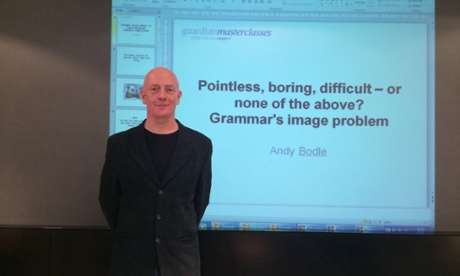
Next up is Andy Bodle, standup comedian and Guardian subeditor. Time also, dear readers, to mention Muphry’s Law, which is in the Guardian style guide. Go easy on me... I’m doing my best.
A woman in the audience works in PR and has been sent along by her boss, who is a prescriptivist. What should I tell him about this masterclass, she asks? “Tell him he is a very lovely, talented man, who is 100% wrong,” says Ritchie, sounding a bit prescriptivist himself there. “The dialogue between prescriptivists and descriptivists is like Professor Brian Cox talking to Russell Brand about astrophysics.”
Updated
Another question from the sophisticated audience. “I wondered whether you would develop the distinction between written English and spoken English. And how written English has a fossilising effect.” Ritchie agrees. The British jihadi, John, in the desert, has had linguists listening to him, trying to place his origin. The Yorkshire Ripper was trapped partly in this way - because a linguist was able to place him geographically very precisely - but jihadi John speaks a form of English that is prominent in Hackney but which has spread across the whole of southern England, making it nearly impossible to place him.
Updated
Ritchie: on the other hand, trying to get served late at night in a Govan bar with standard English would put you at a disadvantage.
Updated
It really helps to be able to speak standard English, says Ritchie. But if you don’t there shouldn’t be a bias against it.
An audience member says that if someone uses “I have went” surely they need to be told the standard English usage?
Updated
Ritchie says that in Guardian’s sports pages José Mourinho says “I have went” on a regular basis. “It would look really patronising if we put it in square brackets,” says Marsh.
Updated
Yes, says Ritchie. If they could do everything else relevant to the critic’s job they could also be taught to tweak their language.
David Marsh asks, though, if someone had put in a job application to Ritchie at the Sunday Times “I went to Oxford innit” would he have given them a job?
“Ashamed of your English?” That advert used to be on the front of most newspapers. The one great human achievement is language, says Ritchie, and most of us know it is hugely important. But he doesn’t have an opinion on the use of “enormity” or “fulsome”. We collectively agree on the rules of English because it is our language and not Fowler’s language or Gwynne’s. English is also spoken in South Africa and North Carolina. When an astronomer looks up at the night sky and tells you that the earth is 4.5bn years old, someone else will tell you instead that you’re going to have a great day on Thursday. (That would be astrologers.) There are plenty of examples of people just getting subjects wrong, as Ritchie says traditional grammarians have. Mystic Meg is not good enough, using leeches to cure headaches is not good enough. There are real rules to real grammar but we shouldn’t use it as a way of making class points. Much of what we know about grammar we know innately. This is our language, not Neville Gwynne’s, Ritchie says.
Updated
Unspoken rules govern the order that we use adjectives. The red big bus? No- the big red bus #grammarfun
— The Best Bit (@thebestbit_com) September 6, 2014
And example of what Ritchie meant when he was talking about adjectival ordering.
Grammatical knowledge is buried in our basic cognition, when one is a native English speaker, says Ritchie.
Apparently there is a correct order to adjectives in a sentence structure. Adjectival ordering is one of the things that identifies native English speakers. Ooh! Here comes the gerund... But we were promised a settling in period first. And yet here it is regardless. The gerund, it turns out, is when the verb becomes a noun. So: to cook is great, wherein “to cook” is the verb. But in “cooking is great”, “cooking” would be the gerund. Voila!
Updated
Ritchie is talking about the present tense. Try explaining the present continuous to a French businessman on a Monday morning, he says: it would be almost impossible for him to get his head around. There are “about” 14 tenses in the English language, apparently. Can anyone name them?
Updated
"We live in a 'voiceist' culture- accent and spoken word identifies you" Harry Ritchie #grammarfun
— The Best Bit (@thebestbit_com) September 6, 2014
These days it is all too often the case, says Ritchie, that the only people who know the rules of English are those who have learned it as a foreign language. Native English speakers can already do it, so why do they need to learn the rules? Good question. But is he putting himself out of work here?
Updated
Linguistic prescriptivists like Neville Gwynne pretend that linguistics doesn’t exist, says Ritchie, whereas descriptivists pretend that traditionalists do not exist.
Yay! A tweet from inside the room
Hoping to discover that grammar can be fun #Grammarfun
— Lee-Ann Coleman (@LAScienceMuse) September 6, 2014
Updated
And here comes our first speaker, Harry Ritchie, former literary editor of the Sunday Times, to tell us about the grammar we don’t know. He has a soft Scottish accent and quickly establishes that five of our attendees have taught English as a foreign language. He’s discussing why people like grammar books: he thinks that they either want to be told they’re wrong or celebrate the fact that they already knew the thing that’s being taught. The most complicated rule of all, he says, is that and which. Fowler is gobbledegook on this, he says, giving an example from Bake Off: the cake that Ian baked melted. Should it be the cake that Ian baked, or the cake which Ian baked? What do you say, grammar fiends?
Updated
Ooh. Attendees ahoy! Apparently there are 55, which seems like a lot for 10am on a Saturday. As I write David M is taking responsibility for the Guardian’s spelling mistakes and thanking people for coming. Apparently we won’t be doing the gerund until 2.30pm. Time for coffee first then... David M is telling an anecdote about an ex-girlfriend who went to Harvard and took him on a tour of the institution. At the end a guy in a ten gallon hat said “Can you tell me where the rest room is at?” The tour guide said “I’m sorry, sir. This is Harvard. We don’t end a sentence with a preposition.” “OK, then,” said the ten gallon hat guy. “Can you tell me where the rest room is at, asshole?” Tone set.
Updated

Updated
Good morning, pedants. Welcome to the liveblog of a Guardian Masterclass at Kings Place, York Way. It’s called “The essentials of grammar with David Marsh”, who is the Guardian’s style book editor and the itinerary runs thus.
- 10am. Introduction by David Marsh Your emcee for the day recently had a book published called For Who the Bell Tolls and will be providing continuity
- 10.10am - 11.10am Harry Ritchie, former literary editor of the Sunday Times English for the Natives: discover the grammar you don’t know you know
- 11.30am - 12.30pm Andy Bodle, standup comedian and Guardian sub-editor Pointless, boring, difficult - or none of the above? Grammar’s image problem
- 1.30pm - 2.30pm Steven Poole, journalist and author of Who Touched Base in my Thought Shower? A treasury of unbearable office jargon
Facepalm: language and the internet
- 2.50pm - 3.45pm Mark Forsyth, author
The elements of eloquence: how to turn the perfect English phrase
I’ll be doing my best to describe proceedings through the various media at my disposal - all blessings be upon the gods of wifi - and if you’d like to ask a question, make a comment or send your pictures of grammatical stuff that drives you wild, you can tweet me using the hashtag #grammarfun. Contact me directly on @emma1hartley
Updated