And that's a wrap!
A big thank you to our panel tonight for their time and thoughts.
And an even bigger thank you to you, and all who watched and participated in the event tonight. We had some really complex questions Below The Line and I want to thank everyone for such a constructive, civilised discussion on a divisive topic.
If you’re interested in attending Guardian Live events in the future, head to Guardian Membership to learn more. Might see you there!
Parting thoughts
“You’re in the Golden Age, ladies and gentlemen,” Bonnie says. “This is the best time to be a woman, this is the best time to be a man, this is the best time to be a person of colour. Use it.”
“We didn’t have anything before. This is the best time, right now: use it and hand it on.”
“Make our words turn into actions,” Yas continues. “Campaigning as a feminist doesn’t need to be complex. It’s about every small change you can make.”
“Remember, if you get a lift, you’ve got to pull another person up,” Bonnie says.
“And engage a man,” Laura says, to laughter.
Do celebrities expressing opinions on feminism do more harm than good?
Half the time feminism makes a headline, it is because a celebrity mentioned it. Not always in agreement - as Lady Gaga once said: “I’m not a feminist. I hail men, I love men. I celebrate American male culture: beer and bars and muscle cars.”
Well. Should celebrities talk about feminism? They seem to be doing it a lot - but Yas is not impressed. “Having one very very privileged woman say these things and having people go ‘That’s amazing’, that leaves behind the women who are fighting this on a grassroots level.”
Yas expresses an admiration for Emma Watson and her recent campaign with the UN, He for She, but shares her dislike for Russell Brand (prompting mass applause), “and other people who become martrys for a cause”, the people “stomping out the people who are fighting for something, every day.”
Bonnie talks about her mentor, Norman Mailer, the infamously gruff, masculine author and playwright.
One day she asked him about his character, his “macho mask.” “Why do you do this?” she asked, gesturing to her body. ‘Fear, what else,’ he replied.”
“He called it fear, but he was brave enough to say that to my face,” she says. “Engaging with men - I don’t know what that means. I love men, I have lots of male friends and I enjoy them.”
“I am fucking amazed by all of you,” she says to the room. “You have to deal with so many complex questions and problems these days. I salute you. But this about humanity; we have a short time here and we have to live together.”
Updated
Are feminists alienating men?
“Is there another way of thinking about it?” asks Beatrix. “Is there anyone in this room who doesn’t worry about what patriarchy produces, the things we encounter every day? There is no one in this space who doesn’t engage with men.”
“There isn’t a society where women hold institutional power. In Britain, we’ve probably got one of the best pieces of legislation on sexual crime in the world. Ten years on, we’re told by researchers that rape is effectively decriminalised. Rape is a crime committed by men - not all men, some men- and we employ people to police this and sort it out. The duty to engage with men sits with the criminal justice system - because these problems are products of masculinity- but they don’t do it, so it falls to us. It doesn’t fall to the UN. It falls to us.”
“Feminism is very interested in men and masculinity; how could it not be?” She brings up another audience question, about men taking on more feminine roles in the house. “Men themselves have not initiated any mass movement to enable them to take care of their children, to be parents rather than providers.”
More audience questions
Microphones are going around the room for more audience questions, including one man who calls himself “a refugee from Planet Patriarchy.”
“We must discuss the problems that boys have,” Bonnie says, citing the ways they are pushed into masculine tropes, like sports. “As feminists, we must have discussions about men and masculinity.”
“I get trolled a lot by young men,” she continues. “I just speak to them as if they are human and it disarms them; they don’t expect that, they expect a fight.... they constantly have to define manhood, not just in their houses, but everywhere, online, on the street corner: ‘Are you a man, are you a man, are you a man?”
Applause around the room.
Back to the boys
Beatrix goes back to the previous question, about boys and their feelings on feminism. “Boys are invited daily and every minute to polarise their sensibilities about what it means to be a boy. I saw a child, aged six, wearing a shirt that said ‘Boys rule’. Imagine if that said ‘Whites rule’ or ‘Muslims rule’. We’re experiencing a very polarising time about what it means to be a man. The idea that boys might identify with girls is inconceivable right now- they’re just princesses, they’re in waiting.”
“The great thing is that people are on to it. We know that our definitions of what it means to be masculine or feminine are destructive.”
Jane says she is not “pro-porn”, despite being labelled as such before. “None of the men involved in the porn framework are discussing women doing it for themselves, or true depictions of LGBTQ pornography. I know we’re not doing enough to control it, to bring respect to [pornography].”
Updated
Beatrix brings up Page 3, sharing the fact that the topless feature began in the same year the first Women’s Liberation conference was held in Britain. “It was Rupert Murdoch’s riposte to feminism in Britain. It is not about the glorification of women. We should be absolutely confident in our repudiation of [Page 3].”
She likens it to - ahem - a woman failing to orgasm during sex. “This is not about preventing pleasure, it is about giving women the chance to have some,” she says, to applause.
Can we celebrate female sexuality while fighting objectification?
While calling Anais Nin “a crypto-fascist”, Bonnie says she admires how she found a language to examine female sexuality. “The expression [of female sexuality] is narrowed by how it is effected by the male gaze. That term is not about gender, that is a way of looking.”
“We have to celebrate ourselves as women. You have to find this in yourself and glorify the women who find their own language to do it and celebrate that. We’re beginning to ask these questions: ‘Can I experience pleasure?’ ‘Can I feel joy?’ These are ancient questions, explored by Virigina Woolf and other women before, but we have to discuss them again and again.”
Are young boys unaware of feminism?
“Definitely, in my experience at school,” says Yas. “And if they are interested, they will be bullied into being not interested. The amount of people I speak to who say ‘Oh but women are equal now, they have the vote’- what is this?”
“The resurgence of feminism in the last few years is reassuring. But I hope it is not a trend, it needs to grow. Talking about it is incredible, but we need to engage with people who don’t see themselves as feminists.”
She brings up her role as a campaigner for better sex and gender education in schools. “Anything to do with feminism [at school], all we talk about is the suffragettes and even then, the word ‘feminism’ is never really mentioned. We should start those discussions at that crucial time, when you’re starting to establish your own opinions separate to your parents’.”
Time for audience questions
The microphone is going around the room. We’re getting a great question from a “84-and-3/4 year old”, who has “been a feminist all her life.”
Updated
What is equalism?
Laura Bates brings up a question from a online commentor, SpinningBeams:
Why do more and more people eschew the label of feminism and refer to themselves as equal rights proponents or humanists?
“The most infuriating thing about that label [equalism] is it assumes victimisation,” Beatrix says, “All men should be feminists. The best thing a man can do is be a feminist.”
“It’ll extend your life as a man, it’s easy,” Bonnie says, to laughter.
Bonnie cites the monetary reward some movements receive for holding contrarian view. “We are developing a new narrative.”
Laura raises a question posted by commentor roding:
I would like to hear more about why some women do appear to hate feminism, it seems inexplicable to me as they probably have had jobs, custody of their kids, the vote, or say a bank account.
Beatrix talks about finding the sexism and violence women can encounter online “a revelation”.
“Women are being maligned with an intensity that takes your breath away. This new platform is fantastic but it is also fantastic for those who put about the most vile misogyny. They don’t need to leave the house, they don’t need to buy a stamp. They don’t need to come to an event like this and face us. I think Germaine Greer must be feeling quite vindicated.”
She compares the second wave of feminism online to the fourth wave. She calls the modern fight for feminism “a fight for breath. “For any of you - look at you,” she says, gesturing to the room. Fantastic women, so accomplish, so skilled. You want to save our lovely planet and save yourselves and save men. But to come here, you had to confront something difficult about yourself. You don’t want to have to tell your daughters that this isn’t fair. It’s more than that, it may cost them their lives.”
Updated
Jane Fae weighs in on the impact of technology on modern feminism. “The internet is a panopticon- everyone sees everything you do and you begin to police yourself.” She brings up Jon Ronson’s latest book, So You’ve Been Publicly Shamed and cites the extreme reaction she encountered online after she made a mistake in a tweet. “It can make you bland and that is a problem.”
Updated
Bonnie raises the issue of making assumptions about women and their view on feminism based on their appearances. “Part of values and part of being a feminist is to ask these questions that the patriarchy takes for granted and does not ask,” she says.
She mentions the Muslim students she has met at her university and notes she can not see any veiled women in the room. “If you see a woman walking around veiled, we can not make assumptions about these women. It is very important to identify what women want to say and what they don’t want to say... my feminism is to say, ‘Who isn’t here and why aren’t they here?”
Updated
Are young women more hesitant to identify as feminists? Yas says the internet has made feminism more accessible than ever, identifying Tumblr as a good forum for young feminists. “I love that the internet exists so we can discuss feminism in a non-academic way. I think that is making it much easier. I am talking about the good stuff, rather than the bad stuff.”
Laura asks the room if to raise their hands if they identify as feminists. About 90% of the room raises their hands. “Wow,” Laura says, sounding surprised enough to raise a laugh.
Is the sexualisation of young women increasing?
While she “can’t speak for all young people”, Yas says she feels the pressure of sexualisation is oppressive. “The media and social media and online porn - all these different sources are great influences on society and young people - they project this patriarchy in really subtle ways and over time it becomes normalised and that’s how things are. It seems like there isn’t a massive problem, but there is.”
“Fifteen years ago you couldn’t get this many women to talk about feminism,” Bonnie says. “It was a dirty word.” She brings up Sex and the City- which she didn’t like, but found it fascinating to watch the women around her form fantasies around the show. “I can see the sexualisation of young women around me. I am interested whether this is the pressure that has moved people to talk about [feminism].”
Beatrix says we are currently living through a new historical sexual settlement. “There is nowhere in the world where that isn’t true,” she says, identifying Asia, and China. “These are places where inequalities and oppressions experienced by women are accelerating.”
Bonnie calls the UK as “deeply patriarchial”. Beatrix disagrees; “Neoliberalism has converged and works with neopatriarchy to produce a new world order.”
Jane identifies her knitting circle as a example of a female support structure: “The real danger is teaching people that they’re in it for themselves.”
Updated
The panel has moved onto the polarity around the definition of feminism. As commentor SirHumphreyButtons put it BTL:
“I think it’s perfectly possible to have a feminist outlook but not to like the label.
Any political “isn” carries the stigma of dogmatic, inflexible thinking and people’s political identities are increasingly towards individual, flexible and independent thought and away from proscribed ways of thinking.”
Why do we need feminism?
We’re starting with each of the panel’s individual ideas about needing feminism.
Beatrix says despite seeing growing inequality gaps everywhere, “there is resistance. We are the hope.”
Jane says is not a feminist, she “is feminist”. “Basically, we are faced with enormous problems, feminism is the answer and we need to stop putting hard boundaries down on what feminism is.”
Bonnie recounted not wanting to fight with a female colleague in front of male colleagues because she was “too much of a feminist”. “If I was a young woman now, I would probably not call myself a feminist,” she said. “I think the word has become a brand and we probably need a new word.”
Yas spoke briefly about learning about feminism for the first time. She ended, simply: “It’s just obvious. We need this.”
We're live!
You can watch the live stream in the video box above.
Meet the panellists
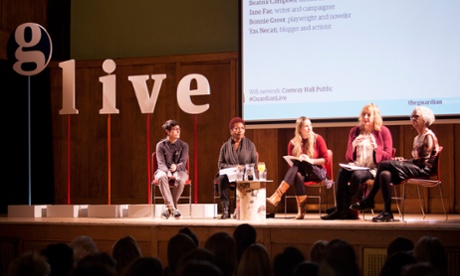
The event tonight will be chaired by Laura Bates, the creator of the Everyday Sexism project. She will be joined by:
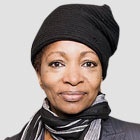
Bonnie Greer OBE is an award-winning playwright, author and critic based in London who grew up in Chicago. Greer originally set out on a legal career, but dropped out when her professor told her he did not think women should work in law. Bonnie contributes to many radio and television shows, including Newsnight Review and Question Time.
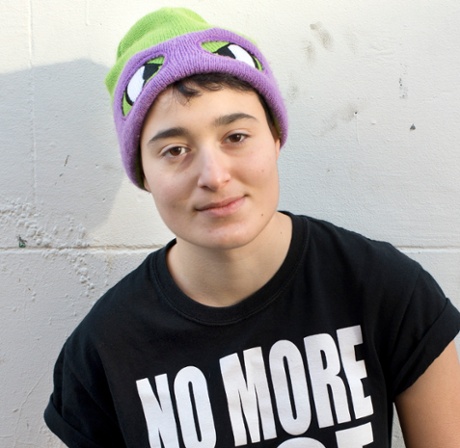
Yas Necati is a gender rights activist who campaigned for the end of topless models on Page 3 in the Sun newspaper and continues to fight for more effective sex education in schools. Just 18 years old, Yas is writing a book about teenage feminism.

Jane Fae is a feminist and writer on political and sexual liberty, with a particular interest in the rights of individuals to express their own sexuality without censure. She is an active supporter of Consenting Adult Action Network, as well as regular contributor to national and LGBT press. She also writes about climate change, medical ethics and online censorship.

Beatrix Campbell OBE is an award-winning journalist, author, broadcaster, campaigner and playwright. Beatrix first became involved in the women’s liberation movement in the 1970s and. She is a Green Party member and has stood as a candidate twice previously. Her latest book is The End of Equality, a call for a global feminism.
Some homework – and some fun
While the audience settles into their seats here in Conway Hall, you can read up at home:
- Read tonight’s chairperson Laura Bates’ reflections on her last year blogging on the Guardian women’s blog.
- Watch our videos on the Guardian’s End FGM campaign page (warning: some videos contain graphic content).
- Read “Why I am an equalist and not a feminist” by Laura Waters, a scientist from the University of Huddersfield.
- Read this great piece from last year by Colin Walker, the man in charge of Plan’s Because I am a Girl campaign.
- Read Randa Kattan’s recent piece on women’s rights as an Arab woman.
- Ever unsure if you are a feminist or identify more as a humanist or equalist? Read the accounts of four women who all sit on different parts of the spectrum (and as the headline says, they’re not all from the left).
- Read our readers’ list of the top feminist thinkers that have influenced them.
For a bit of fun:
- Do our Which pop star said what about feminism quiz?
- Read Emer O’Toole’s lament for the 10 things feminism ruined for her.
- For anyone feeling bad about their feminist cred, read Roxane Gay’s piece or Rhiannon Lucy Cossett’s piece on being half-arsed feminists. It’s okay, guys.
- Check out the Confused Cats on Feminism tumblr, made in response to the Women Against Feminism tumblr. The internet is an odd little place.
Let us know what you think!
The room is starting to fill up here at Conway Hall. If you can’t make it tonight and want to share your thoughts, you can do so on Twitter using the hashtag #guardianlive or in the comments section below.
We’ll be trying to weave in as many of your thoughts as we can into the live discussion! So get typing.
Join us on Wednesday 18 March
In 2015, the f-word is making headlines more than ever: why do some women hate feminism? What is the “fourth wave” of feminism? Who decides what it means to be a feminist? Can men be feminists? Do campaigns such as #freethenipple trivialise feminism when global issues like female infanticide, genital mutilation and #bringbackourgirls remain unsolved? And, with men still earning more than women and sexism rife from campus to offices, where has it really got anyone?
On Wednesday 18 March, the Guardian is holding a sold-out debate about feminism at Conway Hall in London, with a panel spanning a wide range of generations and perspectives. Chaired by Laura Bates, founder of the Everyday Sexism Project, the panel includes the award-winning journalist and author Beatrix Campbell OBE; writer on politics and sexual identity Jane Fae; author and playwright Bonnie Greer; and teenage feminist and No More Page 3 campaigner Yas Necati.
Knowing many people would have liked to ask questions or share their thoughts on feminism are now unable to attend the sold-out event, we will be livestreaming and liveblogging the event here, from 7pm GMT on Wednesday 18 March.
Leave your questions and comments below and we’ll collate some of the most popular themes to put forward to the panel. It should be an exciting and challenging evening.
If you missed this one, sign up to Guardian Membership to find out about future events and do join us #guardianlive on the night.